


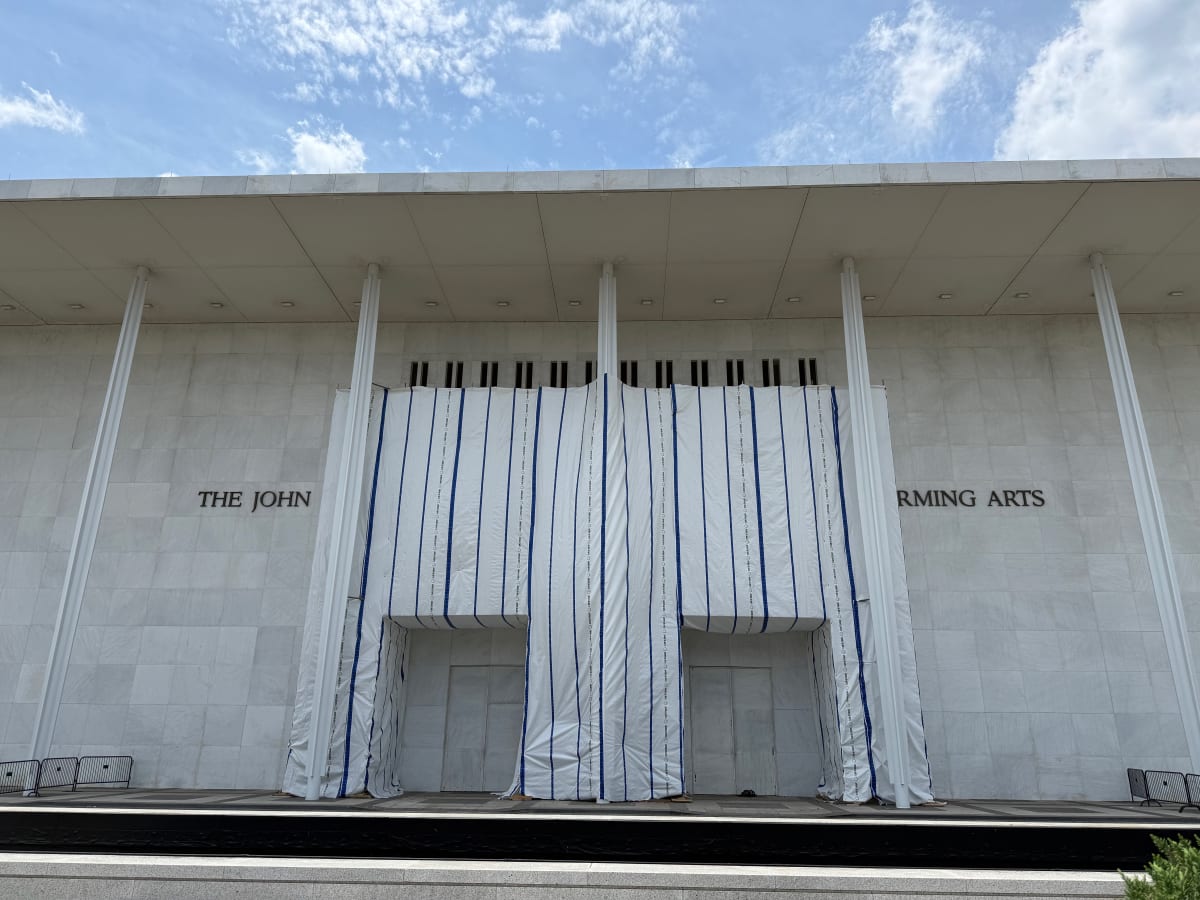
If the Washington Mystics or D.C. United suddenly vanished from the local sports scene because of the president of the United States’s contempt and negligence, the town would be in an uproar. But right now, a D.C. institution that draws more people than either of those teams has been struck silent and is in danger of disappearing – and there’s not nearly enough clamor about it.
The National Symphony Orchestra, which should be celebrating its extraordinary artistic growth as it approaches its 100th anniversary, is instead selling no tickets because it has no concerts scheduled for the coming year. That musical vacuum has developed solely because Donald Trump, through his disdain for America’s crazy quilt of cultural passions, his obsession with control of the capital city and his incompetence at the very thing he considers his best skill — building things — has left the orchestra without a home, without a plan and quite possibly without a future.
The shame is that the NSO is at the top of its game, performing with an elegance and zest that musicians attribute to its dynamo of a conductor, Gianandrea Noseda. But now, with the Kennedy Center all but shuttered and the orchestra’s former artistic adviser, Ben Folds, saying “it may not survive,” it seems that only Trump, the self-proclaimed impresario of Washington’s cultural capital, can save the music.
He’s betting that no one cares. Soloists and guest conductors have been booked, often years in advance, at alternative sites, but nothing can be announced until the NSO has a budget to pay for its performances. The orchestra’s board has promised for months that one is coming “soon,” but the president and his hand-picked Kennedy Center board have remained mum.
What Trump fails to comprehend is that even for those who don’t give a hoot about classical music, a city’s symphony is a powerful symbol of its identity, unity and stature. Even cities that struggle with rough reputations turn to their orchestras to polish a gritty reality (think Cleveland, Pittsburgh, Detroit.)
I’ve seen the power of orchestras again and again, around the world: As the Washington Post’s bureau chief in Germany, in 1989, I witnessed the citizens of Leipzig in East Germany rise up against their communist government and then turn to their orchestra’s conductor, Kurt Masur, for protection against the Soviet and East German troops that seemed ready to attack their own people. Masur, with his Leipzig Gewandhaus Orchestra beside him, negotiated with the authorities and inspired his city to come together and keep the revolution peaceful.
Similarly, on the day after the Berlin Wall opened, the then-music director of Washington’s National Symphony, Mstislav Rostropovich, flew into town, set up his cello at the base of the Wall and played Bach for an audience from west and east alike. Tears flowed in both Germanys, and back in Washington too.
The NSO hasn’t settled any international crises of late, but it has long played a vital ceremonial and ambassadorial role: In 1993, the orchestra traveled to Moscow, Rostropovich’s hometown, for a concert staged on Red Square before an emotional crowd of 100,000 people, at the same moment as guns were trained on Moscow’s White House in a tense confrontation between the newborn Russian government and its internal rivals. The NSO returned to Moscow in 2017 amid allegations that Russia had interfered with the 2016 U.S. elections.
Here at home, the orchestra has played at White House state dinners and at concerts honoring the victims of the 9/11 attacks and frontline workers during the COVID-19 pandemic. One person close to the orchestra told me it serves as “emotional first responders for our community.”
More regularly, the NSO plays free concerts for anyone who shows up to the Mall on Memorial and Labor Day. Twenty thousand local kids a year attend NSO Young People’s Concerts, without charge.
My favorite of the orchestra’s local ventures is its NSO In Your Neighborhood project, which since 2012 has sent the musicians into cafes, churches, museums, libraries, clinics and even a homeless shelter to play in small groups or as one big unit, for free. There are programs aimed at little kids, high schoolers, emerging musicians and the elderly. They’ve gone to Petworth and Kenilworth, to Capitol Hill and Capitol Riverfront, sharing the stage with folk singers, rappers, go-go bands and drumlines.
The NSO was the first orchestra Kendrick Lamar ever played with, in a 2015 concert that sold out instantly. (The opener for that show was an a cappella student group from the Duke Ellington School of the Arts.) The orchestra has played with Nas, Babyface and CeCe Winans, fusing the classics with hip hop, gospel, jazz and indie sounds.
“The NSO really shaped this kind of profile, being experimental, innovative,” said Warren Williams, who spent most of two decades running educational and community programs for the orchestra. The neighborhood visits were meant “to introduce the orchestra to underserved communities,” Williams told me. The visits led the NSO to present a wider variety of music, which has brought in lots of different audiences.
Before Trump turned the Kennedy Center into a symbol of national polarization rather than civic pride, the NSO drew about 300,000 people a year to its concerts. Compare that with the 170,000 that the D.C. United soccer team drew to its games at Audi Field last year or the 117,000 that the Mystics hosted at their arena in Ward 8 last season.
But the orchestra’s audiences have diminished sharply since Trump took over the Kennedy Center. Those righteous liberals who think they are somehow striking back at Bad Orange Man by staying away are actually only hurting the musicians and other artists for whom the Center is a lifeline. Trump drives people on both sides of the political divide to do some very weird stuff, but this proto-boycott is among the most self-destructive reactions to Trump’s tyrannical ways.
Orchestras, like opera companies and many theaters, have gone through a rough patch since COVID drove people out of the habit of going out for an evening with a couple thousand of their closest friends. The industry’s longstanding dependence on season subscribers has run smack into a generation that loves music, but doesn’t like to commit a year in advance to attending concerts on a particular night.
“The orchestra faces an enormous cliff if this uncertainty continues,” Williams said. Musicians might find more stable jobs elsewhere, big-name soloists may make other plans and audiences are hard to lure back once lost. “Everyone’s on high alert now.”
The judge handling a lawsuit against Trump and the Kennedy Center this week extended his deadline until late August for a report on how the Center plans to present performances this fall. The pressure to make that actually happen will come only from the audience, from the city the orchestra has served so loyally for nearly a century.
