


[The following piece is reprinted from Boston’s ArtsFuse online magazine.]
Christopher Nolan’s The Odyssey has provoked a range of opinion. Among the most cited reviews is a condemnation by Emily Wilson, whose 2017 translation of Homer’s epic has enjoyed a surge in sales. From Wilson’s perspective, the film crudely fails to honor its source; she juxtaposes it with Homer. I found myself applying a different perspective, one that suggests that contemporary cinema – its vocabulary and resources – simply isn’t up to the task at hand. The Odyssey would play more strongly as a 1920s silent film.
I am hardly the first to suggest that silent film attained a higher genre than film with sound, or film with sound and color, or IMAX film with sound and color, or whatever comes next. A classic formulation of this opinion, by no means eccentric, is Rudolf Arnheim’s concise 1957 study Film as Art. Citing numerous examples, Arnheim argues that the technical limitations of silent cinema, in its highest embodiment, create a pure artform eschewing naturalistic representation. Formal composition is favored over three-dimensional, colored replication of real life. And the absence of sound inspires ingenious expository strategies.
Silent film was international. The Russians, the Germans, the French, the Americans were all good at it. My favorite silent film director is F. W. Murnau. But the film I couldn’t keep out of my brain, experiencing Nolan’s three-hour adaptation of Homer, is Fritz Lang’s 1924 version of the German saga Die Nibelungen, five hours long in two parts. Nolan’s script clumsily resembles colloquial present-day English. His cinematography is splashed with color. His rendering of the Cyclops is in itself a tour de force of realism: the gigantic creature’s scrambled one-eyed face registers a gamut of human feeling.
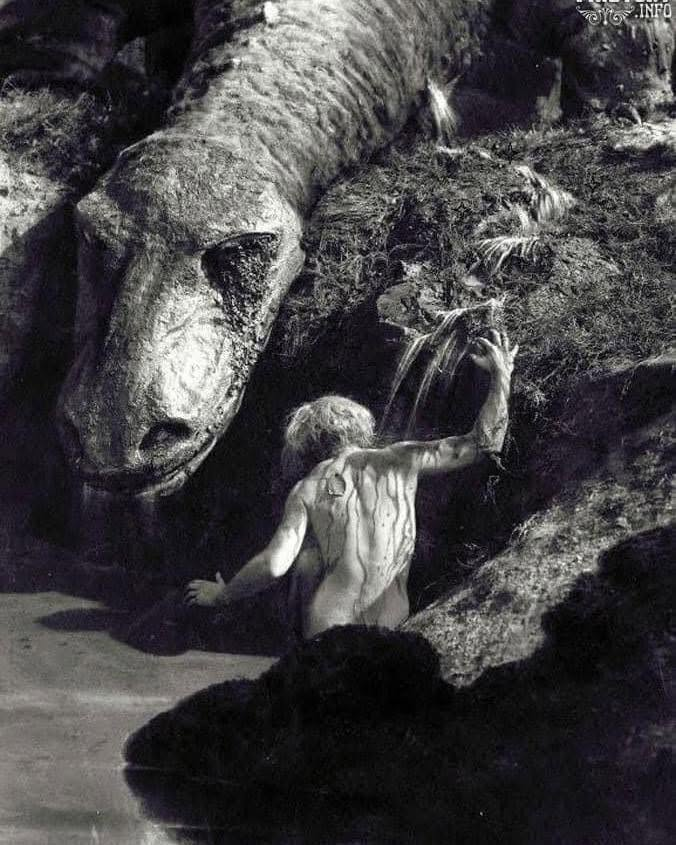
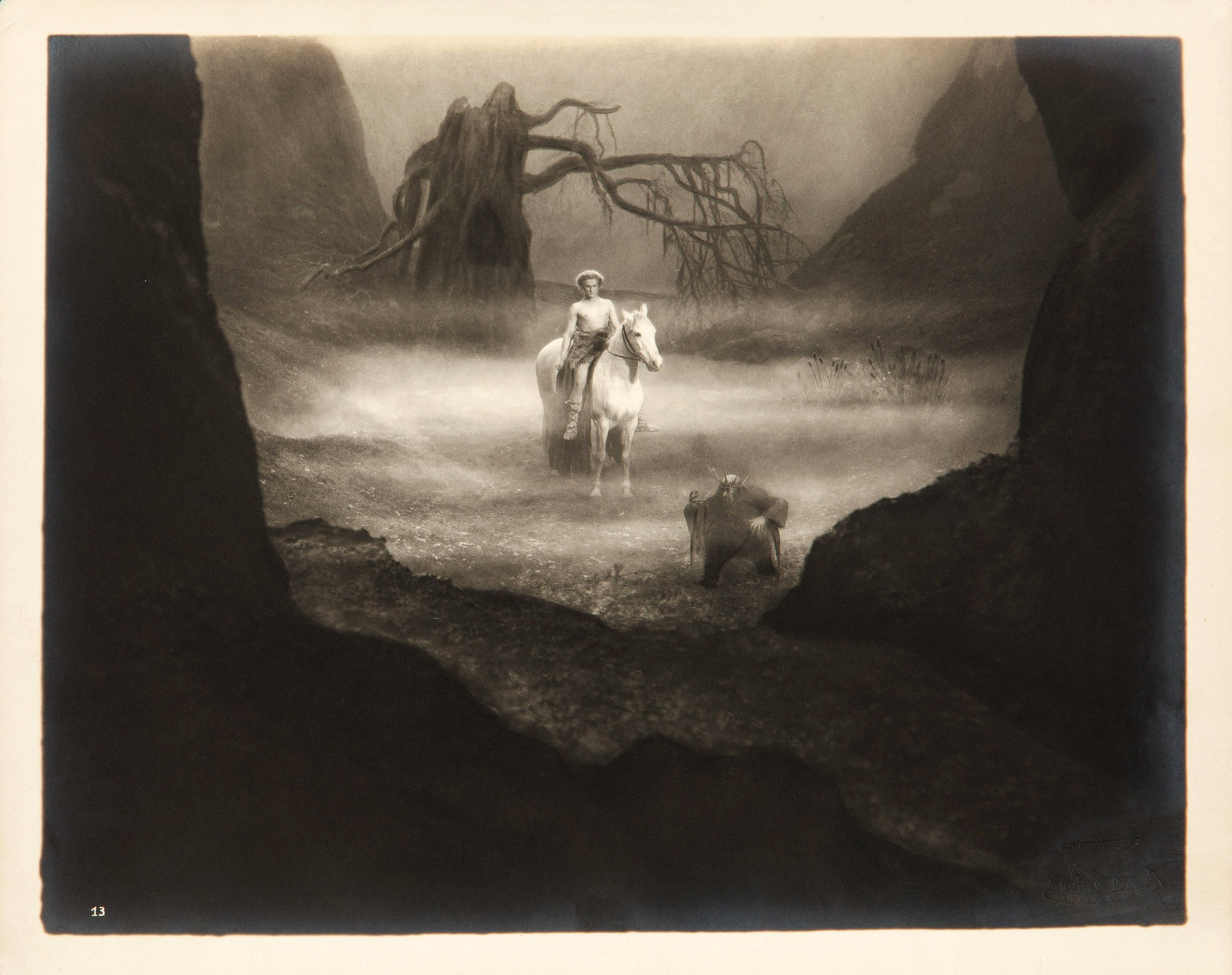
In Lang’s film (co-authored by Thea von Harbou), the dragon is synthetic, and so is the misted forest through which Siegfried embarks on his tragic odyssey. No one speaks. Nothing is colored. The velocity of movement is sometimes accelerated, sometimes not. In short: as in Homer, as in the Niebelungenlied, realism is eschewed. In its place arises a hieratic grandeur.
Though the stories overlap, the result is wholly distinct from Wagner’s Ring of the Nibelung. The magnificent visual vocabulary of Die Nibelungen conveys not only the atmospheric romanticism of Arnold Böcklin and Caspar David Friedrich, but the precise ornamentation of Gustav Klimt and the spare rigor of the Bauhaus: a high German lineage. Wagnerian, however, is Lang’s masterful control of pacing and tone: few films attain climaxes as punishing in their cumulative weight. Rare, too, is the unity of means and ends. The film’s glacial motion – many scenes unfold in real time – is supported by the elegance of its framed imagery, the formal bearing of its actors, and a symphonic score (more Straussian than Wagnerian) by Gottfried Huppertz, superbly calibrated to reinforce the dirgelike dramatic rhythm.
Epic spectacle is achieved not via DeMille-like masses in motion but via grandeur of tableau. The forest is a haunted still life whose vaporous mists, cloaking or disclosing Siegfried astride his white steed, were produced by fire extinguishers in the presence of wan sunbeams pouring through the glass walls and roof of a studio. (Arnheim, in Film as Art, pertinently comments: “The effect of a bright beam of sunshine falling across a dark space could hardly be obtained with the same success in color.”) Brunhild disembarks in Worms along a bridge of shields whose human pylons are armored warriors standing waist-deep in water. Every set, every movement, was discussed in detail. Shoots could last fourteen hours without a break.
In Lang’s subsequent American films (I am thinking especially of The Woman in the Window [1944] and Scarlet Street[1945]), human destiny would become an implacable backdrop to contemporary human dramas. In Die Nibelungen, this fate theme assumed its purest, most apocalyptic form. The film’s political overtones have always disturbed – on the right, for ostensibly reducing Germans to a pack of murderers; on the left, for purportedly jingoistic depictions of German strength and honor. Siegfried Kracauer, in 1947, influentially found foreshadowings of Leni Riefenstahl’s Triumph of the Will: “an ocean of flags and people artistically arranged . . . absolute authority asserts itself by arranging people under its domination in pleasing design.”
However experienced, Die Nibelungen epitomizes the epic poetry of the silent cinema; dialogue and color could only diminish its spell. It was a popular success in Weimar Germany. Its slow motion poetics would (alas) prove less spellbinding for audiences today.
I have so far said nothing about what Christopher Nolan’s The Odyssey sounds like apart from what the characters say. Mainly, it’s punctuated throughout by a loud succession of realistic grunts, shouts, and screams. There is also a soundtrack by Ludwig Goransson: generic pseudo-music carpeting every scene. Goransson (whose credits also include Ryan Coogler’s Black Panther and Nolan’s Oppenheimer), here deploys 35 bronze gongs, scrap metal, synthesizers, and reconstructions of such ancient instruments as the lyre and the aulos – as if he has somehow attempted to recreate the music-making of the ancient Greeks. He has not. If the film’s prosaic visual aesthetic makes me savor Die Nibelungen, its all-purpose score counter-reminds me of the bardic symphonic grandeur of Jean Sibelius’s Four Legends from the “Kalevala” (1896). Evoking Finland’s bloody national poem, itself an odyssey, Sibelius resists detailed narration in favor of saturated mood. The most famous of his Legends, “The Swan of Tuonela,” renders the brooding majesty of the island of the dead. “Lemminkäinen and the Maidens of Saari” is a siren song. “Lemminkäinen in Tuonela” corresponds to the cantos in which Lemminkäinen is slain and his body dismembered, only to be reassembled by his mother. “Lemminkäinen’s Return” is a final homecoming. The Legends thrive on Sibelius’s singular gift for evoking a fraught environmental tremor . In fact, this score (which began as part of an operatic project) has the makings of a tremendous soundtrack were someone to attempt a Kalevala film. (I have presented the Four Legends in concert in tandem with extensive Kalevala readings. It works.) A composer of Sibelius’s austere genius (should one somehow materialize today) would immensely enhance any movie version of The Odyssey; they would also ruthlessly challenge the film’s verbal and visual content.
Goransson’s score for The Odyssey seals its lineage as a common-denominator commercial product, a twenty-first century state-of-the-art action picture.
***
A beautifully realized restoration of “Die Niebelungen,” with Huppertz’s score newly recorded by the Frankfurt Radio Symphony, is readily available. But Lang’s mega-film of course deserves to be experienced in a large auditorium with live orchestra. It is a remarkable oversight that – at least to my knowledge — no American opera company undertaking Wagner’s “Ring” has thought to add a couple of screenings of “Die Nibelungen.” It would be a hot ticket – and the juxtaposition with Wagner’s tetralogy would fascinate and inform.
You can find the 2012 restoration in excellent sound here.
A couple of excerpts that seal the film’s grandeur – its five hours are undeniably uneven — are 7:50 to 23:00 (Siegfried sets out; Siegfried slays the dragon) and 1:06:30 to 1:17:15 (the jilted Brunhild marries the hapless King Gunther).
I wish I could claim that silent cinema produced a plethora of great film music. It did not. A rare exception – a cinematic tour de force wedded to a master film score (Dmitri Shostakovich’s first) — is The New Babylon (1929).
(The foregoing description of “Die Niebelungen” draws heavily on my discussion of Fritz Lang in “Artists in Exile: How Refugees from Twentieth-Century War and Revolution Transformed the American Performing Arts” [2008].)
