


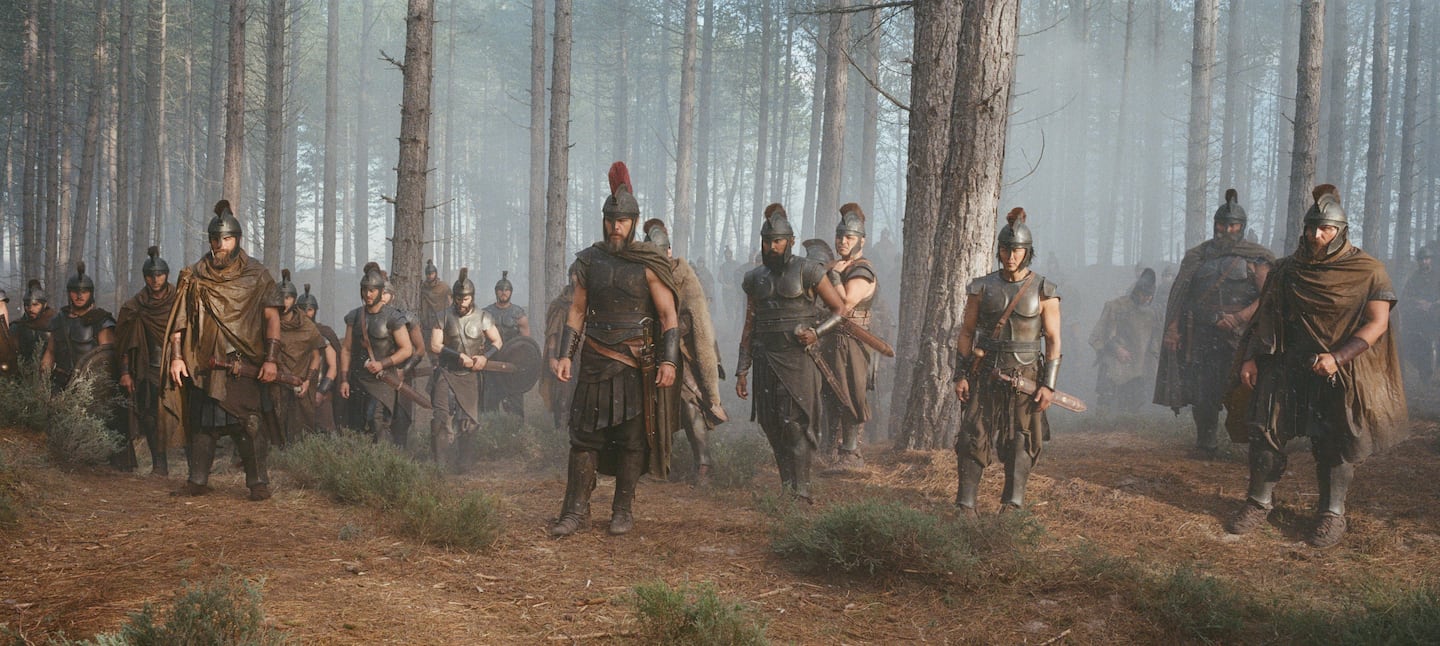
From opening title card to closing credits, “The Odyssey” is a nearly three-hour barn burner, racing from event to event with whirlwind kinetic energy. Blink and you’ll miss some roaring fire, raucous tempest, or piggy sorceress on the spinning carousel of adventure. Nolan’s film zooms along as though locked into a high-speed drag race with the “Fast and Furious” franchise.
That’s why it’s so forgettable.
Nolan’s reluctance to take a pause should, actually, give us pause. After all, Homer’s poem doesn’t just involve a lot of waiting. It is a postwar tale about waiting, about enduring, for long stretches of time, separation and grief, without any recourse to heroic action: Penelope at her loom, weaving at dawn and unweaving at twilight, year after year, to forestall the imperative to choose a suitor. Odysseus, held captive for seven years on Calypso’s island, weeping for home. His ship and its crew, becalmed amidst the Sirens’ wails.
Nolan’s version, however, is short on patience and asks none of its audience. His blockbuster film could well be the culmination of a fundamental transformation of the Hollywood epic. We are deep into an entertainment age of rapid-fire gratification that has dispensed with the ecstasy and agony of waiting — and that revolution may well leave a dagger in the heart of all that’s distinctive about the Hollywood epic.
Conventional wisdom these days holds that the power of the epic lies in grandiose spectacle. But we once knew that spectacle wasn’t enough. “Cleopatra” (1963) was rightly dismissed as a gaudy parade of razzle-dazzle that collapsed under the weight of its own bloated, decadent pretensions. It’s a fatal error to assume that a lengthy cacophony of action forms the backbone of the epic.
To the contrary, it’s by suspending the audience in rapt attention, in awe of sublime visuals, that the epic shines with a singular power all its own.
Take the iconic railroad depot sequence in 1939’s “Gone with the Wind,” which unfolds during the siege of Atlanta. Scarlett O’Hara, rebuffed in her effort to fetch a doctor and disoriented by self-pity, stumbles into the open-air depot grounds. The shot begins tightly focused at ground level on Scarlett’s flustered face, and then, with painstaking patience, slowly draws back using a high-angle crane shot. Across an agonizing 53-second span, the audience is forced to grapple with what gradually enters the frame as a vast expanse, whipped by dirt and dust, that is blanketed by wounded and dying Confederate soldiers, laid out in rows, writhing and bellowing in pain as they bake under a scorching sun.
The brilliance of the shot — which was achieved by leasing a 125-foot construction crane in tandem with the construction of a 150-foot-long concrete ramp — is that it holds its gaze with unflinching patience. The camera’s journey visually tracks the entire thematic arc from Scarlett’s flinty self-absorption to the sublime scale of epic tragedy — and then comes to rest on the tattered Confederate flag flapping listlessly in the foreground, emblemizing the death of the antebellum South. (The stubborn endurance of the racist “lost-cause” mythos owes much to the power of these visual pacing techniques.)
Director David Lean likewise leverages the pregnant pause to grand effect to herald the arrival of Sherif Ali in 1962’s “Lawrence of Arabia.” A long lens remains fixed on the distant horizon for a tense spell that feels interminable until a tiny black speck emerges out of the phantasmagoric heat mirage — and finally materializes as Ali, who raises a rifle and shoots a man dead in a callous act of territorial violence. That climactic gunshot is nothing without the long shot that precedes it. The arc of emotion — from wonder to dread to fatal climax — is what makes the entrance an indelible artifact of film history.
Waiting is also at the emotional core of 1985’s “Out of Africa.” The film’s protagonist, Karen Blixen, played by Meryl Streep, muses, in a Penelope-like monologue, that women in war are tested “for patience, for doing without, and for how well we can endure loneliness.” The stakes of this observation are made wrenchingly personal by a plane crash that kills Karen’s lover, Denys Finch Hatton, played by Robert Redford. The film lingers on Karen’s bereavement, giving us an unabridged recitation at an open-air funeral of A.E. Housman’s poem “To an Athlete Dying Young” — an agonized moment of suspension that feels unfathomably at odds with Hollywood’s current penchant for breakneck action.
Granted, to some, the wait can feel either emotionally invasive or unendurably tedious. The latter is Elaine’s reaction, in a famous episode of “Seinfeld,” to being forced to sit through 1996’s Best Picture Oscar winner, “The English Patient.” Dragooned into watching the slow-paced epic fraught with emotional land mines, she finally erupts with impatience: “I can’t do this anymore! I can’t, it’s too long! Quit telling your stupid story about the stupid desert and just die already! Die!”
The resistance to waiting has only worsened in the three decades since that iconic outburst. Fractured attention spans, smartphone scrolling, and a preference for passive consumption have induced corporate media gatekeepers in the digital age to impose a callous efficiency in storytelling. Today’s epics serve up a frenetic spectacle and cacophony of action, spliced together in such tight succession that the stakes of the film almost can’t be contemplated over the din and roar of action. The “Mad Max” franchise reboots in 2015 and 2024, for instance, are teeming with ideas, but with action sequences akin to a woodpecker relentlessly hammering its beak against a tree trunk, they all get blotted out by relentless noise.
The ever more frenetic pace of film sequences are sapping the power of the medium, as neuroscientists are confirming: Helter-skelter audiovisuals make us pay attention in the moment but reduce our ability to grasp the story on a deeper level. Sequences of this ilk inundate audiences with rapid-fire dopamine hits, not unlike the effects produced by the architecture of social media algorithms, but the impression these sequences leave behind is fleeting.
A few epics in the old stately style still find their way into being. The 2022 adaptation of “All Quiet on the Western Front” and 2019’s “1917” feature both slow-rolling stretches of boredom and transfixed moments of horror, a rhythm that follows easily from their subject matter. Both center on a war notorious for leaving soldiers hunkered down for months at a time in the trenches. Another laudable outlier is Denis Villeneuve’s “Dune” series, which creeps with the exquisite pacing of slow-burn escalation. But these are exceptions in a film landscape remade by the likes of Michael Bay and Zack Snyder.
It gives me some hope to see audiences turn away from predictable corporate franchise horror films to embrace indie horror that bristles with experimentation. That said, horror movies can be made on microbudgets, whereas epics are far more costly to produce, meaning that throttling back the pace of action is risky, especially when vying for audiences accustomed to TikTok videos and Instagram reels. It would take a big-name visionary — someone like, say, Christopher Nolan — to insist on boldly deviating from the now-ubiquitous style of frenzied bombardment.
In the meantime, we’re stuck with “The Odyssey,” a film full of sound and fury that ends up signifying not much at all.
