


Last week I learned that Arizona State University had launched a new degree program, a Bachelor of Arts in Content Creation, which can be taken either online or in-person:
Do you dream of monetizing your video channel or making social media your career? Arizona State University’s online Bachelor of Arts in content creation prepares you to become a strategic storyteller who thrives in the rapidly evolving creator economy. This online program teaches you how to create powerful content across video, podcasts, social media and emerging platforms while building your personal brand. You’ll learn the art and science of digital influence to grow your audience and build the foundation for monetizing your content.
It is difficult to know where to start with this program aimed at the delusions of teenagers, and at separating their parents from their money. It suggests that “powerful content” can be made without having taken the trouble to learn anything about anything: If Paul Krugman can have a really successful podcast about economics, why can’t Kyle from Flagstaff make one? It suggests you can make a personal brand without yet having fully formed your character and values. It suggests that a four-year degree is the most effective way to get any good at this sort of thing. And it hides the fact that monetized social media exists in a superstar economy, with very few actually able to earn a living, and very many getting virtually nothing from it.
Now if I had to act as an advocate for ASU, what could I say to defend the program? I could say “well, your university in Indiana has a top flight music school, and only a handful of students, if that, are going to reach Joshua Bell levels of success, but they can take what they learn there into teaching, and playing in their local orchestra, and such, even if they never get a record contract or a world tour. And the same is true for our content creation program.”
But is it? If you put all your effort post-graduation into “building your personal brand”, and that won’t pay the rent, what then?
Sage Steele is a graduate of Indiana University, and went on to success as a commentator on ESPN. But a controversy arose: on a podcast in 2021 she complained that ESPN and its parent company Disney+ had forced her to get a Covid vaccine as a condition of work. She made a public apology to the network for what she had said, but later said the apology was forced and violated her rights to free speech. She sued, and an out-of-court settlement was reached in 2023, as she moved on from ESPN.
She went forward with her social media career. Her YouTube show has 226K subscribers. She is also active on other platforms, Insta and X and all the rest. Her “personal brand” is being an outspoken MAGA, the sort who “tells it like it is” where “it” is whatever Donald Trump thinks it is.
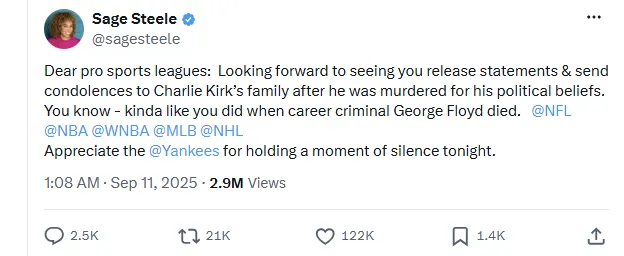
In May of 2025, Indiana governor Mike Braun signed a bill that would end the ability of IU alumni to elect three members to the university’s Board of Trustees, so that he could make all such appointments himself, and in June he removed the three sitting elected trustees in favor of his own appointees. One of them was Sage Steele.
Last week, in the wake of Republican politicians thinking our national priority right now ought to be interrogating Anthony Fauci, she posted this:
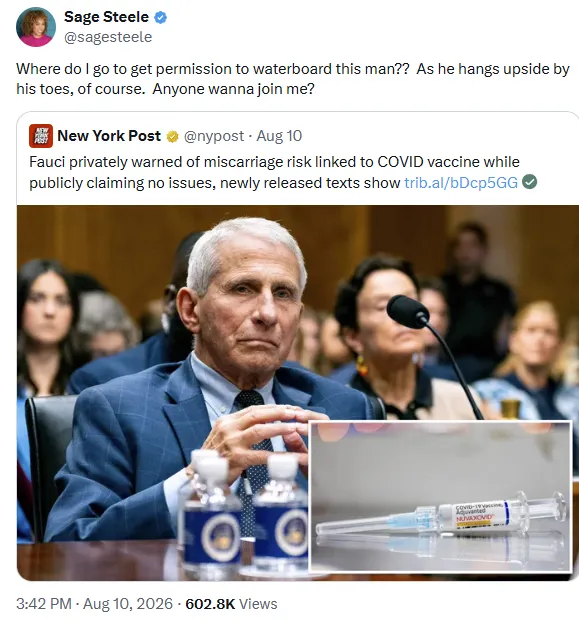
This post actually has a content warning on X, which is rather a high bar. And the post seems to violate an IU Board of Trustees policy. Indiana Public Media reports:
The IU trustees’ code of conduct includes this: “…Trustees (are to) to act in good-faith and in a manner that the Trustee reasonably believes to be in the best interests of Indiana University and its public purposes, rather than their own interests or the interests of another person or organization, and to avoid conflicts of interest. The Trustee must not act out of expedience, avarice, or self-interest.”
The code also states trustees should avoid situations where their personal interests or those of their immediate family members or close associates would cause a person to think their actions are influenced by considerations other than the best interest of the university. …
Randall Tobias, former chair of the IU Board of Trustees as well as a former U.S. Ambassador and head of U.S. Foreign Aid, condemned Steele’s post.
“I want to go on record that I find it appalling that ANY responsible person would say such a thing about anyone, but especially a person whose public statements reflect on the institution she has been appointed to help govern,” Tobias wrote in a Facebook post. “It is in my view a statement that is both reprehensible and abhorrent and should not stand unchallenged by those who care about the standards and values of Indiana University and those charged with leading it.”
The Board of Trustees has not responded to a request for comment. They have a regularly scheduled meeting Friday [at my time of writing, that’s tomorrow] at IU Indianapolis.
Mike Braun appointed as a trustee someone who had already, famously, got into trouble with an institution to which she owed some decorum. Who could have thought this would happen again?
Well, I could have. Because if a person has established a “personal brand” of a sort, and had some success with it, in their mind brand maintenance takes precedence over any loyalty to an institution (yes, she is loyal to MAGA, but that’s because it is a brand choice). Her brand as being vociferously anti-vaccination meant that she could not let the Fauci hearings slip by without trying to gather clicks and likes, even if, as Mr. Tobias says above, it does not reflect well on the institution of which she is expected to play a role in governance. IU comes second.
Braun should have known this.
Which brings me back to the ASU degree in Content Creation. Most kids make dumb social media posts. Even distinguished retired professors who post on Substack have a made a few. That’s par for the course these days. But to make social media a career, to create that personal brand, is a different thing; the past can’t be discarded when applying for a more mundane job, and the present social media brand will either have to be put in the archives, or scaled back to harmless fare like cat pictures and Thai recipes. You can’t “tell it like it is” when you work for a firm in any sort of position of authority.
I was working in mid-level administration when I made a post about how the existence of tenure posed distinct challenges in long-run planning for universities (which is I think obviously true) but someone interpreted it as a statement that we should abolish tenure. It was not what I was saying, but even the hint that I might be got me into no end of trouble with my bosses, understandably.
Does the new degree program explain that? Your personal brand might mean anything – many people establish a personal brand by being truly appalling, save for like-minded followers, and, when the brand begins to rust, where does that leave you?
Universities need to remind their students, who I don’t think are fully aware of this, that freedom of speech, which is a very good thing, comes with taking responsibility for your speech, and that some people and some firms might want to cross to the other side of the street when they see you coming based on things you have said. There are consequences to the “content” you “create”.
Cross-posted at https://michaelrushton.substack.com/
