


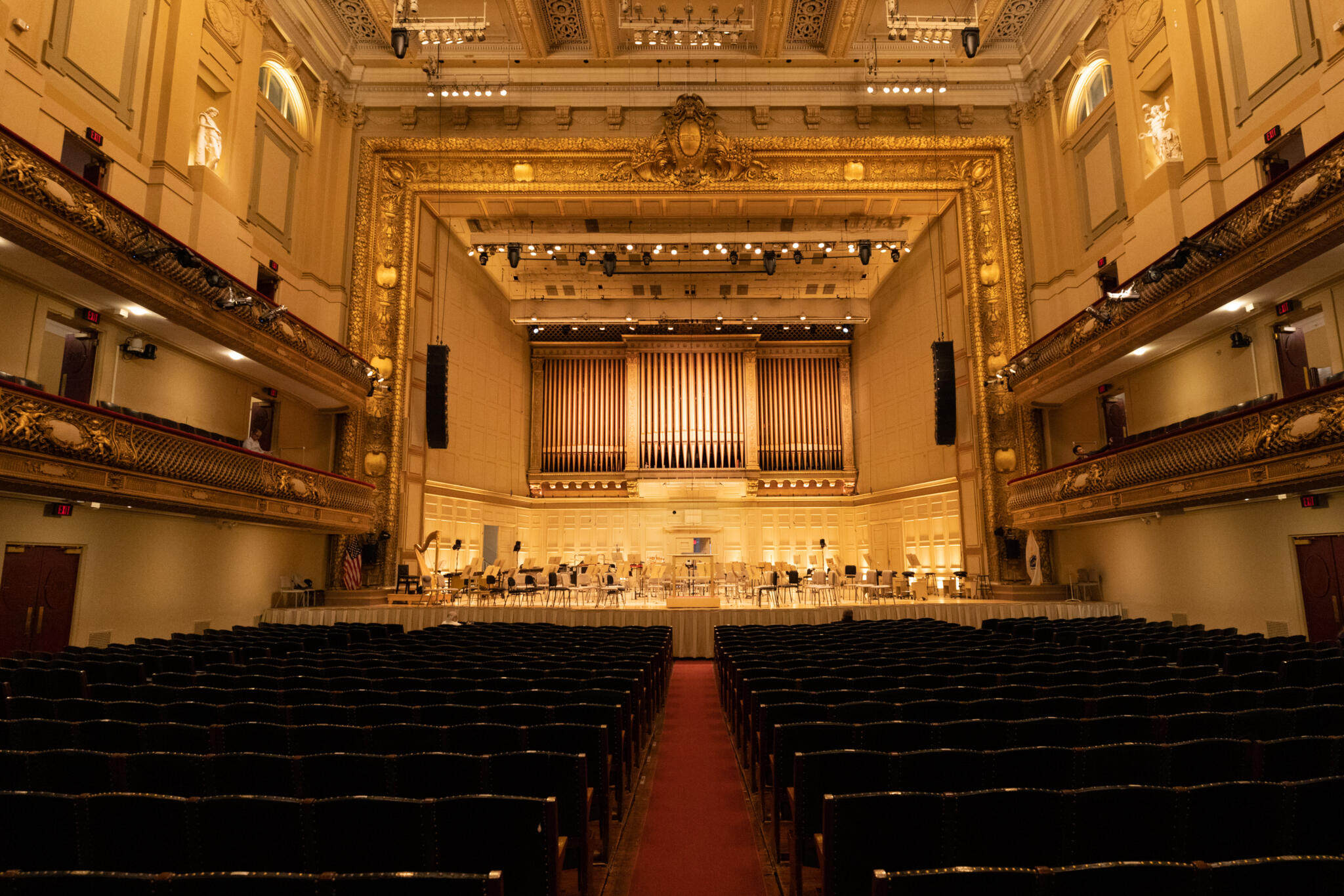
Did anyone think a Boston Symphony Orchestra announcement would linger as front-page news this long? On March 6, BSO CEO Chad Smith and the Board of Directors announced that they were not renewing Music Director Andris Nelsons’ contract after the 2027 Tanglewood season. But the news itself, after considerable debate by BSO followers, is still alive. It varies from the recent page one Boston Globe story that has set off a lot of snickering about Tanglewood forbidding unauthorized distribution of the red flower pins that symbolize support for Nelsons (he wears one himself) to serious debates about the future of classical music in this country.
At the end of July, Smith raised eyebrows when — for the second time — he announced a family medical emergency the day before a scheduled public discussion about his still insufficiently explained “vision” for the orchestra. This time his Tanglewood interlocutor was Smith’s friend, conductor Esa-Pekka Salonen, who’s been a major source of speculation as a possible replacement for Nelsons (his name had even come up 12 years ago as a replacement for James Levine). Some online commentators have not been sympathetic in their speculations of Smith’s motivation to cancel this discussion.
One crucial element in the dispute is that the orchestra itself was never consulted about Nelsons. The players have largely leapt to his defense (many of them wearing those front-page flower pins) and one result of the board’s decision not to offer any reasonable explanation of their dismissing Nelsons is that they’ve turned him into a martyr. And just about everyone, fans of Nelsons or not, agrees how badly this whole business has been handled.
One new question that has arisen is whether the BSO board actually cares anything about music. Was this whole scandal at bottom just another attempt at a corporate takeover? The independent music critic Anne Midgette (formerly of The New York Times and The Washington Post) has been following the story closely and recently posted on Facebook a scathing letter from D. Wilson Ochoa, the BSO principal librarian (a tenured position), warning of the longtime attempt of the corporation to be more fully in charge of important BSO decisions. This was first signaled by the costly changes to the BSO and Symphony Hall logos as unnecessarily expensive attempts at “rebranding” and the elimination of historical photos of the BSO in the Symphony Hall lobby. “Did the hall really need refreshment,” Ochoa asked in his letter, “or was it all part of the plan to purge it of references to the orchestra?”
The BSO declined to share the amount spent on the rebrand, but said “the various costs associated with rebranding work represent a small portion of our overall marketing and facilities budgets.” A spokesperson also said the “refresh” to Symphony Hall and the new black-and-white photos installed “were selected to show all aspects of our organization, including historic moments of the BSO, Pops, and Tanglewood. This work was mostly funded by a deferred maintenance grant.”
This crisis largely seems unconcerned with serious musical issues, such as the quality of the playing and the choice of repertoire, which is, according to Ochoa, “less and less classical music.”
“But is this really a recent turn of events,” Ochoa posits, “or is it all part of the long game by the BSO’s CEO and board where Andris’ firing is just the latest in a list of actions over years designed to lead exactly to this moment?”
Since I wrote in March, I’ve been joined by other critics such as Midgette and the Times’ David Allen about the simple fact that Nelsons has been a disappointment as a conductor. I’ve found him lacking important musical (and extra-musical) qualities. He’s never really committed himself to Boston. Just a few years after his appointment, he took on the leadership of the orchestra in Leipzig, which gave him even less time for fundraising or to really win an audience. (Ticket sales have been falling; according to the BSO, sales have declined 40% since 2004.) And after the first year of his double appointment, which had some interchange of players and repertory, little of significance has materialized from this joint venture. And I’ve too often been disappointed with his actual performances. Even his much applauded, Grammy-winning recordings of Shostakovich (mostly extremely well-played) lacked an authentic Russian ring (and he’s from Latvia!). Are these performances really about anything? They certainly were to Shostakovich.
Is Nelsons at his best only when he lets the orchestra get too fast or too loud? Or at his worst? The answer is probably both. After a dozen years of conducting the BSO at Symphony Hall, with its uncanny acoustical warmth, he hasn’t yet learned how to find its sweet spot. Or how to make slow music move forward. Or how to give fast music a real swing. His Russian music is as unidiomatic as his American music. And he seems to have shown little interest in contemporary work.
The multi-faceted music critic, novelist, entrepreneur (etc.) Joseph Horowitz has a recent blog post lamenting how much current music-making doesn’t seem to have much emotional depth compared to recordings by the old masters. With some vivid exceptions, that lack of feeling seems to be what I’ve been hearing, and especially from Nelsons.
Soon after he started to lead the BSO there were shocking failures. Wagner’s “Tristan und Isolde: Prelude und Liebestod” may be symphonic music’s greatest example of romantic longing. Any conductor ought to know that. But instead of yearning desperately for some resolution, we got something completely static. Did Nelsons not know how to play slow music or understand that the last thing it should do is just sit there?
Even amateur orchestras have learned to navigate the Scylla and Charybdis of Stravinsky’s “Rite of Spring,” one of the most mind-altering scores in the orchestral repertoire — originally ballet music choreographed by Nijinsky. I’ve heard performances that were messy and raucous that still had some life, but until I heard Nelsons, I’d never even imagined I’d ever hear one so dull. The person sitting next to me met my eyes with similar disbelief.
Early this year, Nelsons led a performance of one of the most memorable and romantic scores in American opera, Samuel Barber’s “Vanessa,” with a libretto by Gian Carlo Menotti. It had been a long time since I’d heard a performance, and probably many younger attendees had never heard it before. It was also one of the few American scores that Nelsons had chosen to play. But there was no American idiom. It could have been Czech or Hungarian. What a waste!
We may have forgotten how hard it was to replace James Levine. There seemed to be no obvious frontrunner. None of the speculation I heard included a woman (I hope times have changed). There was the excellent Stèphane Denève, who — like Charles Munch, the BSO director in the 1950s — specialized in French music, and there was Nelsons, who didn’t seem to specialize in anything, but he made a good impression when he substituted at the last minute for an ailing Levine leading Mahler at Carnegie Hall. I confess I was leaning to Nelsons — the boyish modesty, the energy. I remember actually arguing with some of my friends at the BSO after his first performance at Tanglewood. I found his odd approach to a chestnut like Ravel’s “La Valse” at least promising. But it wasn’t long before my curiosity turned to qualms.
Last year, when the board renewed Nelsons’ contract, it had become a so-called “rolling contract” — easier to renew, but also easier to cancel. I thought a conductor admired by the board and the orchestra didn’t particularly need a contract that would be easier to renew… or cancel. After 11 years, was there trouble in paradise? So the announcement that the board was going to end Nelsons’ tenure after the summer of 2027 didn’t come as a shock. I thought the board had finally awakened to the inadequacies of their music director.
But they didn’t handle it well. The announcement seemed rushed, the official PDF didn’t even come on BSO letterhead. There was the vague gobbledygook about Nelsons not sharing the board’s “vision,” with no clarification of exactly what that meant. And the orchestra members had not been consulted. Another major mistake. Rumors about Nelsons missing rehearsals underlined the rumors about his making too few demands on the players. And he seemed tired.
At Nelsons’ first press conference as BSO music director in March 2014, I asked him if he was going to maintain Levine’s radical change to the seating of the string section: first violins on the left, as usual, but instead of being hidden behind the first violins, the second violins would be seated opposite the firsts, at the front of the stage. For most classical music, up into the 20th century, that change meant you could actually hear the two violin sections in dialogue. Or one echoing the other. At Levine’s press conference, he spoke for nearly half an hour about this historic change, looking back to the Baroque period. And suddenly the music sounded like what Symphony Hall must have been designed for. Suddenly you could hear more of what composers intended. But when I asked Nelsons whether he planned to keep Levine’s seating plan, he seemed bewildered. He answered something like: “Only when it is necessary for the music.” He clearly hadn’t given the seating plan any thought. And as far as I can remember, he conducted only one piece of contemporary music with “divided” violins, because the composer actually insisted on that seating plan.
So I’m not sorry to see Nelsons go. And he’d probably be happier in Europe. I would love to see the BSO hire one of the outstanding women who are currently conducting, though another rumor, reported in the Globe, was that some members of the orchestra were quite disrespectful to the Finnish guest conductor Susanna Mälkki (a disciple of Pierre Boulez), who would be my own choice for Nelsons’ replacement. Back in 1977, the press was invited to a rehearsal with Sarah Caldwell conducting, and I saw for myself the same misogynistic disrespect.
At the bottom of all this continuing controversy may be an attempt to diminish the mandate of the BSO to be a home for classical music. The question for myself is whether I would rather have Nelsons over increasingly less classical music? But that’s not the choice I want to be forced to make. I want — don’t we all want? — more and better classical music. Isn’t that what Symphony Hall and the Boston Symphony Orchestra were intended for? If word suddenly got out that the BSO was the place to hear great performances, wouldn’t people be battering down the doors?
