


I was bleary-eyed on a delayed flight when I spotted a New York Times article about Kerri Greenidge, a historian of Black political life and memory. It took me a moment to realize I was reading a postmortem, written while the body was still warm.
The source of Greenidge’s downfall, The Grimkes: The Legacy of Slavery in an American Family, had only recently been treated as a triumph. In 2022, the book had been widely praised as one of the best history books that year, and selected as a finalist for the National Book Critics Circle Award. It fit her profile: Greenidge’s previous work is held in high regard, too. I was somewhat aware that a few determined scholars had challenged several of the book’s citations, with varying degrees of specificity. Given the subject and the field, I assumed that was par for the course.
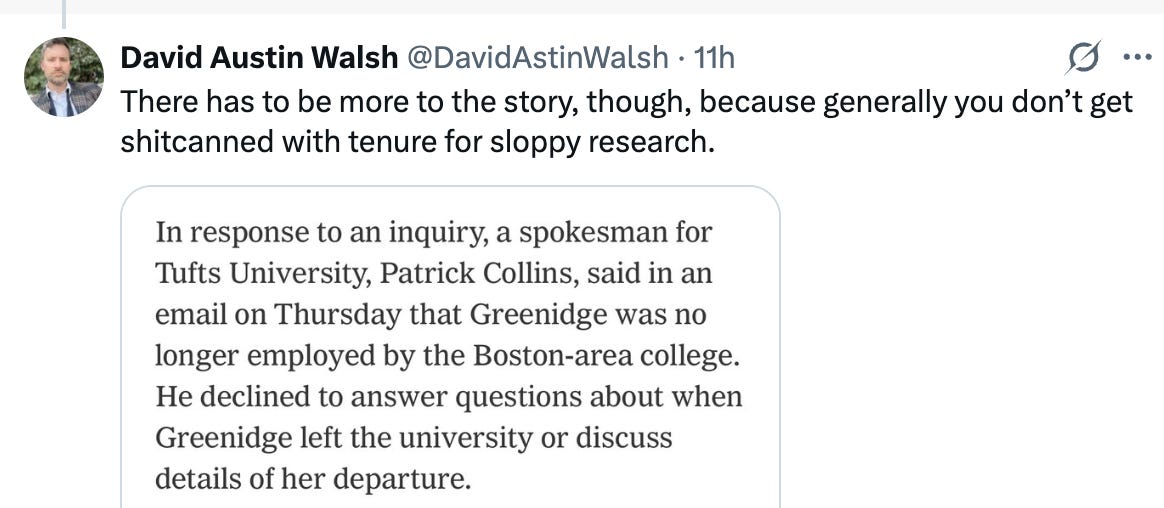
What followed was anything but: The publisher now appears to have stopped listing the book, and Greenidge is no longer employed by Tufts.
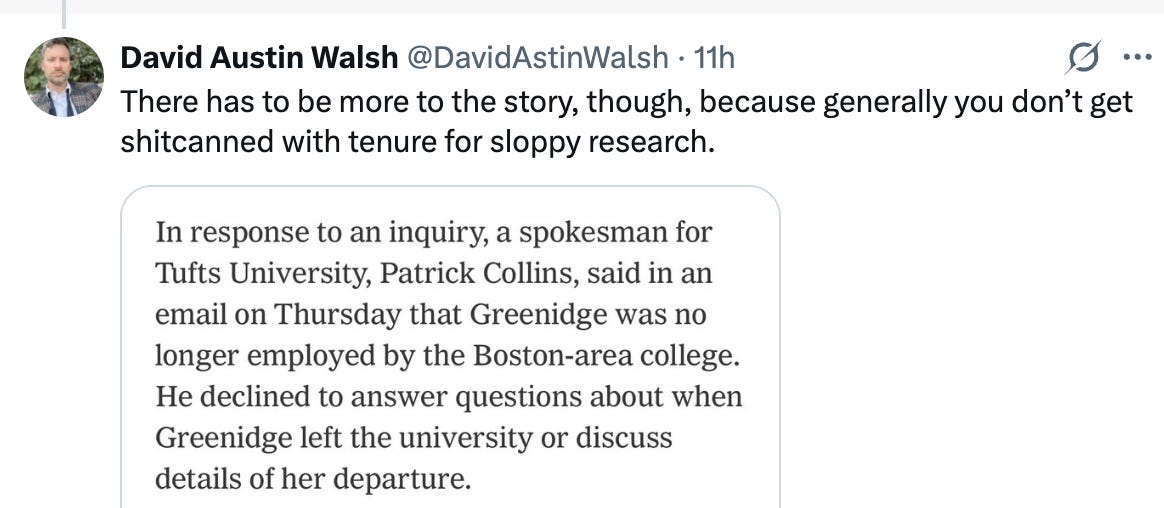
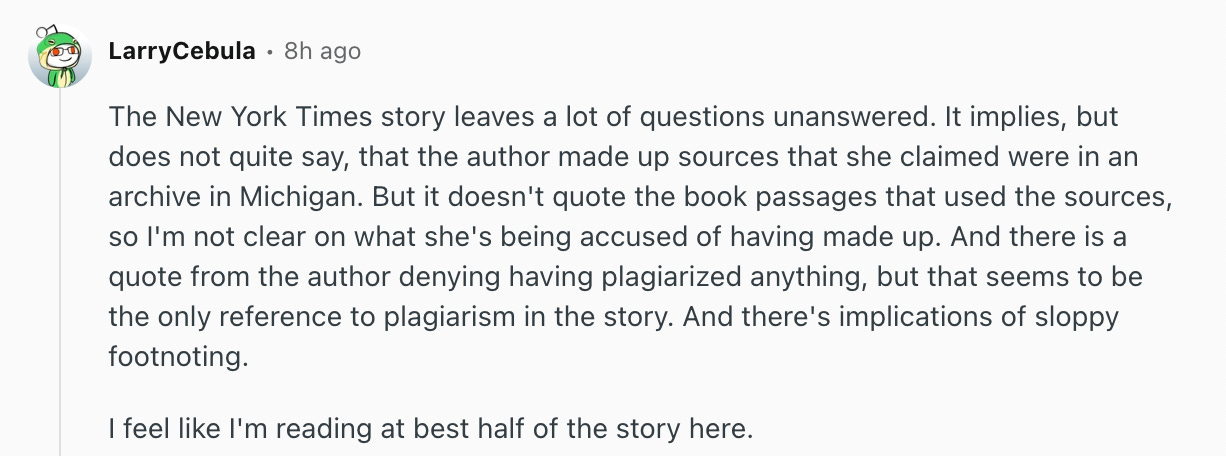
Why are we reading about this now? I have no idea, and I don’t think the facts reported here explain the scale of what followed. Either far more happened than it tells us, or the response was wildly disproportionate. Instead of resolving that central question, the piece gives us the wreckage without explaining the force of the impact: a secret external review, an unnamed complainant, a requested restraining order, a vanished book, and a vanished career. It leaves the reader to assemble the crime scene from fragments, then declines to investigate the most damning ones.
What I can confirm is that the article offers no convincing explanation for a response this totalizing. It does not solve the mystery. It compounds it.
So let’s go with what little we do know: Greenidge, who was allegedly surprised the Times cared (a weird use of space in place of something substantial and useful to the reader), confirmed that the Tufts review began with complaints from “a white woman scholar.” She declined to name that scholar, whom she had sought a restraining order against. The article names Myra C. Glenn as a prominent critic, but it does not establish that Glenn was the unnamed complainant.
That distinction matters, as does the unexplored question of how an academic dispute reached the point of a restraining-order request. It’s notable in any profession, I’d hope, and certainly this one. I’ve seen and felt my share of ire, but never anything like that.

What the article omitted almost entirely, as Jim Downs and other historians have noted, was why The Grimkes mattered—and what the book unsettled. Greenidge challenged one of women’s history’s most polished origin stories: Sarah and Angelina Grimké as self-rescuing heroines who rejected their slaveholding family, crossed into righteousness, and emerged as founding mothers of American feminism. It is a version generations of scholars helped construct, institutionalize, and teach.
Glenn spent her career teaching and writing women’s history, a field that helped establish Sarah and Angelina Grimké as foundational figures, and Greenidge widened the Grimkés’ frame until it cracked. She centered Archibald and Francis Grimké, the sisters’ Black nephews, born to their brother Henry and Nancy Weston, an enslaved woman. She traced, then, a different story: how slavery’s violence continued inside a family celebrated for transcending it. By doing so, she demonstrated how white feminist history manufactures usable ancestors—and who must disappear to make them usable.
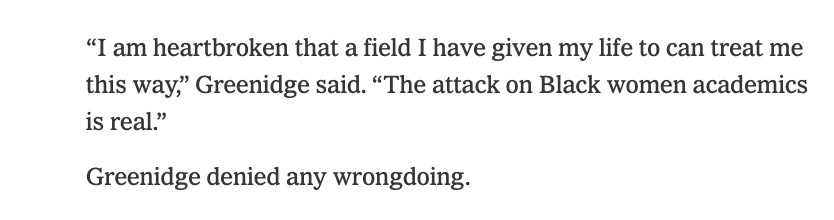
Many reviews understood Greenidge’s intervention, even when they disagreed with parts of her interpretation, but the current controversy appears to mostly ignore it, and the Times foregrounds a handful of disputed points. Glenn’s full review appears to make a broader charge: that some of Greenidge’s central conclusions are unsupported by the sources she cites. I have not examined the archival record closely enough to adjudicate those claims, and I’m unlikely to find the time to do so, but I hope someone really good does. I hope the critics’ claims receive the same scrutiny they have directed at Greenidge, because the Times places tremendous weight on a handful of disputed points in a four-hundred-page family history without adequately asking how they produced such an extraordinary escalation.
Greenidge has pointed to a fact that is difficult to ignore: prominent historians granted far more interpretive latitude are white, and she is Black. That does not prove racial discrimination in any single institutional decision. It does make race and power legitimate subjects of inquiry rather than rude interruptions of a supposedly neutral process.
White historians routinely receive remarkable indulgence for scenes reconstructed beyond the archives, thoughts assigned to dead people, dialogue burnished until it gleams, and quotations no archive can quite produce. I have written with far greater specificity about Ron Chernow inventing details and claiming unsupported interiority and Erik Larson’s penchant for arranging the record according to a highly particular vision of dramatic momentum. In both cases, I’m in good company, but we’re outnumbered by fans who confirm that the great white male synthesizer can walk into the archive wearing muddy boots, and everyone calls it narrative authority. (In addition to the intro to my Washingtion bio, see “Chernow Gonna Chernow.”)
In most cases, the white woman historian can too. I once failed to locate material cited by a well-known white woman historian at a major New York university. When I asked her about it, she replied that the research had been done a long time ago and she could no longer answer the question. The archivist found that response especially strange because accessing the documents, as cited, would have required a court order. The experience stayed with me, not least because neither the archivist nor I could find any record that such an order had ever been issued. That historian now runs a well-funded institute at the university.
Do I fact-check myself? Of course. And I hire people to do it too. Do other responsible historians? Yes. Do errors still survive? Constantly. This isn’t about passing down judgment or issuing anyone a pardon. I am pointing to a reality, even among the most careful scholars: notes go astray. Collections are reorganized. Call numbers change. Researchers misread handwriting, transpose dates, trust a predecessor’s citation, or discover too late that a quotation has traveled from book to book like a counterfeit bill no one bothered to hold up to the light.
Another conversation we should be having: what “fact-checking” a history book can realistically mean. Trade presses rarely send researchers back through hundreds of archival citations, and even academic peer reviewers cannot retrace years of work scattered across multiple repositories. The system rests heavily on trust, reputation, and the assumption that scholars are representing their sources honestly. That may be unavoidable. It is also a spectacularly fragile form of quality control.
When does an error require a correction, when does it become a scandal, and when does it become an execution? The Times did not resolve those questions, or many others. It mostly narrated the fall. That uncertainty should slow everyone down, and the fact that it hasn’t is its own kind of evidence.
