



Sustainability initiatives have been part and parcel of corporate business strategies for over a decade. Those programs responded to demand on two fronts: an increasing desire by shipping customers for more “green” operations and help reducing their carbon footprint, and secondly, government mandates by the U.S. Securities and Exchange Commission (SEC), which in May 2024 implemented final rules to standardize climate-related disclosures for public companies. These included mandatory reporting of greenhouse gas (GHG) emissions on a phased-in basis.
Fast forward to today. The Trump administration has canceled or scaled back many government programs addressing GHG emissions as well as other environmental policies. Other regulatory mandates have been stymied by legal actions.
That’s brought trucking and logistics operators to a crossroads. Do they continue pursuing goals for and investing in sustainability, particularly GHG emissions reporting and reduction initiatives, or do they tap the brakes on them and put such programs on hold?
NO TURNING BACK
“From a U.S. government perspective, some [programs and policies] have been turned back,” notes Bart De Muynck, principal at consulting firm Bart De Muynck LLC. “What has not [diminished] is consumer expectation and demand.”
Many companies, consumer packaged goods companies in particular, De Muynck says, are staying the course, responding to consumers who continue to want products that are made, packaged, and shipped in an increasingly sustainable manner. Truckers and 3PLs (third-party logistics service providers), in turn, have to support those demands by finding ways to reduce their environmental impact—which is primarily GHG emissions from the combustion of diesel fuel.
“Logistics operators continue to pursue these initiatives because they want to,” says De Muynck. “And they are looking at how do we reduce our [carbon] footprint and cost at the same time.”
The incentive for any fleet, for hire or private, to decarbonize comes from one of three places, says Matt McLelland, vice president of sustainability and innovation for Covenant Logistics, which operates one of the nation’s largest truckload fleets.
“One is altruism; it’s the right thing to do,” he notes. “Second is regulatory, a [federal or state] mandate to measure and report emissions or convert some portion of an operation [to lower-emission vehicles],” he notes. “Third is it’s what our customers are telling us they want, then deciding how to respond.”
He says Covenant “goes above and beyond” with decarbonization efforts. Its fleet is young, with trucks averaging two years old, which helps the company ensure it is benefiting from “the latest technology and engine performance for lower emissions,” he notes.
Working with a specific customer, Covenant has deployed tractors that are 100% biodiesel-fueled as well as electric “hostlers,” or yard tractors for moving trailers to and from docks. It also is doing a pilot test with another customer of a Tesla electric Class 8 semi. “The price, weight [load capacity], and range are all trending in the right direction,” he reports.
One big win, McLelland shares, has been Covenant’s fleet conversion to electric auxiliary power units (APUs), which provide emissions-free power to in-cab systems when trucks are parked. McLelland says the fuel savings alone, from eliminating some 2,000 hours of idle time per truck per year when used in sleeper cabs (which equates to 1,600 gallons of fuel), pay for the unit. That also translates to reducing CO2 emissions by 36,656 pounds annually.
A side benefit: happier drivers who sleep better. “Parked at night, waiting to pick up or drop off a load, engine idle time can be really high,” he explains. “Eliminating [the truck engine running] reduces emissions and noise that can interrupt sleep,” he notes, adding “a better rested driver is a happier and safer driver.”
Yet while electric and alternative fueled vehicles are promising, the ability to increase deployment of them “is directly proportional to what the customer will pay for,” he says. “You have to find a customer willing to pay that premium.”
McLelland believes that fleets of the future will be powered by a combination of traditional diesel; renewable or biodiesel; some hydrogen; CNG, or compressed natural gas (natural gas pulled from the ground); and RNG, or renewable natural gas (methane captured from renewable biological sources like landfills, dairy farms, wastewater treatment plants, or food waste decomposition). “I call this stage the ‘messy middle,’” he says. “Gas and diesel on the right, hybrid technology in middle, electric [and other technologies] on the other side.”
TRANSPARENCY, CONSISTENCY, CONTINUOUS IMPROVEMENT
For many trucking and logistics firms, sustainability is a full-speed ahead activity that is deeply embedded in daily operations, attitudes, and habits of employees, with management leading from the top. That’s the approach being taken by LTL (less-than-truckload) carrier Estes Express Lines, says Sara Graf, vice president of sustainability, culture, and communications, who heads up the company’s sustainability program.
Estes celebrates its 95th year in business in 2026. Sustainability is a core part of its DNA, Graf notes. “We focus on long-term value creation, rather than reacting to short-term regulatory swings.”
What is the recipe for a successful sustainability program?
“First is building a strong measurement and reporting foundation, very intentional and very focused on data,” Graf says. Along with a credible measurement foundation, the two other legs of Estes’ sustainability strategy are “reducing emissions where it makes financial sense, and enabling customers with transparent, accurate, and consistently actionable data.”
Estes has set up a cross-functional task force and working groups across the company to design and drive its sustainability efforts. One looks at fleet emissions and fuels. Another at electrification opportunities, like adding solar power generation and battery storage to facilities, with a focus on facility emissions reduction. There is also a group examining electrification of yard and dock equipment.
Yet another studies fleet emissions reduction through route and load optimization, minimizing route miles and maximizing load factor. Finally, there is a working group that focuses on driver behavior and how that affects fuel efficiency, including a program that rewards drivers for exceptional fuel performance.
With the company now several years into the journey, Graf says the most durable successes are found in employees who are fully engaged, and adopt and sustain good habits that lead to small wins, which collectively add up.
“We look for ways to find small, repeatable improvements,” she explains. “There are no magic bullets, just working hard on the little things, focused on process improvement and efficiencies,” she adds. “Operational excellence drives sustainability. That pays dividends both in lowering our emissions and running a financially sustainable and growing business for the long term.”
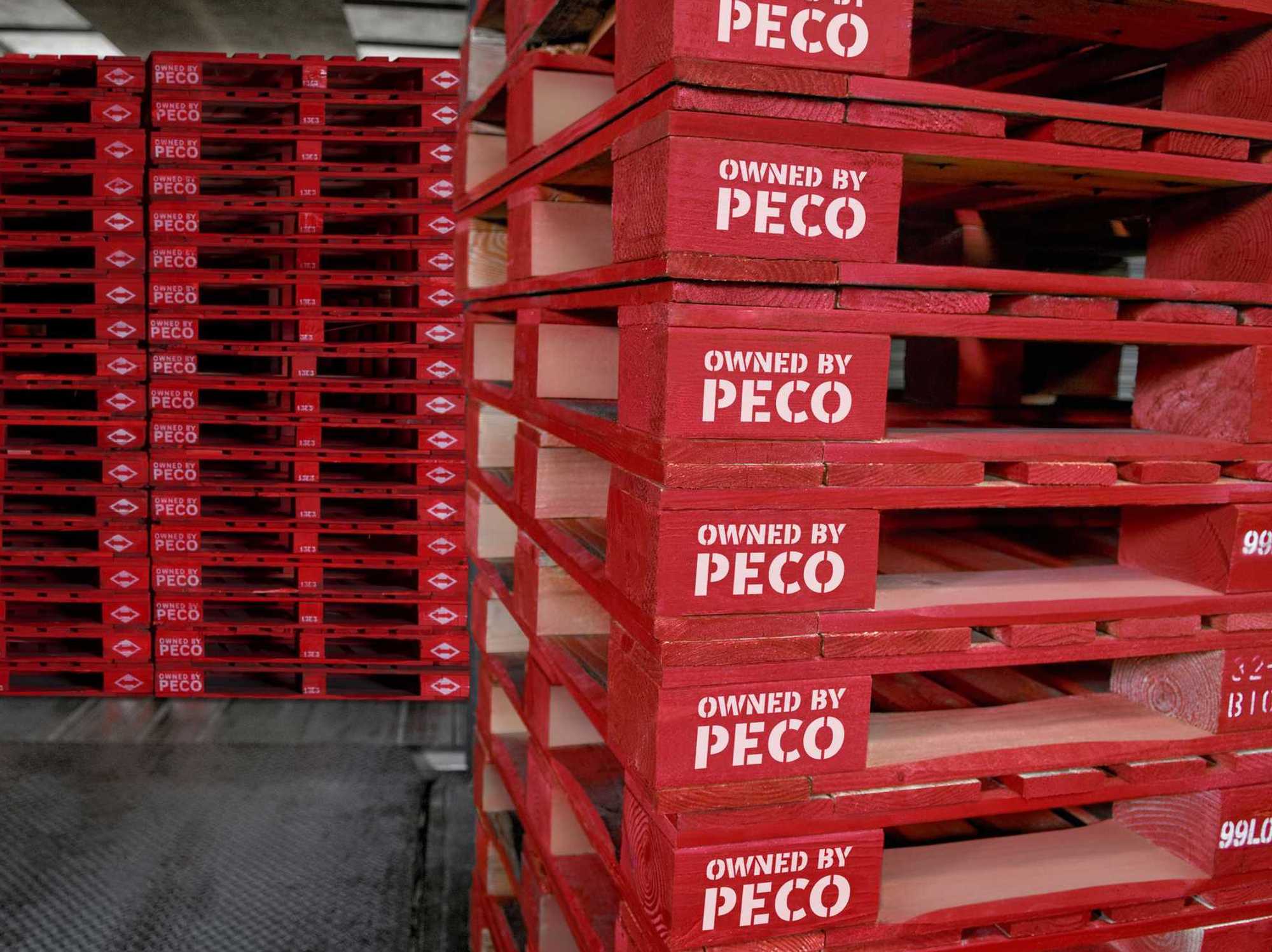
Katie Bishop, ESG (environmental, social, and governance) program manager for PECO Pallet, which operates one of North America’s largest rental pallet networks with tens of millions of its signature red, nine-block pallets in circulation, also cites the importance of having solid measurement tools in place; reliable, accurate data; and a commitment to sustainability led from the top.
In 2024, PECO completed its first companywide GHG inventory (of 2023 operations). With that foundation in place, it has set reduction targets and is able to produce an annual GHG inventory, which informs its five-year roadmap for emissions reduction. Those findings allow PECO to “measure more accurately [and] see where we are reducing [emissions] and where we have opportunity to improve,” she notes.
Among the activities on the drawing board are pilots for electric trucks and forklifts, conversion of facilities to renewable energy, reducing emissions from materials used in the maintenance and repair of pallets, and using advanced software to further optimize overall network efficiency to minimize route miles, fuel use, and the resulting emissions.
Sustainability isn’t new to PECO; it has been a core focus guiding how it operates “even before it was trending,” Bishop says. “And it is still part of our strategic plan every year.”
In addition to being a good steward of the environment, Bishop cites clear and compelling financial benefits, including lower costs and more-efficient operations, reduced energy and material use, and recycling programs that reduce waste going into landfills by instead taking retired pallets and converting them to landscape mulch.
While the current administration’s regulatory rollbacks have created some uncertainty, “that has not changed our overall approach or commitment to sustainable business practices,” Bishop says. The company has set a goal of achieving net zero emissions by 2050. “Sustainability is embedded in our culture and with our employees; their engagement is the key to our results and our success going forward.”
RECRUITING AN ADVANTAGE
It is a similar story at LTL carrier Pitt Ohio. “We see sustainability as core to our business strategy,” says Geoff Muessig, Pitt Ohio’s executive vice president and chief marketing officer. “It is an opportunity to drive engagement with customers and employees.”
He also is convinced that there is “a really strong business case for any asset-based [trucking] provider to figure out how to reduce carbon emissions.” For an LTL carrier, he adds, wages and salaries are the No. 1 cost bucket. No. 2 is fuel consumption.
Last year Pitt Ohio completed a major electrification project at its Harrisburg, Pennsylvania, terminal. Advanced charging infrastructure now supports electric trucks, forklifts, and passenger vehicles. The project enabled the deployment of Mack MD electric trucks, which are used in city and regional pickup and delivery.
Taken together, Pitt Ohio’s various initiatives are yielding results. Muessig notes that the company’s “carbon intensity metric” has improved each year as measured on a carbon emissions-per-shipment basis. That’s good news for Pitt Ohio’s customers, who include the trucker’s emissions as part of their own GHG reporting.
Muessig also has found a meaningful sustainability program can be a recruiting advantage. Drivers in Harrisburg rave about the electric trucks, citing their quiet operation and swift acceleration. Positive feedback also has come from potential employees considering Pitt Ohio for a career.
“I often ask candidates how they heard about Pitt Ohio,” Muessig shares. “They had read about our sustainability initiatives [and] were impressed with them, and that’s what attracted them to us,” he notes. “So there is this groundswell of interest in working for a company that has purpose beyond profit. A company that is doing business in the right way,” he concludes.
GREEN SHIPPING CORRIDORS
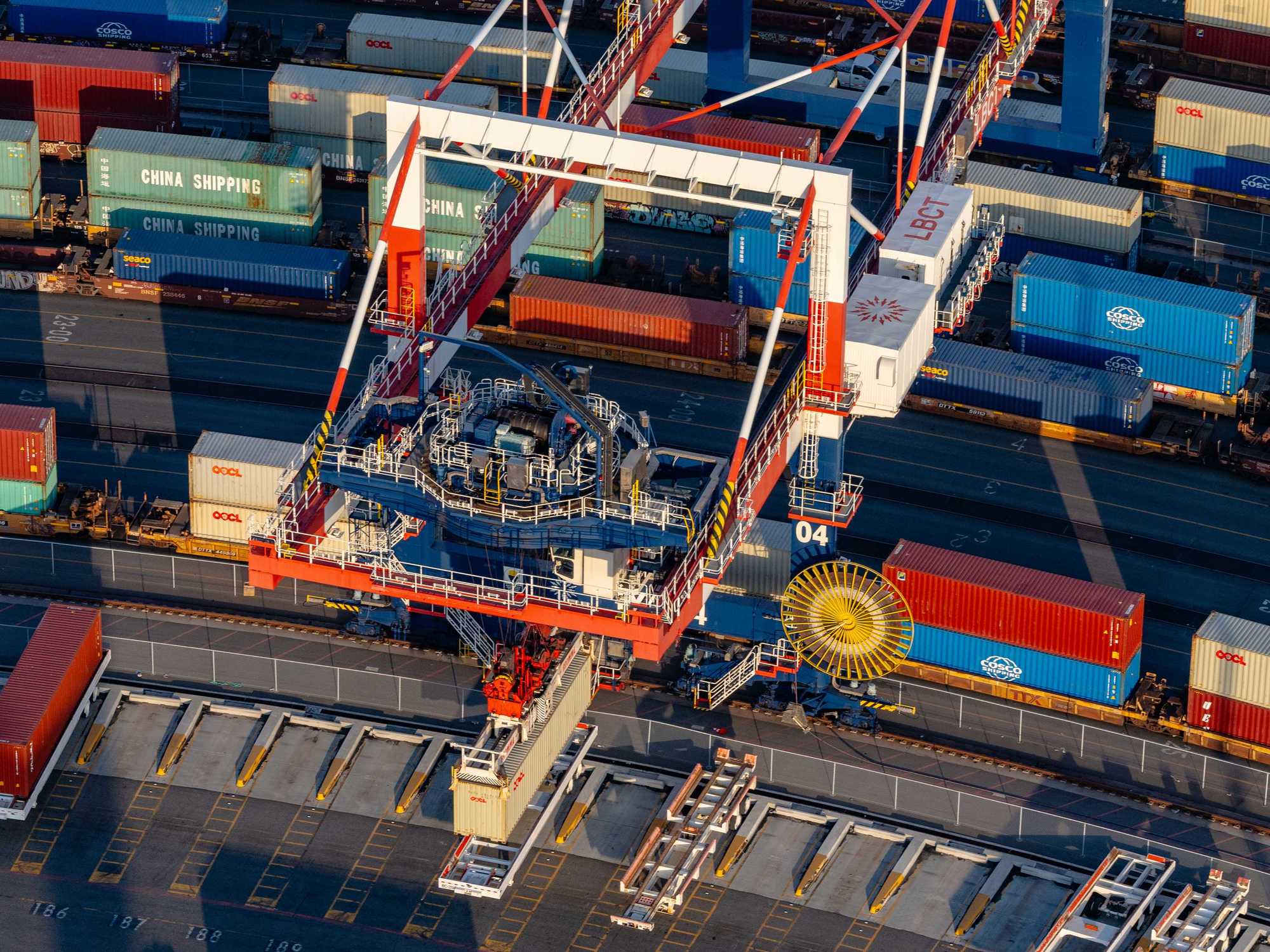
Perhaps one of the most impressive areas where sustainability initiatives are generating meaningful results is in ocean freight, particularly port operations. “Since 2005, according to our emissions inventory, emissions are down 70% to 90%, depending on the pollutant,” reports Dr. Noel Hacegaba, chief executive at the Port of Long Beach.
“We have not wavered from our goal to become a zero emissions port,” he says, adding “we’ve certainly faced headwinds in the past year as the federal government pulled back on funding and regulatory support for electrification. But we are still committed to building the ‘Green Port of the Future’” and reaching the zero emissions goal.
That goal isn’t pursued in a vacuum. Partnering with the ports of Los Angeles, Shanghai, and Singapore, Long Beach is promoting what it calls “green shipping corridors,” designed to accelerate the use of cargo vessels powered by clean fuels, like methanol. “We call it the ‘green print’ for decarbonizing trans-Pacific shipping, which is the busiest trade route in the world,” Hacegaba says.
As the port has pursued its sustainability journey, both the speed and scope of technology change have provided opportunities to advance goals, as well as hard-earned lessons. One key lesson, Hacegaba notes, is that “zero emissions operations are not simply an equipment swap-out. It requires a wholesale shift in how the port designs, operates, and builds facilities.”
Operators have to manage equipment differently to support extended fueling and charging windows. Yard layouts are reimagined to enable fast, easy charging and to accommodate extra electrical equipment in already space-constrained property. Technologies have to be tested and piloted ahead of time to prove their promise. Then there are questions to be answered about how sustainable and reliable electrical grid capacity is.
With an operation as complex and dynamic as a port, “there are always challenges,” Hacegaba says. Yet he emphasizes that the sustainability “wins” to-date are significant and progress is accelerating.
“We are finally on the cusp of having zero-emission trucks and equipment that can handle the tough port duty cycles,” he notes. As more of that equipment is deployed, he expects the journey to zero emissions to gain even more momentum. “Today, 20% of our cargo-handling equipment is zero emissions, and there are nearly 640 zero-emissions trucks servicing the port.”
BEING DATA DRIVEN
Bill Combs has spent over a decade deeply involved in large fleet operations and related sustainability initiatives. As senior vice president of sustainability for logistics services giant Penske, he’s worked at all of Penske’s divisions. Today he oversees an operation of dedicated and leased trucks under the Penske Transportation Solutions name that sits at 387,000-plus units.
In his view, sustainability is a function of deep and continuous collaboration across many stakeholders—OEMs, dedicated fleet customers, leasing customers, drivers, facility operators, maintenance and repair resources (Penske has some 970 shops around the U.S.), and technology. “It is hard work,” he says. “It’s not just you snap your fingers and it happens. You have to be data driven and constantly looking to innovate” in the solutions that drive sustainability results.
He and his team focus on comprehensive data collection and management, deriving lessons learned and trends from that data, converting those lessons into measurable actions, and then applying all that to understanding and continually lowering the total cost of ownership—and providing customers with the lowest cost to operate, reliably and consistently.
One tactical example he gives is tires. Penske retreads 96% of its tires at least once or twice during their lifecycle. “One retreaded tire uses 15 gallons less in fuel than a virgin tire,” he notes. Another area is lubricants. One-hundred percent of oils and other lubricants are reclaimed and re-refined. Even diesel particulate filters, rather than being tossed out after one use cycle, are cleaned and reused several times.
This aggressive, comprehensive approach to sustainability is delivering results. Over the 10-year period from 2014 to 2024, Penske reduced emissions per metric ton mile by 21%.
“We look at sustainability as a function of innovating the business, not just reducing our carbon footprint,” Combs says. “It’s important for many reasons, but at the end of the day, we have to be practical about it. We still have to stay in business and make a profit.”
