Support CleanTechnica’s work through a Substack subscription or on Stripe.
Or support our Kickstarter campaign!
Wasting time and taxpayer money yet again, US President Trump has suffered yet another blow in his war against the domestic offshore wind industry. On January 27, a federal judge allowed work to resume on the massive, 800-megawatt Vineyard Wind project in Massachusetts, staying a stop-work order issued by the Trump administration. It the fourth such defeat for the President in recent days.
Yet Another Victory For The US Offshore Wind Industry
To be clear, Trump has already done considerable damage to the domestic offshore wind industry. Virtually the entire industry depends on offshore leases administered by the Bureau of Ocean Energy Management in the Department of the Interior. Upon taking office last year, Trump ordered a halt to new lease approvals. The Interior Department and the Environmental Protection Agency also took steps to halt projects that had leases in hand but were still in the development stage. Earlier this year, the administration also ordered work to stop on two projects already under construction. Both were allowed to resume work after taking their case to federal court.
On December 8, a federal judge ruled that the President has the authority to stop issuing new leases. However, the same judge also ruled that the President can’t obstruct lease-holders from pursuing their projects to completion, at least not without a good reason.
Just two weeks later, on December 22, BOEM chief Matt Giacona issued a stop-work order against Vineyard Wind and four other wind farms under construction along the Atlantic coast, citing an unspecified national security emergency related to wind turbine operation as the good reason to stop work on the five significant energy infrastructure projects and throw a total of 8 new gigawatts of power generation out the window at a time with the nation is thirsty for more electricity (see more stop-work background here).
Just a few weeks later, courts have ruled in favor of four of the five projects, making it more likely that the fifth project, Sunrise Wind in New York, will also get the green light. In addition to the Vineyard Wind decision, other three to get the go-ahead in court this month are Revolution Wind in Rhode Island, Coastal Virginia Offshore Wind, and Empire Wind in New York.
Judge To Trump: Ohfergawdsakes
The stop-work case against Vineyard Wind was particularly weak. The project wasn’t merely deep into construction, it was practically complete. The developer was on track to meet a deadline of March 31 this year.
What tipped the judicial scales, though, is the fact that 44 of the wind farm’s 62 turbines were already in operation and delivering electricity to the grid, with some up and running as far back as last summer. Giacona acknowledged the situation on December 22, when he separately informed Vineyard Wind that it could keep the 44 turbines running even while ordering work to stop elsewhere on the site.
US District Court Judge Brian E. Murphy pounced on the disconnect when he issued a stay of the stop-work on January 27. “ If the government’s concern is the operation of these facilities, allowing the ongoing operation of the 44 turbines while prohibiting the repair of the existing turbines and the completion of the 18 additional turbines is irrational,” Judge Murphy said, as reported by the WBUR.
As reported by WBUR, Murphy’s decision was further informed by the timing of Giacona’s order. The Department of Defense reportedly provided the Interior Department with classified information leading to the stop-work order back in November. Murphy ruled that the delay undermined BOEM’s case for an urgent emergency.
After all, if it’s that urgent, why keep everyone in the dark for weeks on end. That’s what the governors of the impacted states were wondering. They never heard a word about any danger to their citizens from BOEM or the Defense Department until Giacona issued the stop-work order.
Back To Work For The US Offshore Wind Industry
On its part, Vineyard Wind refrained from doing a victory dance. As in the other three offshore cases, Murphy issued a temporary stay of the stop-work order, so the ball is back in BOEM’s court. “As the legal process proceeds, Vineyard Wind will continue to work with the Administration to understand the matters raised in the Order,” Vineyard Wind explained in a press statement on January 27.
“Vineyard Wind will focus on working in coordination with its contractors, the federal government, and other relevant stakeholders and authorities to safely restart activities,” they added.
Other offshore wind stakeholders were not so restrained. The trade organization Oceantic Network, for example, took the opportunity to go to bat for all five projects.
“Once operational, the five projects are expected to bring 8 GW of much-needed power generation online, enough for 2.5 million homes, and to help the states keep rising power costs in check,” the organization stated.
“Stopping these projects means $30 billion of fully permitted economic activity has been paused and threatens more than $11 billion in supply chain assets that have spun up to support construction,” they added, while also taking note of the 12,000 jobs under threat from the stop-work order.
Women & The Offshore Wind War
Coincidentally or not, the President’s well-known antipathy towards wind turbines also puts him at odds with the march of women up the ladder of power. Four of the five offshore wind projects are located in states with female governors. Along with Kathy Hochul of New York and Maura Healey of Massachusetts, who already hold office, voters in Virginia also elected Abigail Spanberger to replace term-limited Greg Youngkin (New York has two projects, so that makes four all together).
That’s…interesting! If you have any thoughts about that, drop a note in the comment thread. Meanwhile, stay tuned for news about Sunrise Wind, which is scheduled to get its day in court on February 2.
It will also be interesting to see what happens to the offshore wind industry over in New Jersey, where voters chose Mikie Sherrill to take over from term-limited former Governor Phil Murphy last fall. Murphy laid the groundwork to kickstart a home state offshore industry during his eight years in office, including an onshore turbine manufacturing hub on the Delaware River. However, the effort foundered when Trump took office last year.
During her campaign for office, Sherrill was pretty quiet on the topic of offshore wind, preferring to focus her energy on stimulating New Jersey’s already hyperactive solar industry. Odds are that the state’s offshore wind resources will remain dormant, at least until January 20, 2029, when Trump is scheduled to leave office — peacefully one hopes, this time.
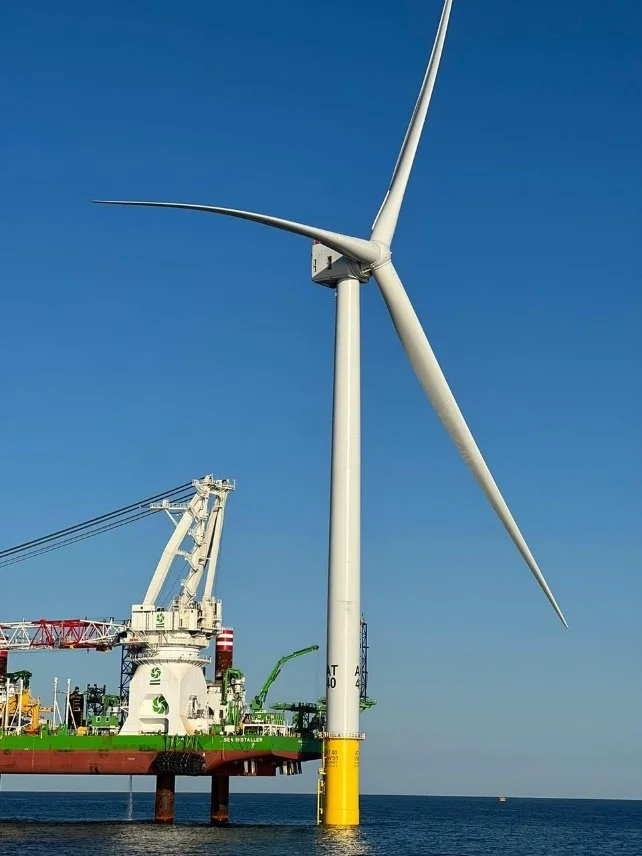
Photo: The 800-megawatt Vineyard Wind offshore wind project is back on track for completion by March 31, now that a federal judge has stayed a stop-work order issued by the Trump administration (cropped, courtesy of Vineyard Wind).
Support CleanTechnica via Kickstarter

Sign up for CleanTechnica’s Weekly Substack for Zach and Scott’s in-depth analyses and high level summaries, sign up for our daily newsletter, and follow us on Google News!
Have a tip for CleanTechnica? Want to advertise? Want to suggest a guest for our CleanTech Talk podcast? Contact us here.
Sign up for our daily newsletter for 15 new cleantech stories a day. Or sign up for our weekly one on top stories of the week if daily is too frequent.
CleanTechnica uses affiliate links. See our policy here.
CleanTechnica’s Comment Policy