


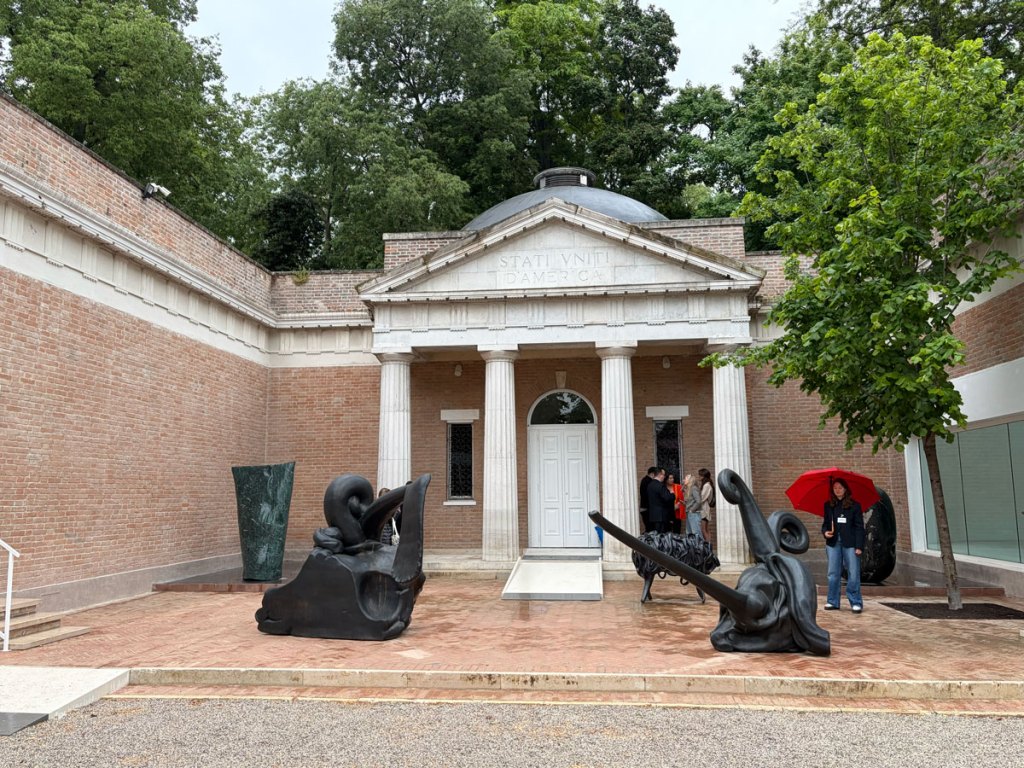
Despite months of controversy, the United States managed to get Alma Allen‘s enormous sculptures to Venice for this year’s Biennale. Getting them home, however, is proving more difficult.
The American Arts Conservancy, the nonprofit behind the US Pavilion, is roughly $1 million short of the funds needed to cover the exhibition’s costs, including dismantling the show and shipping the artworks back to the US, according to a report in The New York Times.
Jenni Parido, the pavilion’s commissioner, has been appealing to potential donors for help. In a letter obtained by the Times, she acknowledged that the final stages of the project had become difficult.
“While we have accomplished a tremendous amount in a relatively short period,” Parido wrote, “the final phase of this undertaking has presented financial challenges that I am working tirelessly to resolve.”
The American Arts Conservancy, which Parido runs, has brought in $1.4 million against a projected budget of just under $2.5 million. That shortfall has left it without the funds to store the massive stone and metal sculptures or ship them back to the US. The problem is growing more urgent, as the Biennale is due to close next month. There’s no obvious place nearby to put them, either: the US Pavilion has no storage facilities, and the Guggenheim Foundation, which owns the building, doesn’t have room for them.
The funding troubles add another chapter to what has already been an unusually messy American outing at the Biennale.
Parido, whose previous business experience included running an upscale pet boutique in Florida, was a surprise choice to oversee the US Pavilion. The Trump administration had scrapped the traditional selection process, which relied on proposals from established arts institutions and an independent review panel. Parido got the job after being recommended by her friend Erin Scavino, who heads the State Department’s Art in Embassies program.
The organizers eventually landed on Allen, an American sculptor based in Mexico, after several artists reportedly turned down the opportunity. Things didn’t go smoothly from there.
Allen told the Times that neither Parido nor the exhibition’s curator, Jeffrey Uslip, visited his studio to see the sculptures before the show. By the time the Biennale’s preview days were over, Allen and Uslip were no longer speaking.
As for the financial predicament, Allen said he knew nothing about the nonprofit’s fundraising. His own expenses, he said, amounted to travel and a cheap Airbnb, for which he was reimbursed.
The organizers had initially pitched the exhibition’s modest price tag as a selling point, calling it one of the cheapest US pavilions ever mounted. For comparison, the 2024 American presentation cost about $5 million, while the 2022 edition came in at nearly $7 million.
The State Department provided a $375,000 grant toward the pavilion, with private donors expected to cover the rest. Parido’s fundraising efforts included a party during Art Basel Miami Beach and a dinner at Mar-a-Lago. The department told the Times it wasn’t involved in raising the money.
For now, it’s unclear what happens if Parido can’t close the million dollar gap. The American Arts Conservancy didn’t answer the Times‘ questions about what it would do if it couldn’t afford to bring the sculptures home.
Katy Siegel, who helped organize the 2017 American pavilion, had a rather pithy assessment of the situation.
“This is crazy,” she told the Times.
