



“The money runs out but the title remains.…” observed the original head of the John Simon Guggenheim Memorial Foundation, adding: “Once a Guggenheim fellow, always a Guggenheim fellow.”1 Beyond the resources during the funding term, these types of fellowships offer acclaim and recognition that recipients carry for years to come, either reaffirming their existing presence in elite circles or, for a more limited number, entrée into those circles. In fact, across a variety of fellowships in the arts, humanities, and social sciences, our research shows that a majority of the recipients of “the title” work at a small cadre of prominent universities.
Look to the most recent round of Guggenheim recipients: if 100 years of data are any indication, then an outsized share of the new recipients work at the most renowned universities in the US. Over time and across fellowships, the high prevalence of winners from well-resourced, high-status institutions can understandably bring to mind Percy Bysshe Shelley’s adage that “the rich have become richer.”
Indeed, sociological research suggests that it is the people who already have considerable money, status, or both that are more likely to win grants, fellowships, and awards, especially more prestigious honors that enhance the cultural cachet of recipients. This tendency exists due to the ways that social networks, cumulative advantages, and access to greater resources play a role in the preparation of the application, recommender solicitation, and ultimate selection process. And, once you’ve won an award, you’re much more likely to win another.
Resource and status differentials do not detract from the work people have put into their scholarship and creative pursuits. At the same time, it strains credulity to believe that fellowship winners are definitively the “best” in their fields. Even Nobel Prize selection committee members admit that they “are perfectly aware of the fact that it is impossible to discover who is best … All one can do is to try to find a particularly worthy candidate.” Finding that “worthy candidate” when there are so many potential winners often involves using shortcuts to assess excellence or potential for greatness. And part of those shortcuts includes the reputation of the organization where someone works.
Scholars and government agencies have primarily examined this phenomenon by investigating bench or lab scientists and Nobel Prize winners, which is particularly understandable given the large volume of funding historically available from organizations such as the National Institutes of Health and National Science Foundation. Researchers have also found that professors who work in departments with other well-known scholars benefit from that association with increased engagement with their work. Focusing on the humanities and social sciences, sociologist Michèle Lamont explored the mechanisms of the peer review process that undergirds interdisciplinary fellowships and grants. Throughout years of observation and interviews, she found that many peer reviewers “believe that private, elite, and research-focused universities are privileged in the competition process.”
Yet we could not find clear evidence on the historical trends of the institutional affiliation of the recipients of prestigious fellowships in the arts, humanities, and social sciences. So we decided to examine it ourselves.2
The composition of fellowship winners matters even more because of the increased uncertainty about federal funding for the creative arts, humanities, and social sciences from entities like the National Endowment for the Humanities. Against this backdrop, it is natural to wonder where such funding has historically been directed—particularly for the types of exclusive fellowships that afford recipients the funding, flexibility, and collaborative environments that can facilitate breakthrough works. Unfortunately, the types of people for whom such fellowships might represent the greatest departure from their everyday experience—and whose career trajectories might be most dramatically shifted given freedom from their usual constraints—are infrequently their beneficiaries.
As part of an ongoing research project upon which we embarked about eight months ago, we have catalogued the affiliation at time of first award for nearly 30,000 fellowships awarded by the Guggenheim and five other fellowship programs for which any individual in the arts, humanities, or social sciences can apply. Though the precise details of each fellowship program differ, the six programs we examined generally last for a meaningful period of time (one semester to two years); provide fellows with wide latitude to pursue work on a topic of their choosing; offer financial awards of $50,000 or more; and provide extensive opportunities for networking and collaboration.
Among the fellowship programs we examined, the longest-running comes from the Guggenheim Foundation.3 Providing a substantial portion of the field-initiated fellowships in the creative arts, humanities, and social sciences outside of the federal government over the past century, the Guggenheim Foundation “offers [f]ellowships to exceptional individuals in pursuit of scholarship in any field of knowledge and creation in any art form, under the freest possible conditions.” In its 101-year history, the foundation has awarded fellowships continuously, providing over 21,000 fellowships to nearly 20,000 people, including luminaries like Langston Hughes, James Baldwin, Zora Neale Hurston, Martha Graham, Merce Cunningham, and Aaron Copland. From its founding, as documented in its first annual report, the foundation committed to funding “men or women … irrespective of race, color, or creed.”
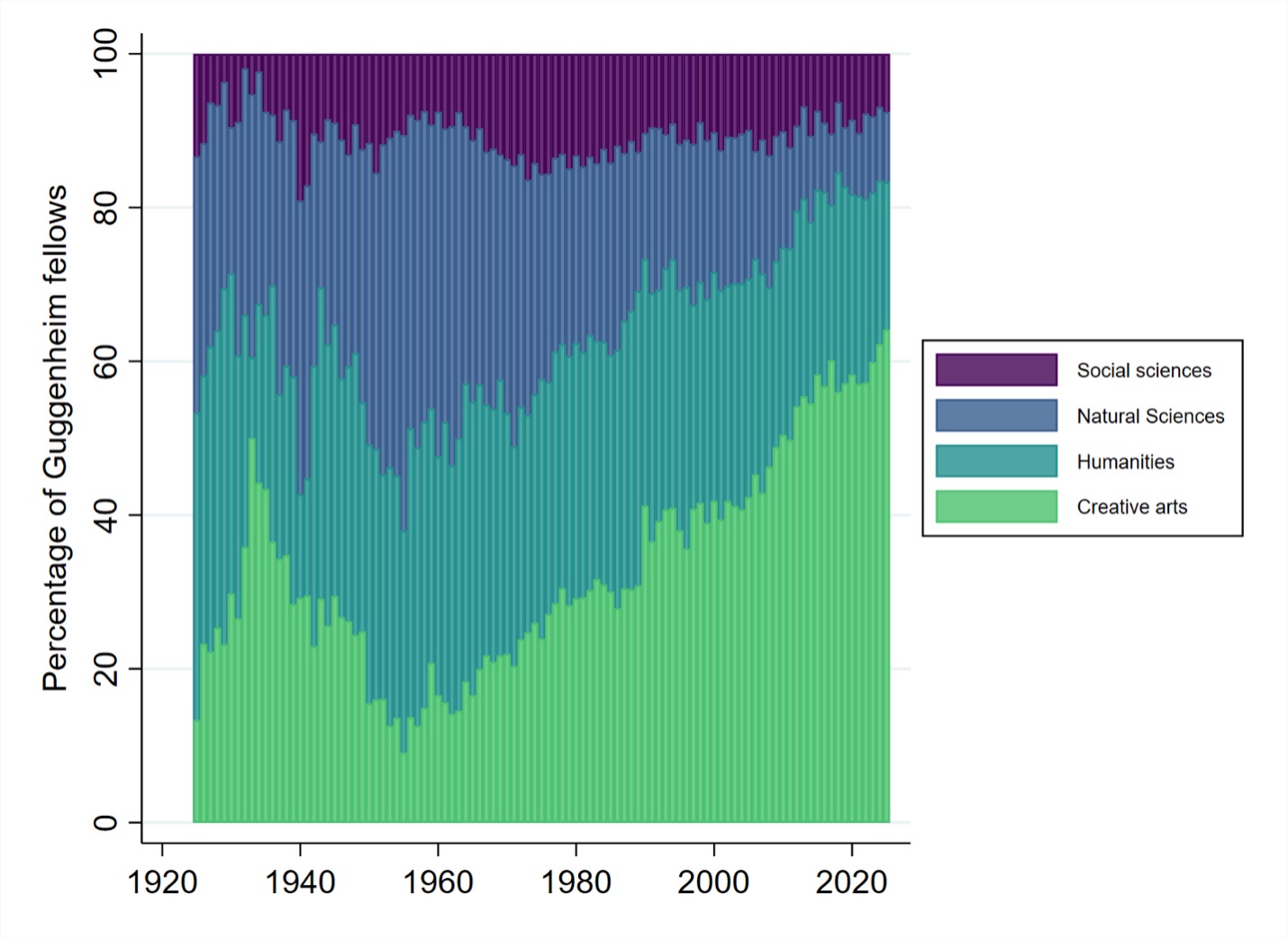
The number of fellowships awarded by the Guggenheim has fluctuated widely, ranging from a low of 15 in its first year to a high water mark of nearly 400 in 1972. The heady days of awarding more than 300 fellowships in a single year have long passed (see Figure 1). In recent years, the number of awards has stabilized to roughly 170 to 200 fellowships per year. The Guggenheim awards fellowships that fall into four broad categories: the creative arts, humanities, natural sciences, and social sciences. Since the 1950s, the foundation has gradually increased its share of funding to the creative arts, with the largest reduction coming from fellowships in the natural sciences (see Figure 2).
Funding like the Guggenheim’s is particularly important within the political economy of the creative arts and research because it can be field-initiated, which means the program welcomes applications from anyone who chooses to apply. In contrast, some other private foundations primarily award funds to people who have been pre-selected to apply or do not allow applications at all (such as the MacArthur, Mellon, Gates, and Hewlett foundations), which restricts the pool of applicants in the expected ways.
In short, grants like the Guggenheim are meant to support the conditions that can help spur pathbreaking scholarship and creativity: the types of “life of the mind” activities that often prove elusive in the typical working environment. Such fellowships include the Guggenheim but also others like the Stanford-based Center for Advanced Study in the Behavioral Sciences (CASBS), the National Humanities Center (NHC), the National Academy of Education Postdoctoral Fellowship (NAEd), the Russell Sage Foundation Visiting Scholars Program (RSF), and Harvard’s Radcliffe Institute for Advanced Study (Radcliffe).4 In terms of scale, it is worth bearing in mind that none of these fellowships have awarded nearly as many as the Guggenheim (the next largest, CASBS, has provided a little over 3,000 since its inception).5 Across all of these funders, 300 to 400 fellowships have been awarded every year since the 1950s. Winners of one of these fellowships are more likely to be winners of one of the others. For example, Michèle Lamont, whom we mentioned earlier, has been a Guggenheim, CASBS, Radcliffe, and RSF fellow.
As scholars of higher education, our interest in better understanding the institutional affiliations of fellowship winners was rooted in an expectation that the vast majority of these fellowship recipients have been based at a US college or university. Our investigation confirms that US university affiliation is the predominant affiliation at time of first award across all of the fellowships, with approximately three-quarters holding such a position (see Figure 3).

All told, only two fellowships had less than 80 percent US university affiliations: the Guggenheim, which has prioritized the creative arts more in recent years while also reducing the number of fellowships overall, and Radcliffe. We explored the affiliations of the other winners and found a mix of international university affiliations, visual and performing artists, writers, journalists, and independent scholars, among others. Overall, then, the patterns we can observe for those with a US university affiliation actually speak to the experiences of the vast majority of winners for these fellowships. In turn, exploring these affiliations can shed light on the types of institutions that have the greatest familiarity and “success” with prominent fellowships, which are poised to attract even more applicants amid increased federal funding uncertainty.
Funders get to decide how they identify that talent—and, equally importantly, whose talent they choose to cultivate.
The Data
Looking at all fellowships for the full time period from 1925 to 2025, we find that the five most common university affiliations for grant recipients were—perhaps unsurprisingly—Harvard, the University of California–Berkeley, Columbia, Stanford, and Yale (Table 1).6 When examining the subset of years when all fellowships were available (2000 to 2025; Table 2), only two of the top five institutional affiliations differ from the overall top five: fourth-ranked New York University and fifth-ranked Princeton (replacing Berkeley and Yale). Whether examining the full time span of these fellowships or only more recent decades, these findings demonstrate that the top five institutions are some of the highest-status and best-resourced colleges in the US.
| Overall | CASBS | Guggenheim | NAEd | NHC | Radcliffe | RSF | |
| 1 | Harvard | Stanford | UC Berkeley | Wisconsin | Duke | Harvard | Columbia |
| 2 | UC Berkeley | UC Berkeley | Harvard | NYU | UNC | MIT | Princeton |
| 3 | Columbia | Michigan | Columbia | Harvard | Columbia | Brown | NYU |
| 4 | Stanford | Harvard | Yale | UPenn | NC State | Columbia | Michigan |
| 5 | Yale | Chicago | Princeton | Michigan | Northwestern | BU | UCLA |
| Brandeis | |||||||
| Tufts |
| Overall | CASBS | Guggenheim | NAEd | NHC | Radcliffe | RSF | |
| 1 | Harvard | Stanford | Columbia | Wisconsin | UNC | Harvard | Columbia |
| 2 | Columbia | UC Berkeley | Princeton | Harvard | Duke | MIT | Princeton |
| 3 | Stanford | Michigan | NYU | NYU | NC State | Brown | NYU |
| 4 | NYU | UCLA | Harvard | UC Irvine | Notre Dame | Columbia | Michigan |
| 5 | Princeton | Princeton | UCLA | UPenn | UC Berkeley | BU | UCLA |
| Indiana | Brandeis | ||||||
| Tufts |
Tables 1 and 2 also highlight some clear regional patterns in the top five US university affiliations within fellowships. The CASBS, NHC, Radcliffe, and RSF fellowships have a residential component, which likely contributes to the increased concentration of fellows affiliated with nearby universities. The CASBS is the only fellowship to include Stanford, Radcliffe has more Boston-area institutions, and RSF has several New York–based institutions among the top five. The NHC, which is based in North Carolina, is the only fellowship to include any institution in the South among its top five university affiliations. Interestingly, even though the Guggenheim does not have a residential component, it also has multiple New York–based institutions, which may relate to the strong concentration of creative arts in the area. Meanwhile, the NAEd is the only fellowship program that does not show a clear regional pattern among its top five institutional affiliations.
Of note, we included the NAEd fellowship because the interdisciplinary field of education is one of the most racially and socioeconomically diverse fields of research, as indicated by reports from the American Academy of Arts & Sciences and other scholarship. In alignment with our supposition, the NAEd fellowship does show evidence of being less status-focused than the others we examined. To be clear, this fellowship still shows a clear preference for high-status institutions, but it is the only fellowship to consistently have a public university as its top institutional affiliation, and it has the highest share of US university affiliations that are public (64 percent, with NHC the next highest at 52 percent). It also is one of only two fellowships that has been awarded to people working at community colleges (the other being the Guggenheim).
Ultimately, it is most helpful to understand not just the relative rankings but also the share of fellowships awarded to individuals at the corresponding institutions. To explore this, we dug deeper on institutional affiliation, finding substantial variation in the percentage of fellows with the top institutional affiliation for each fellowship (Figure 4). Radcliffe has the highest share, with over 20 percent of fellows having a Harvard affiliation at the time of first award. In addition, both RSF and CASBS have at least 10 percent of fellows from a single institution (Columbia and Stanford, respectively). On the opposite end, the Guggenheim and NAEd have the smallest percentage of fellows with the top affiliation at slightly under 5 percent.

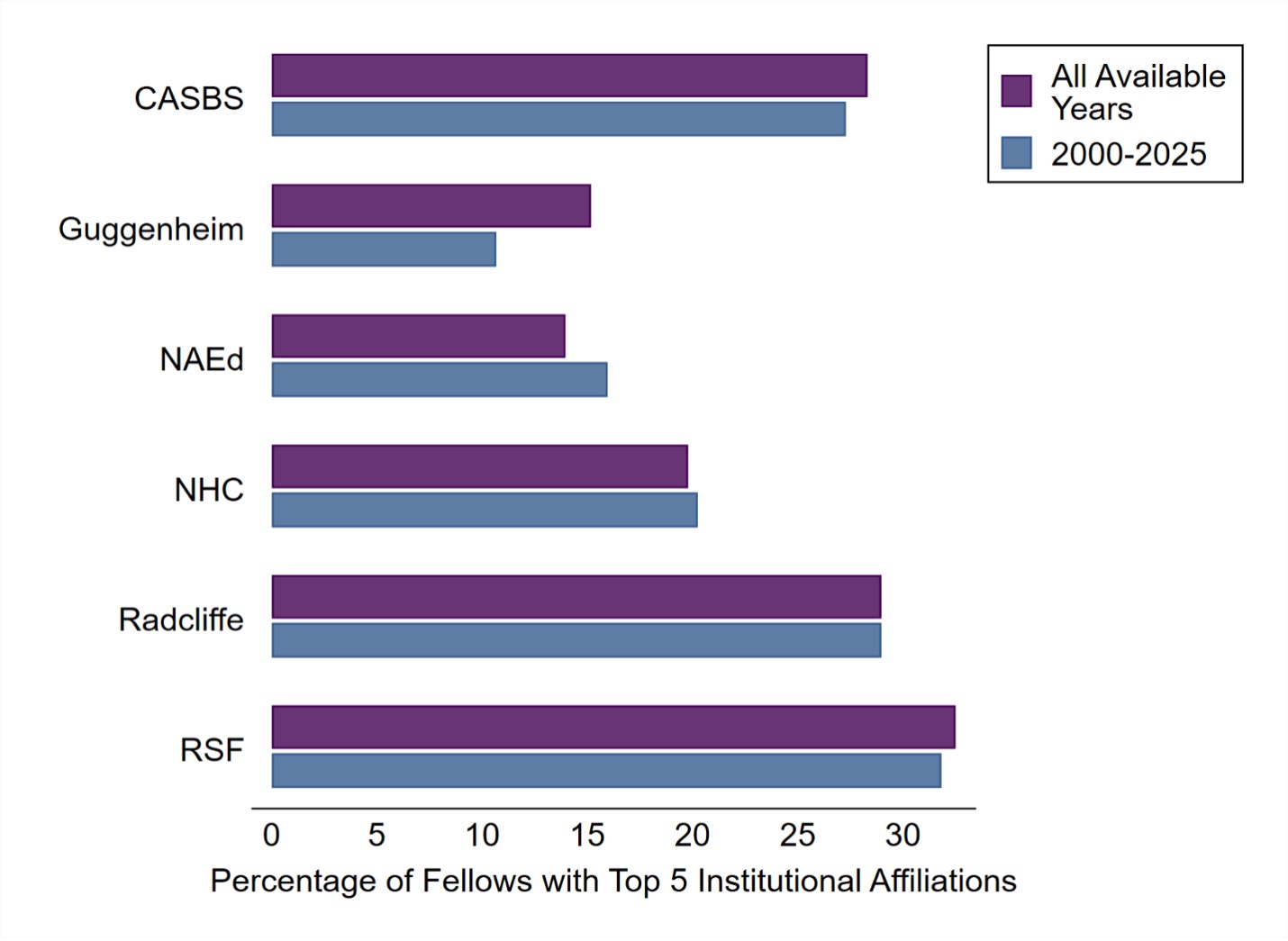
We see the same stark divide in institutional affiliations when we expand to the percentage of fellows with the top five institutional affiliations (Figure 5).7 For CASBS, RSF, and Radcliffe, about 30 percent of all fellows (whether looking across the lifetime of the fellowship or since 2000) have one of the top five institutional affiliations. For context, these institutions have employed only about 1.5–2 percent of faculty overall in the US in the last few decades.
In an attempt to drill down into the stability of the status hierarchy, we trace the rankings over time of the top 10 institutions from 2025 across all of the fellowships (Figure 6). There is some movement in these rankings, but they are generally fairly consistent, particularly for a country with thousands of colleges and universities. Five of the eventual top 10 start in the top 10 and three were tied just outside the top 20. Since the 1980s, every eventual top 10 institution has been ranked somewhere within the top 20 institutions regarding institutional affiliation.
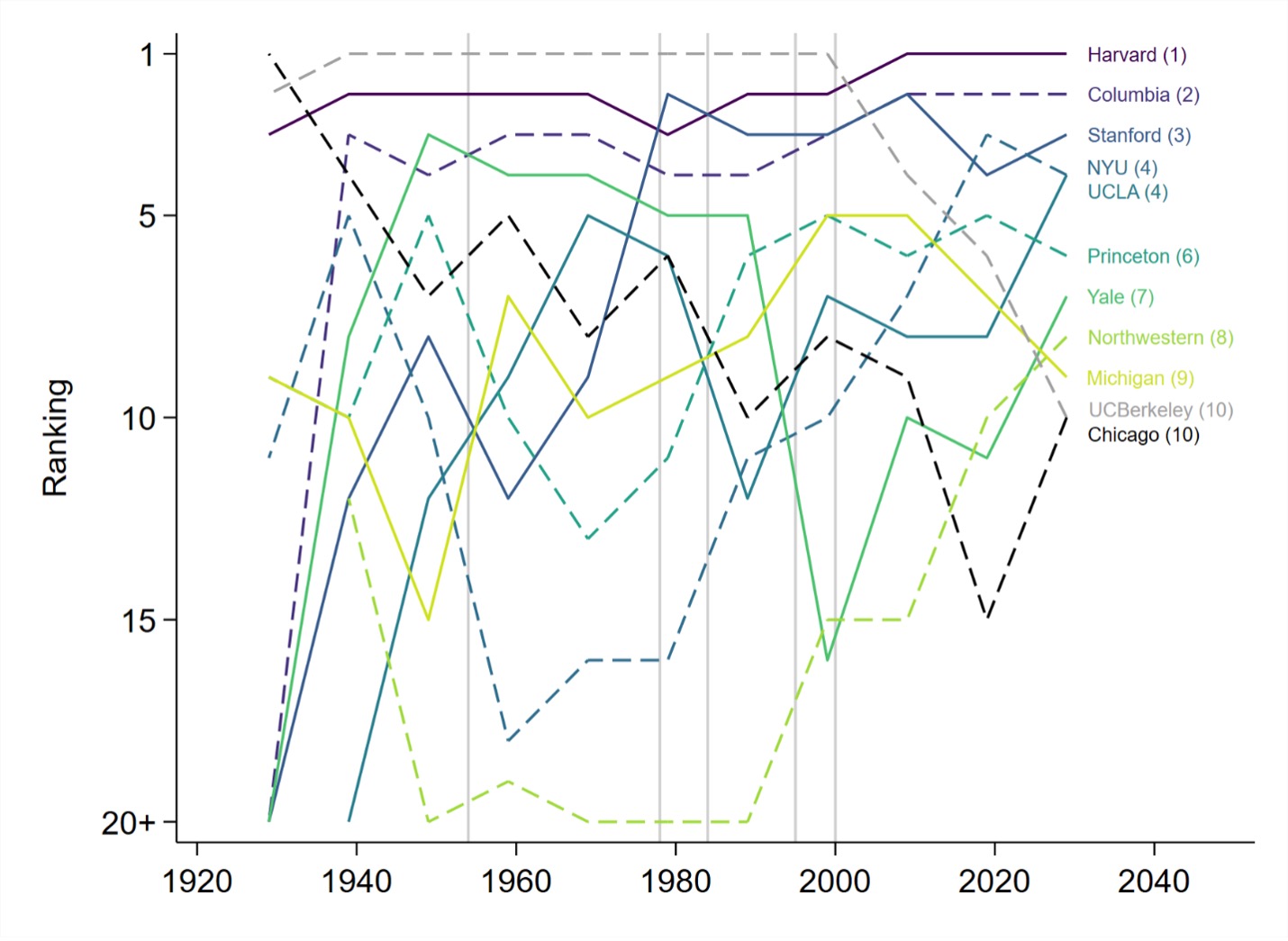
That means that, for four and a half decades, the top institutions for university affiliation have remained at the top. The acceptance rates for such fellowships are quite low, and the organizations themselves often acknowledge that they receive many more qualified applications than they can fund. Under these conditions, it seems inevitable that arbitrary distinctions come into play at some point in the selection process. Even so, the hierarchy has been remarkably durable across time.
The fact that these institutional affiliations remain so dominant suggests that a series of decisions, preferences, and resource constraints tend to favor applicants with higher-status affiliations. One contributing factor, of course, is the likely prospect that the people who apply to these fellowships disproportionately work at high-status, well-resourced universities.
People who work at better-resourced universities may also very well have different track records precisely because they have more support routinely available to them (some get a portion of an assistant’s time, others get funds for students to help conduct research, etc.). For instance, universities with a substantial number of winners often have structures for sharing winning materials and established processes for reviewing each applicant’s draft application materials, streamlining the pathway to a fellowship for those at well-connected universities. Further, several institutions—such as Columbia, Notre Dame, the University of California–Los Angeles, the University of Texas at Austin, and the University of Wisconsin–Madison—even have the financial resources to match funding from certain high-priority fellowships, resulting in a world where people nominally winning the same size award can actually receive different funding amounts.
The strong relationship between the status of an applicant’s institutional affiliation and their chances of winning one of these prestigious fellowships is clear. Such outcomes can result in self-reinforcing cycles, with prospective applicants with less prestigious affiliations deterred from submitting applications in the first place or, as shown in prior research, electing to not apply again after receiving an initial rejection. These dynamics create the risk of missing pivotal opportunities to support the very types of groundbreaking new work that the fellowships were designed to help flourish.
The history of these fellowships suggests a tendency toward, in the words of noted sociologist Robert K. Merton (himself a Guggenheim and CASBS fellow), “the accruing of greater increments of recognition for particular scientific contributions to scientists of considerable repute and the withholding of such recognition from scientists who have not yet made their mark.” Merton built this insight off the research of Harriet Zuckerman—a distinguished sociologist in her own right who was also a Guggenheim and CASBS fellow—whom Merton later acknowledged should have received co-authorship on the original paper but did not (perhaps because she was a student and thus the less prestigious scholar at the time).
An increasing number of scholars and artists are likely to pursue these fellowship opportunities in the wake of disruptions in federal funding. Private funders’ choices will play a key role in determining which scholars are able to explore under the “freest possible conditions,” in the process revealing their vision for the future of research and creative pursuits. There is no shortage of talent and brilliance across the country and the larger world. Funders get to decide how they identify that talent—and, equally importantly, whose talent they choose to cultivate.
The historical trends show that the longstanding methods of selection, which often overlook the cumulative advantages provided by prestigious institutional affiliation, tend to coincidentally find talent in the same places, year after year. Ignoring this reality will result in replicating the status hierarchy of the past decades, all too often rewarding those already flush with resources at the risk of slowing or even halting innovative work from those less well-connected. 
This article was commissioned by Dan Sinykin.
