


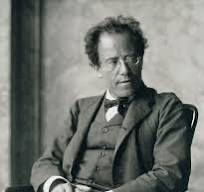
The critic Henry Krehbiel notoriously called Gustav Mahler’s New York career a failure, undone by “foolishness and naivete.” Most accounts of Mahler’s life take issue with this opinion, or refuse to take it seriously. But Krehbiel knew what he was talking about.
At the Colorado Mahlerfest last May, Krehbiel and his Mahler verdict were debated. The debaters were Hilan Warshaw (director of a Mahler-in-New-York documentary film screened at the festival), and myself (author of a Mahler-in-New-York novel and also of a new play produced at the festival). You can see the action here (with Thomas Tape as referee):
Hilan’s argument begins at 13:05, my rebuttal at 22:36. We tackle Krehbiel separately beginning at 32:25.
Hilan claims that Mahler’s accomplishments at the Met and the New York Philharmonic were “huge” and that he “clearly loved America.”
I less quibbled with these claims – Mahler was of course a man of immense talent and energy — than added context. Krehbiel was looking for a cultural leader to help shepherd the nation’s nascent classical music culture – in particular, its fledgling composers. Compared to Anton Seidl and Antonin Dvorak, whose New York careers (1885 to 1898) cast long shadows, Mahler lived inside his own head. Dvorak, given his proclivities, was bound to compose a descriptive New World Symphony. Mahler’s creative response to his environment – notably, to forests and mountains – was preponderantly interior. Seidl took American citizenship, summered in the Catskills when he wasn’t conducting fourteen times weekly on Coney Island, led all-American programs, tutored American composers, and hung out daily with Dvorak at Fleischmann’s Café. Mahler did none of those things. Krehbiel cherished personal memories of Seidl and Dvorak both. Mahler was a different species.
A disagreement early in Mahler’s New York Philharmonic tenure encapsulated their differences. In later life, Krehbiel testified that the supreme honor of his professional career was assisting Dvorak in the New York success of his New World Symphony. He had met with the composer, who supplied commentary and musical examples (an encounter I envision in my new novel The Disciple: A Wagnerian Tale of the Gilded Age). Krehbiel deployed these musical citations in a profusely detailed New York Tribune introduction to the work, prepping an audience for a great event. He saw himself as a cultural custodian.
In fact, Krehbiel had his hands in all aspects of the young nation’s musical life. He wrote the first book musically examining African-American folk song. He acclaimed the complex rhythms of Dahomian drummers at the World Columbian Exposition (dismissed by other writers as “savages”), and likewise esteemed Jewish and Native-American song. He translated Parsifal into English so the Met could continue performing it during World War I. He wrote the most-used layman’s guide for musical novices. The list is endless. In fact, he cannot be categorized as a “critic.”
That Krehbiel was also program annotator of the New York Philharmonic should therefore not be written off as a “conflict of interest.” Rather, it was an opportunity. In that capacity, he requested the composer’s assistance annotating Mahler’s First Symphony for its first American premiere, led by the composer. Specifically, he requested permission to quote a letter in which Mahler disclosed a program for the symphony (in an earlier form). Mahler said no. Krehbiel’s frustration may be gauged from the hilarious program note he supplied. It read in part:
“In deference to the wish of Mr. Mahler, the annotator of the Philharmonic Society’s programmes refrains from even an outline analysis of the symphony which he is performing for the first time in New York on this occasion as also from an attempt to suggest what might be or has been set forth as its possible poetical, dramatic, or emotional contents. . . Mr. Mahler’s conviction, frequently expressed publicly as well as privately, is that it is a hindrance to appreciation to read an analysis which with the help of musical examples lays bare the contents and structure of a composition while it is playing. All interest and attention should be concentrated on the music itself. . . . All writings about music, even those of musicians themselves, he holds to be injurious to musical enjoyment.”
As I insist in my debate with Hilan, none of my Mahler observations “are to be held against him.” He was put on earth to compose great symphonies, not to preside over the burgeoning musical life of a great city.
Henry Krehbiel’s final Mahler verdict gauges his annoyance and disappointment. It also gauges his fervor and idealism – qualities he possessed in common with Gustav Mahler, differently applied.
***
Here’s a pertinent excerpt from “The Disciple”:
Threading his way through the mid-day bustle of Stuyvesant Square, sidestepping puddles of ice and snow, Krehbiel found himself auditioning the speech of bundled immigrant mothers and grandmothers: the Yiddish guttural and excited, the Irish euphonious and laced with felicities of expression, the Slavic thick with glutinous consonants. St. George’s Episcopal – J. P. Morgan’s church – lent a welcome if incongruous formality to the multifarious human spectacle. If this was one face of America, so much the better; it bristled with animation and expectation. His breath lingering in the chill air, he navigated northeast towards Seventeenth Street between First and Second Avenues, descended a short stone staircase, and knocked. A man in shirtsleeves opened the door. He was swarthy and broad-nosed, with wild red whiskers and deep-set black eyes: a countenance at once lined, livid, and dignified.
“Dr. Dvořák.”
“Herr Krehbiel. Bitte.”
The bird cages were open; he could both hear and inhale the thrushes. Having visited before, he understood that he was expected to ignore them, and also the children underfoot. There would be no greetings, no small talk. The little room he entered smelled of tobacco, which was better. They proceeded to converse in German.
“I must thank you again for this opportunity.”
Dvořák pointed to a chair astride a table.
“Having already heard your new symphony in rehearsal under Herr Seidl, I am certain that it is a landmark achievement. I hope to publish certain excerpts from the score with commentary. With your permission.”
Krehbiel laboriously removed his overcoat and fumbled with a worn briefcase from which he extracted a notebook and two pages of music paper, neatly inscribed. He placed these on the table and waited while Dvořák sat. Krehbiel settled himself opposite; the chair creaked in protest.
“Would you be so kind as to look at these with me and offer some remarks I can share with our musical public? This first example, the main subject of the first movement . . . ”
Dvořák’s gaze remained remote.
“Could we suggest something racial here? The Scotch snap? The pentatonic scale?”
Dvořák raised his eyebrows and shrugged his shoulders.
“These are folk music traits, are they not?” Krehbiel persisted. “They color, shall we say, the Negro melodies of our friend Mr. Burleigh? Certain Indian chants? Could we call this theme ‘American’”?
“If you wish. These features are common to many forms of folk music, of course.”
Krehbiel pointed to the next musical example. He had labeled it “Movement One: Third Principal Subject.”
“And this beautiful and poignant theme, Dr. Dvořák, is it not influenced by our slave songs? Does it not evoke some of the specimens I have shared with you? Does it not in fact specifically resemble ‘Swing Low, Sweet Chariot’?”
Dvořák gestured a kind of assent by opening his hands.
Krehbiel’s plump index finger moved downward to an example marked “Movement Two Principal Subject.” “And surely this tune, the one introduced by the English horn, is flavored by plantation song. Or could we perhaps say that it suggests the loneliness of a night on the prairie?”
“The American prairie is a lonely place. Empty. Sad.”
“Thank you, Doctor. And here we have your trills, your birdcalls – animal life on the prairie scene.”
“Birds. Of course.”
“And the Scherzo? What are its national characteristics? Something Indian?”
Dvořák lifted his chin in a quizzical way. “The scherzo also has its birdcalls. I don’t see them here.”
“Yes, of course, the flutes in the Trio section. Could you possibly write those out? I would be very grateful.”
Dvořák took a sheet of music paper and patiently set to work. Krehbiel admired the efficiency of Dvořák’s hand. The passages materialized gradually on two staves, fully harmonized. What kind of a man kept birds in his home uncaged? A rustic man, one who himself felt caged in a tall island city teeming with inhabitants. One who rarely set foot on the city’s hard pavement without the companionship of his eager amanuensis Kovářík. An imbibing man who best enjoyed simple conversation and company, or the organ loft of an unprepossessing country church. A man whose fascination with the city’s departing railroad trains and ocean vessels – from Grand Central Depot; from the great downtown harbors – told of restlessness, loneliness, homesickness . . .
“My birds modulate from E minor to E major.” Dvořák was still writing. “You must not underestimate the musicianship of birds.”
Krehbiel’s own musical examples included one more specimen, labeled “Movement Four — Violas.” It showed a three-note tune chasing its tail. “Could I trouble you with a final inquiry, Dr. Dvořák? Forgive my possible effrontery, but to all American ears this” — he pointed — “will sound like . . . ‘Yankee Doodle.’”
Dvořák actually smiled — like a grizzled pirate; he only lacks a bandana across his forehead emblazoned with a skull and crossbones. A daunting man, not unfriendly, never frosty, but externally a tough kernel of a man.
“A more general question, please, Dr. Dvořák.” Krehbiel cleared his throat. “You have hinted at a relationship between your symphony and Henry Wadsworth Longfellow’s poem The Song of Hiawatha.”
“The story of Hiawatha’s wooing is a favorite of mine. I read it first in Czech, later in English. Probably when I composed the slow movement this was somewhere in my mind.”
Krehbiel scribbled in his notebook, then continued:
“You have titled your symphony ‘From the New World.’ All of my readers appreciate that Mrs. Thurber, when she engaged you to direct the National Conservatory of Music, entertained the hope that you could inspire American composers to cultivate their own native school based upon native sounds and impressions. Has this not been your method in composing your symphony?”
“A composer must listen to his surroundings. This is only natural.”
“His surroundings, yes. Do you not agree that music in its highest form springs from the surrounding dialects or idioms, dialects or idioms that are national or racial in origin and structure?”
“Every composer has a people.”
“As you have been true to your own Czech people and have bequeathed a new musical voice to that people with your Slavonic Dances and kindred works inspired by the peasantry, its customs and folk dances. You were yourself raised among peasants, were you not?”
“My father was a butcher and kept an inn. I played the violin there as a child. These were my musical beginnings and remain deep inside me. And I keep my faith in the poor. They work hard and seriously.”
“In America, we call such men as yourself ‘self-made.’ This is an American ideal.”
“Is it your ideal, Herr Krehbiel? Are you yourself ‘self-made’?”
“I would in general say so. I have no degrees. I have instructed myself in many fields.”
The conversation halted. Krehbiel began again.
“May I offer my own opinion? What I observe is that you have discovered in our ‘Negro melodies’ the music that is most vital in our own folk-song. It originated with the Negro slaves of the south partly because those slaves lived in the period of emotional, intellectual, and social development which produces folk-song, partly because they lived a life that prompted utterance in song, and partly because as a race the Negroes are musical by nature. Being musical and living a life that had in it romantic elements of passing pleasure as well as of great hardship and suffering, they gave expression to those elements in songs which reflected their roots in Africa as modified in the American environment. The result is a folk-music that touches the American heart. That it is also touches your heart is manifest in your new symphony — and especially, I would say, in the slow movement.”
“Your Negroes, and also your Indians, have suffered. Suffering yields self-expression.”
“And may I venture a further surmise? New directions in musical development today have come from the Slavonic school — from yourself and from Smetana, and from Tchaikovsky. The new Slavonic school is fearless in the face of convention. Could one say that it preserves the barbaric virtue of truthfulness?”
Dvořák’s black eyes darted to the side. “You must excuse me,” he said, rising from his seat and lifting a watch from his pocket. “I have another appointment this afternoon.”
“But of course.” Krehbiel hastily gathered his things and repacked his briefcase. He glanced at the thrushes on his way out. The meeting, if very brief, sans amenities, had been highly productive. He would incorporate the musical examples alongside Dvořák’s commentary, preparing the reception that Dvořák’s symphony deserved. He swelled with importance.
