


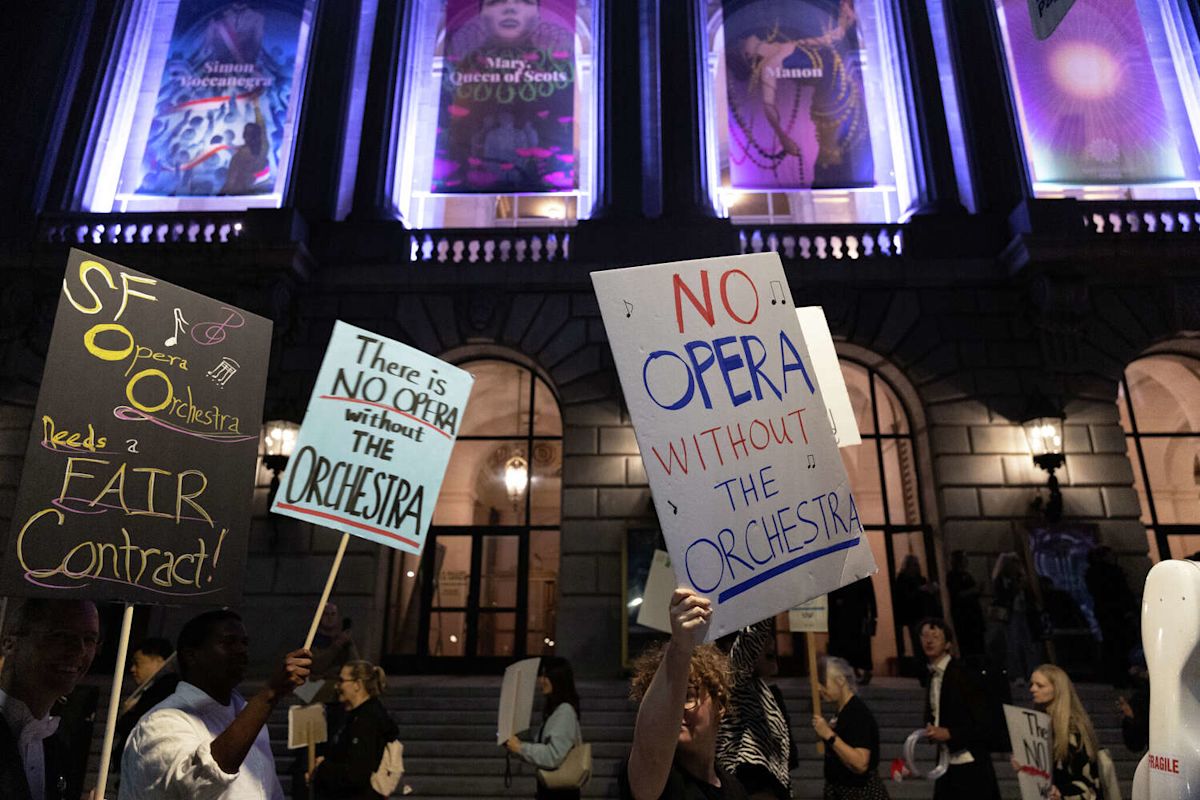
The San Francisco Opera’s 2026-27 season was supposed to begin with Verdi’s “Simon Boccanegra,” a dramatic political allegory about a divided Italy.
Instead, just a half an hour before the 8 p.m. curtain on Saturday, Sept. 12, the Opera itself splintered.
The 69-member orchestra went on strike, marching in protest with members of other unions who work in the San Francisco War Memorial Opera House. The company has since canceled performances through Sunday, Sept. 20.
But the dispute is about more than one contract. It reflects a long-running disagreement over how much the Opera can afford to pay its musicians, how much work the orchestra should be guaranteed and whether the company should respond to its projected $15 million deficit by cutting back or trying to grow.
Both management and the orchestra have undertaken extensive social media campaigns in the days following the strike announcement to explain their positions to audiences.
Here’s what to know about the strike and the numbers behind it.
Why are San Francisco Opera musicians on strike?
Demonstrators march outside the War Memorial Opera House in support of better wages for San Francisco Opera musicians on Saturday, Sept. 12, 2026. San Francisco Opera musicians announced a strike shortly before their planned performance. (Benjamin Fanjoy/For the S.F. Chronicle)
In short, pay.
The orchestra’s previous two-year contract expired July 31 after months of negotiations.
The musicians, represented by American Federation of Musicians Local 6, say management initially proposed a 26% pay cut, later reduced to 20%, and then proposed a five-year wage freeze.
But the musicians say that, once inflation is factored in, that would amount to roughly a 20% pay cut over five years.
The Opera describes the proposal differently.
Management says it would actually increase musicians’ wage rates while gradually reducing their guaranteed work time, ultimately keeping their seasonal compensation the same over the five-year contract.
The basic disagreement is therefore not simply over a percentage raise. It is also over how much work the orchestra should be guaranteed and how the Opera should structure itself now that it stages far fewer operas than it once did.
How much do Opera musicians make?
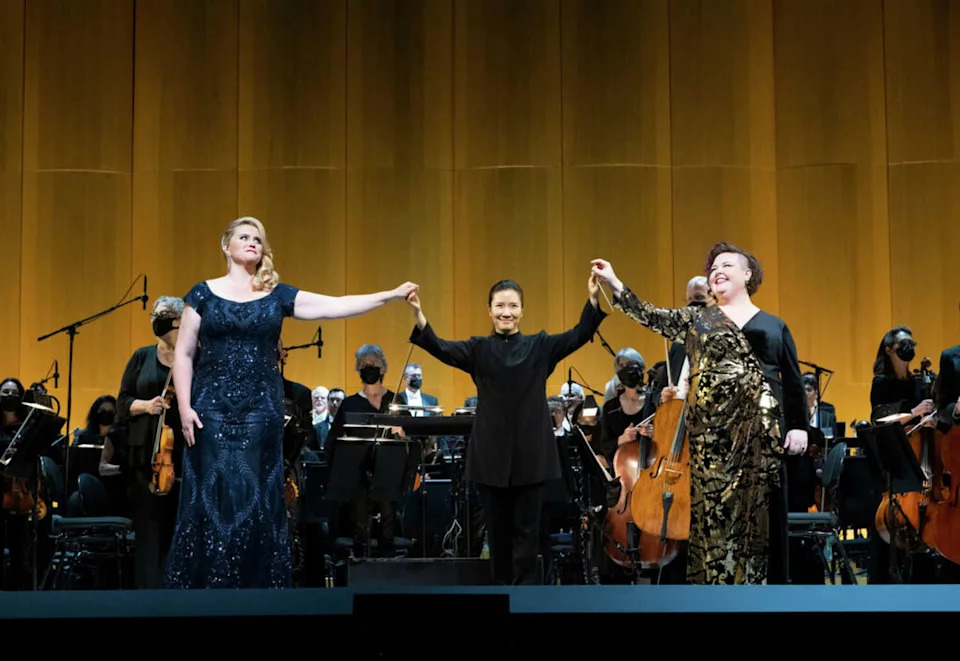
Soprano Rachel Willis-Sørensen (left), Music Director Eun Sun Kim and mezzo-soprano Jamie Barton take a bow at the end the concert. (Laura Morton/Laura Morton / Special to The Chronicle)
Under the previous contract, a section musician had a guaranteed base compensation of about $118,000 for a 24-week season, plus health benefits, vacation and other fees. Musicians in titled chairs can earn up to double the base compensation.
The Opera says the orchestra’s weekly base pay of $3,888 is among the highest in the industry. But the union argues that the figure needs to be viewed in the context of San Francisco’s current cost of living and the fact that musicians need to work other jobs, including teaching and performing, during the rest of the year.
According to Bureau of Labor Statistics data, consumer prices in the San Francisco-Oakland-Hayward area rose 19.5% between June 2021 and June 2026.
Was there a pay cut during the pandemic?
Yes, but pay has returned to pre-pandemic levels.
The orchestra’s minimum wage was cut by 44% in 2020 during pandemic-era reductions. The musicians gradually regained pay in subsequent contracts.
What does the Opera mean by a $15 million deficit?
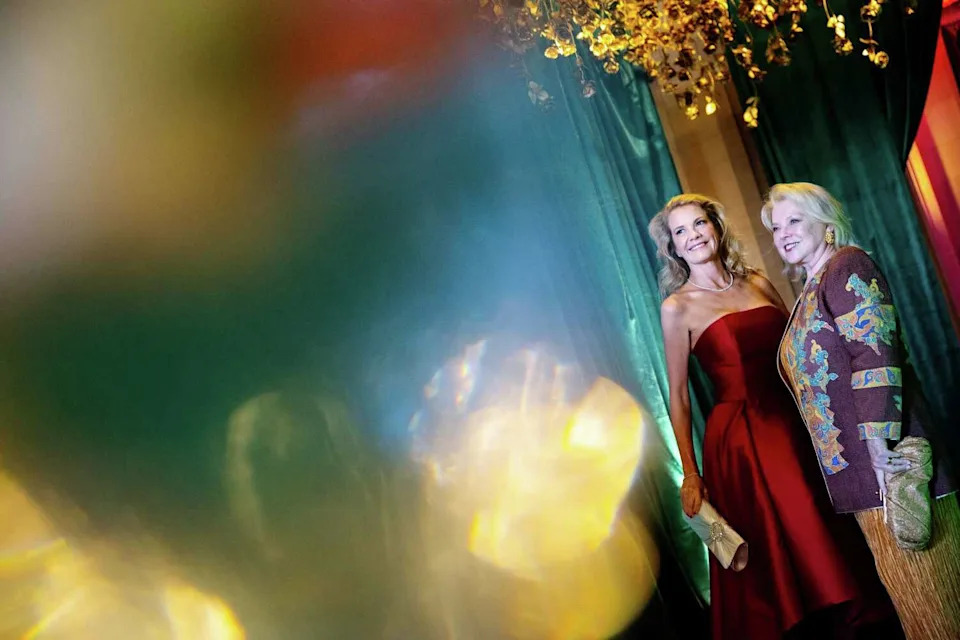
Kelly Grimes, left, and Geanne Lawrence pose for a portrait during the opera season opening ball reception at the City Hall in San Francisco, Sept. 5, 2025. (Manuel Orbegozo/For the S.F. Chronicle)
This is where the dispute gets complicated.
The Opera says it has a structural deficit of about $15 million every year – meaning its recurring expenses exceed the revenue it considers sustainable.
The company says it has been covering that gap in part by drawing down its endowment. Last year, it said it withdrew $30 million, including a normal 5% draw of $15 million and an additional $15 million special draw that it considers unsustainable.
That does not mean the Opera is running out of money or has no assets.
Its audited financial statements show that it had $329.8 million in total net assets at the end of the 2025 fiscal year. But much of that money was donor-restricted or held in endowment funds rather than freely available for annual operating expenses.
A nonprofit can have hundreds of millions of dollars in assets and still face a recurring operating shortfall.
So is the Opera doing well financially or not?
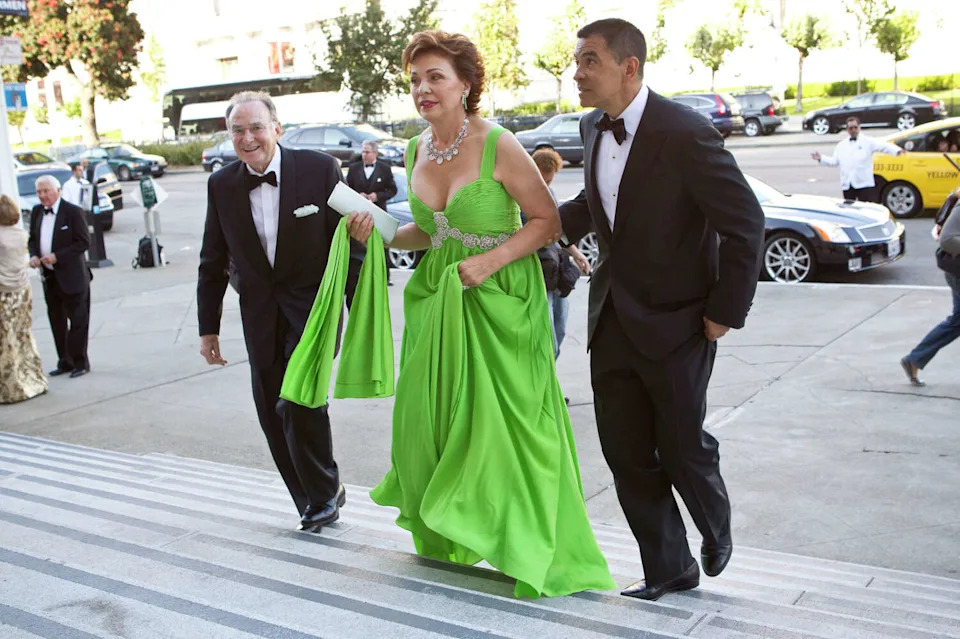
Jan Shrem, Maria Manetti Farrow and Daniel Diaz (left to right) arrive at the War Memorial Opera House to attend the San Francisco Opera Opening Night Gala in San Francisco on Friday. (Laura Morton/For the S.F. Chronicle)
In some ways, yes. In others, according to management, no.
The Opera says subscriptions, donations and audiences have been growing. Full subscriptions were up 13% this season, annual fundraising approached $50 million and the endowment topped $300 million, including a $5 million a year commitment by Nvidia CEO Jensen Huang and Lori Huang, according to the company’s economic briefing.
Six productions have also sold out in the past three seasons, according to the musicians and recent reporting, and the company gained roughly 1,200 subscribers in the 2025-26 season.
But tickets do not cover most of the cost of putting on opera.
How much do ticket sales affect the bottom line?
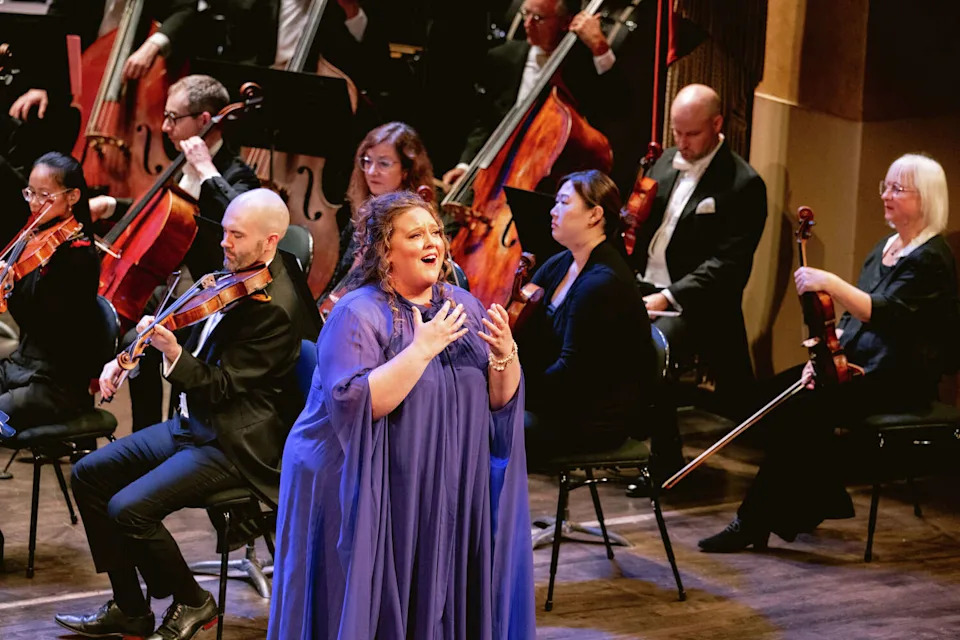
Mary Hoskins performs an aria from Strauss’ “Ariadne auf Naxos” at “The Future Is Now” concert on Friday, Nov. 21, 2025 with the San Francisco Opera Orchestra. (Kristen Loken/San Francisco Opera)
The Opera says it loses money every time it raises the curtain. Ticket sales account for only about 15% of its revenue, while its audited 2025 financial statements show $13.84 million in ticket sales against $82.56 million in operating expenses.
The company says that is why simply adding more performances does not necessarily solve the problem.
According to the Opera, an additional performance of last summer’s “Elektra” would have produced an estimated $191,000 incremental loss, while a 2024 Beethoven Ninth concert lost about $193,000 even after selling all the seats.
Orchestra-only events in smaller venues have added $60,000 to $90,000 in incremental expenses, the company says.
The musicians disagree with the underlying strategy. They argue that reducing performances can create a cycle of fewer shows, fewer ticket sales and less opportunity to build an audience.
That difference over the future of the company is a major part of the labor dispute.
Has there been a strike before?
The last time the opening weekend of the Opera was called off was in 1990, when a contract dispute and lockout involving the musicians’ union canceled the season-opening double bill, the Opera Ball, Opera in the Park and four other performances.
At the Opera’s 2024 season gala, the performance started late after the orchestra and management averted a strike with a last-minute agreement.
Why has the Opera’s season gotten so much smaller?
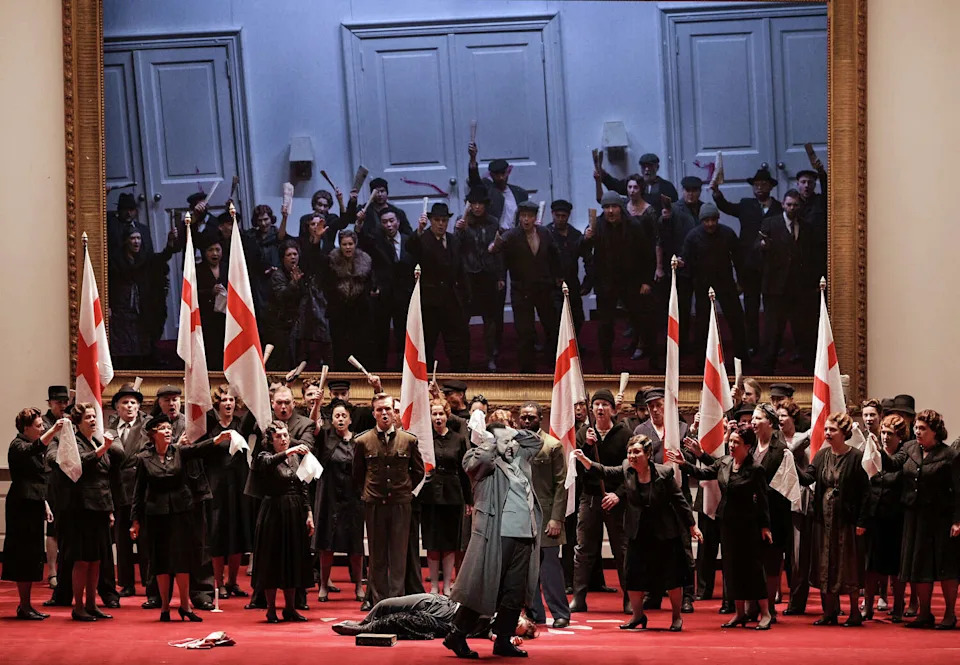
The San Francisco Opera planned to present Verdi’s “Simon Boccanegra” from Sept.12-27 at the War Memorial Opera House before the strike. (Hans Jörg/San Francisco Opera)
The Opera says this has been happening for decades, not simply since the pandemic.
The company went from 16 operas in 1981 to about eight before the pandemic before landing at six in the 2024-25 season. It says the decline has been gradual as the cost of producing opera has risen faster than revenue.
The musicians say that history teaches a different lesson: The orchestra used to have much more work, and they argue the company should find ways to put those musicians back to work rather than use the smaller schedule to justify reducing guarantees.
Meanwhile management contends the existing orchestra contract guarantees significantly more work than the Opera can afford to schedule.
For the musicians, the problem is that the amount of work has fallen partly because the Opera has chosen to stage fewer productions.
That is the heart of the argument.
How much orchestra work is actually going unused?
The Opera estimates that 33% of the orchestra’s guaranteed hours will go unused this season, up from 25% last season.
The Opera puts the value of those unused wages at roughly $1.9 million to $2.5 million per season.
The musicians argue, however, that the calculation leaves out substantial work that happens outside scheduled rehearsals and performances, such as learning scores and maintaining instruments.
Management says its proposed contract would reduce that unused time gradually rather than eliminate it, while increasing wage rates so overall pay stays the same.
What about the Opera’s executive pay?

San Francisco Opera conductor Eun Sun Kim at the War Memorial Opera House. (Liz Hafalia/Liz Hafalia / The Chronicle)
The musicians have pointed to executive compensation as evidence that they should not be asked to absorb the financial burden alone.
Public tax filings show General Director Matthew Shilvock’s reported compensation was $423,796 in fiscal 2022 and $729,130 in fiscal 2025, an increase of about 72%.
The Opera says the board reviewed executive compensation at comparable arts organizations and considered Shilvock’s compensation appropriate for the scope of his job.
What about the music director?
Members of the orchestra said Music Director Eun Sun Kim told them she would resign if they went on strike. The Opera did not say whether she is still with the company and Kim has not responded to the Chronicle’s requests for comment.
Kim’s contract was extended in October 2024 through the 2030-31 season. Her salary was listed at approximately $579,000, plus additional compensation, in the Opera’s most recent available Form 990, covering the fiscal year that ended in July 2023.
What has happened since the strike began?
After the opening night walkout, the Opera canceled the following day’s Opera in the Park concert in Golden Gate Park.
The Opera then canceled three additional performances through Sunday, Sept. 20: “Simon Boccanegra” on Wednesday, Sept. 16 and Saturday, Sept. 19, as well as the premiere of “Mary, Queen of Scots” on Sunday.
The Opera has said the two sides spent two full days and evenings negotiating after the strike began.
The musicians say they still want to return to the pit, and asked supporters to join them at a protest outside the War Memorial Opera House from 5:30 to 8 p.m. Wednesday.
Can the city help?
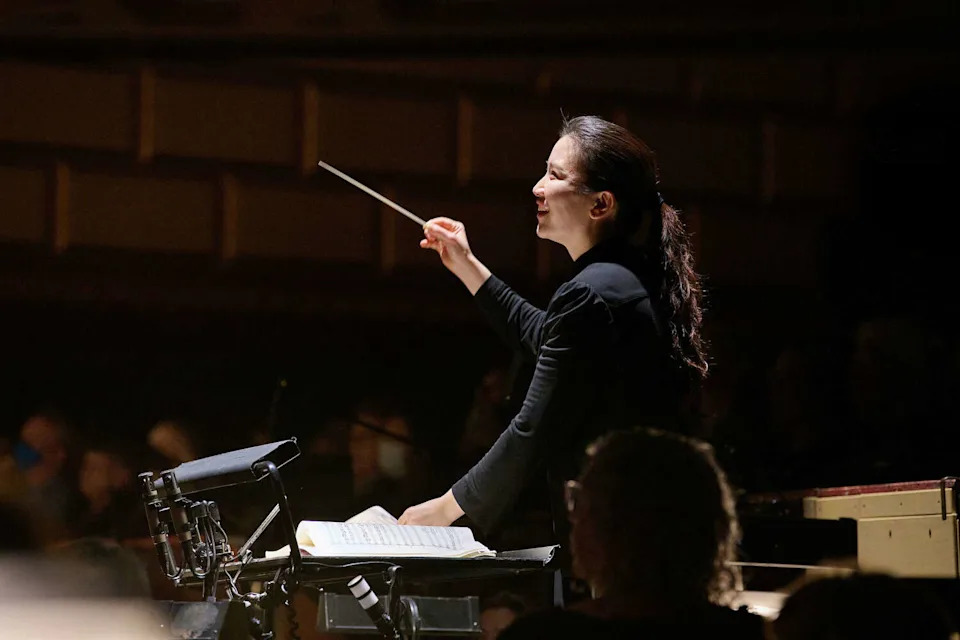
San Francisco Opera Conductor and Music Director Eun Sun Kim in performance of “Madame Butterfly” at the War Memorial Opera House on Sunday afternoon, June 18, 2023. (Stefan Cohen/S.F. Opera)
The city is not directly involved with the Opera, although the company performs in the War Memorial Opera House, which is managed by the city.
Mayor Daniel Lurie and the city’s Executive Director of Arts and Culture Matthew Goudeau, however, have joined the bargaining process in an effort to broker a deal, according to sources familiar with the conversations.
Will there be an Opera Ball?
The company’s biggest fundraiser was rescheduled for Nov. 12. Opera Ball ticketholders may retain their current tickets for the new date; donate the value of the ticket to the Opera and San Francisco Opera Guild for a full tax deduction; or receive a refund.
Are other opera companies in the U.S. dealing with similar issues?
Overall, opera companies in the U.S. are subject to the same rising costs as the San Francisco Opera.
The Metropolitan Opera in New York is currently facing what has been characterized as a severe financial crisis.
Lower ticket sales since the pandemic, a $326 million operating budget (the largest for any opera company in the world) and a shrinking endowment have all contributed, as did the collapse of a major rescue deal with Saudi Arabia that would have seen the Met in an 8-year, $200 million partnership with the country.
Subscribe
There’s more to San Francisco with the Chronicle. Subscribe today for just 25¢.
This article originally published at Why is the San Francisco Opera on strike? The numbers behind the dispute.
