


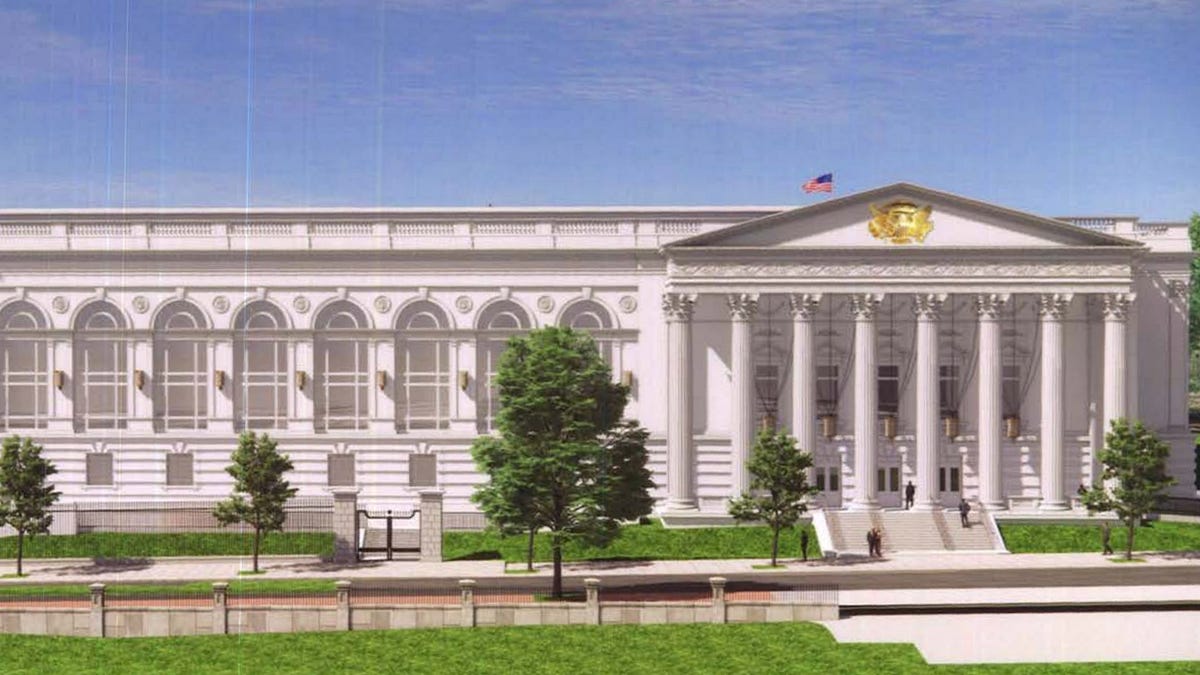
At this point in the President’s White House ballroom saga, I should be content to let the Supreme Court do its review of lower-court rulings that have called for stopping the project while its several likely-to-be illegal aspects are thoroughly reviewed.
The appeal to the Supreme Court by Solicitor General John Sauer is histrionic, and he managed to press my buttons by what appear to be extraordinarily misleading and exaggerated claims about the nature and state of the ballroom’s design and construction, claims that could sway a Supreme Court that may be inclined to give the President what he wants and move on. News coverage I’ve seen also seems to take the claims largely at face value. No one should.
Now my patient readers may have had just about enough of the ballroom project, and I can’t blame them. (No one has complained, I might add.) In fact I am pining to spend the waning days of summer on the beach.
But the project is a civics lesson on the deep attachment Americans develop to a building designed precisely to its expressive purpose, as the White House is. It was intended to be a modest expression for an executive whose duty was to serve the people not himself. The building has been altered and adapted many times but always mindful of its original intention. And so the house’s appeal and its symbolism have endured over the centuries.
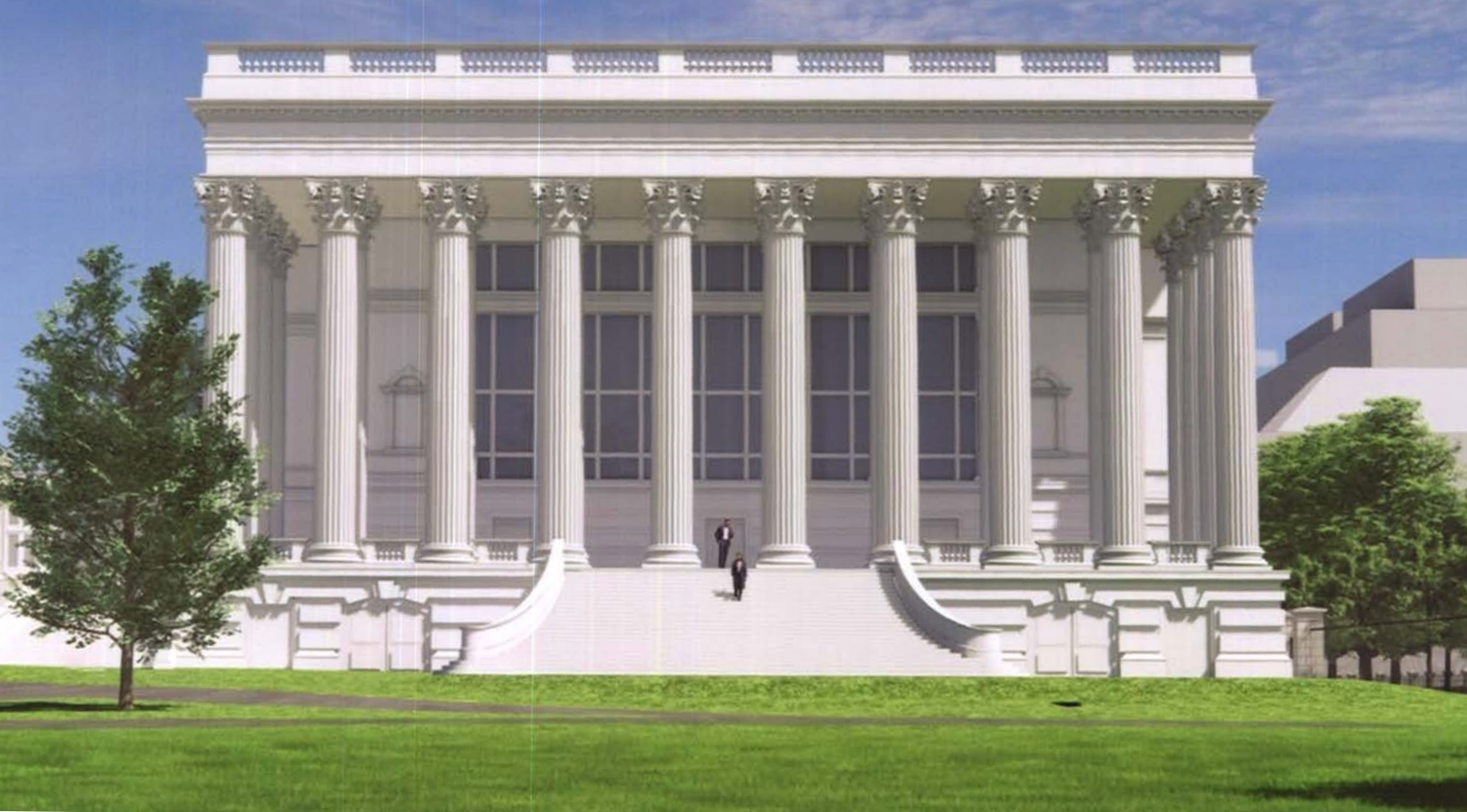
Of course, Trump has inverted the intended modesty of expression as he heedlessly makes it gaudier by the day in a desperate attempt to duplicate the splendor of monarchical palace builders who were aggrandizing themselves and exploiting those they ruled over. In renderings that accompanied the administration’s pleas to the Supreme Court, gold medallions have appeared and the surface is shown pockmarked with fussy decorative gew gaws. While the main house had plain columns, the President insists on fussily fluted ones.
The design is rapidly descending into parody—even as Sauer told the court it has been built so solidly that it cannot be demolished, should the court (correctly) so rule. Just like the “unsinkable” Titanic. The ridiculous grand stair from nowhere to nowhere has reappeared on the prominent elevation facing President’s Park.
Sauer calls the project an “integrated military complex, including a totally secure ballroom space, at the East Wing of the White House,” which, of course, is a belated rebrand of the original whim by Trump to build an oversize party space. It was euphemistically deemed the East Wing Modernization Project when it was approved by unquestioning lackeys at the National Capital Planning Commission and the Commission on Fine Arts last spring. Security enhancements merited barely a mention.
Sauer spills much ink on claims Trump has made about the security aspects of the design, and with Trump’s bragging we know know enough about the security tactics allegedly deployed that the Secret Service is probably fuming.
The subterranean bunker was originally conceived to briefly protect the president and staff until they could be evacuated to top secret sites more readily secured that are equipped with everything a president under siege would need to direct defensive action and keep the government going.

Yet the tough-sounding jargon Trump and Sauer use is strikingly imprecise when not contradictory. Sauer writes of “sniper nests” (tucked behind the Corinthian column capitals?) and a “drone port.” He writes in Trumpspeak of “drone proof” roofs and “ceilings” (to repel aerial critters zooming around the ballroom?).
The structure is allegedly of the strongest concrete made, akin to that of nuclear power plants (which have walls that are several feet thick) and “missile-resistant columns.” The columns, however, have been placed for esthetic purposes not security ones. Classical-style porches, however reinforced, are decorative not defensive.
The walls will have to do the main work of resisting attack but are punched with very large glass areas, which can be reinforced to resist bullets and car bombs but are unlikely to stop drone and missile armadas.
And about that limestone that Italian artists are said to be carving at this moment? The White House is a stone building that was painted more than 200 years ago. Millions are going to be spent on limestone (which has a sober beige surface and is in widespread use in Washington) only to paint it? So many questions; so many obfuscations.
Sauer’s screed speaks of protecting “the White House and surrounding region from aerial attacks—one of the nation’s largest emerging threats.” Aerial attacks are hardly an unknown risk (see 9/11) and the airspace around Washington DC and the Pentagon is protected by air and ground defenses. The White House would be toast (even should the president be cowering in his ballroom bunker) should those defenses be breached in a major way, along with, presumably, the Capitol, the Pentagon, and numerous essential agencies.
Trump seems to be rewriting the script for the defense of the entire Washington region without involving the Defense Department or Congress.
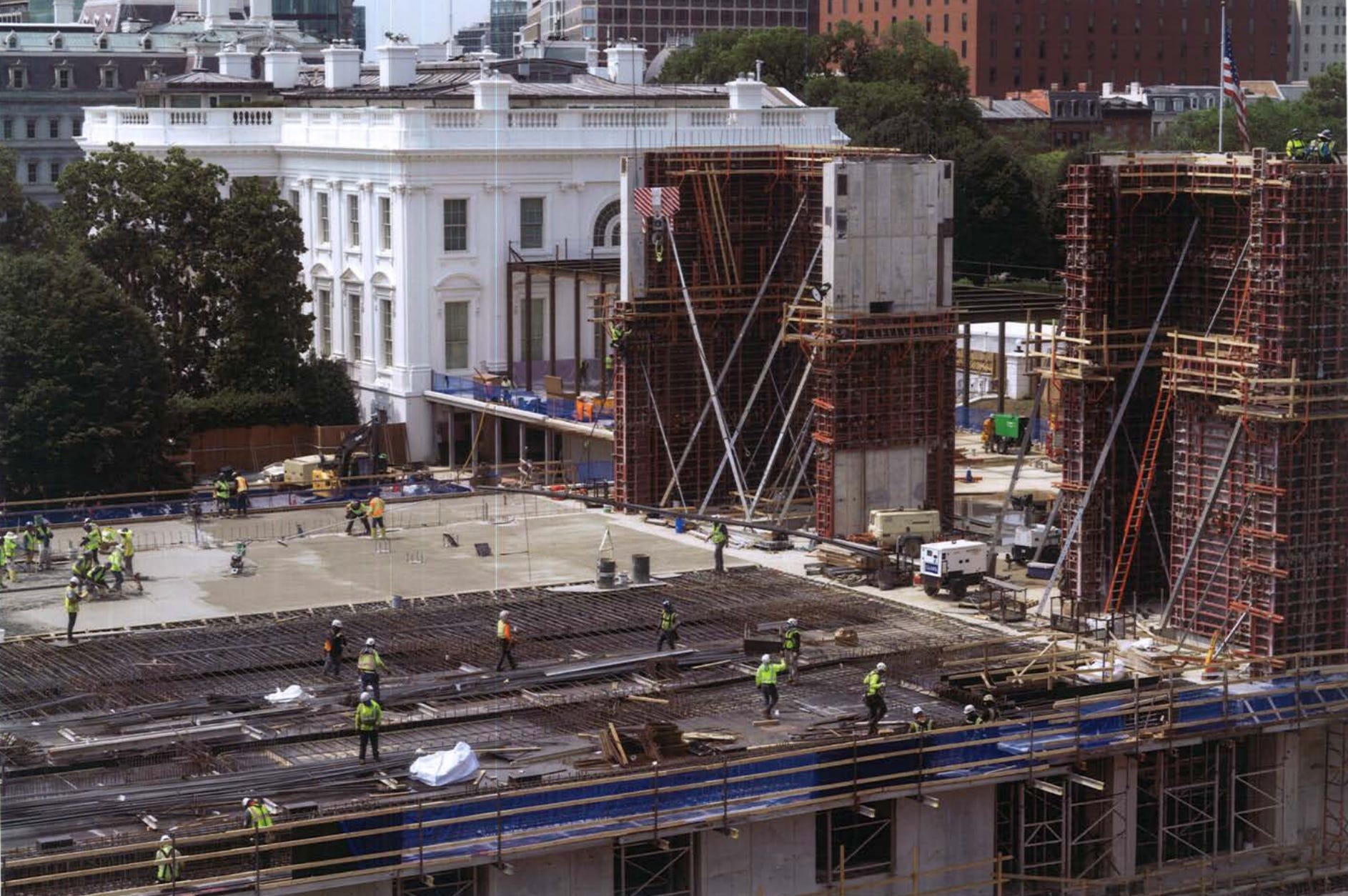
The claims get wilder. Sauer’s brief asserts that the new wing is 65 percent complete, which recent photographs suggest is quite a stretch. The claim would be believable if the ballroom itself was fully framed up but only the northern corners appear to have reached (probably illegally) full height. Only a third to half of the ballroom floor appears to have been cast. (I should note that I am looking at the most recent news photos; I can’t—nor can anyone outside the team working on the building—know the level of completion for sure; no reporters or independent industry experts have been publicly invited in.)
Sauer also claims that stopping construction would compromise security, quoting an earlier administration assertion: “[T]he current unfinished construction site compromises the ability of Secret Service personnel . . . to readily traverse the White House Complex for evacuation or other protective security operations.” This is an admission that the construction site is not fully secure—a risky, unacceptable lapse.
The project should have been planned from the beginning to protect the President at every stage, and if the builders have failed, it is entirely their fault and that of the White House. Everyone involved with the project knew that its questionable legality could lead to halting the project. It was the President himself, not any of the judges involved, that rushed the project so that he could dubiously assert that its stage of completion is beyond the point of no return—flaunting the judges’ orders.
The reasons for Sauer’s hysteria, the reasons the “glaring security problems” have only arisen now, and the reason the district judges have been so steadfast in rejecting the security justification the Administration claims have now become clear. Washington Post sources say that the World War II-era bunker beneath the old East Wing has already been massively reinforced and updated in secret. (Yes, I have “buried the lede” in journo-speak.)
Trump has been taking credit for the construction of a new five-story secure facility that was built by the Obama Administration based on a post 9/11 security analysis. Trump’s claims that the superstructure of the ballroom is absolutely integrated into the secure facility beneath are almost certainly phony.
The Supreme Court doesn’t have to waste time trying to parse these serial dishonesties. It can remand the case to the lower court to complete the fact finding—but halt the project in the meantime, so that taxpayers are not on the hook for any additional construction that may have to be altered or demolished.
The court can stop the blatant bribery of the president by the government-contract supplicants who have extracted quid pro quos from their “gifts” to the project and remind the President that he is free to take his case for the new wing to Congress as he should have all along.
If you haven’t followed my posts on the White House and the vandalizing of Washington’s Monumental Core, you can find them on my Substack, including this on Trump’s design versus the historic evolution of the White House and his reshaping of Monumental Washington. I also wrote on why substantive questions about the ballroom project may not get a proper hearing in front of the Supreme Court.
If you appreciate these stories please share with friends. You can help me do even deeper research by becoming a paid subscriber. Thanks for reading!
