

Writer Behind $1.9 Million Kickstarter Talks Bringing Beloved Podcast to Life as a Graphic Novel

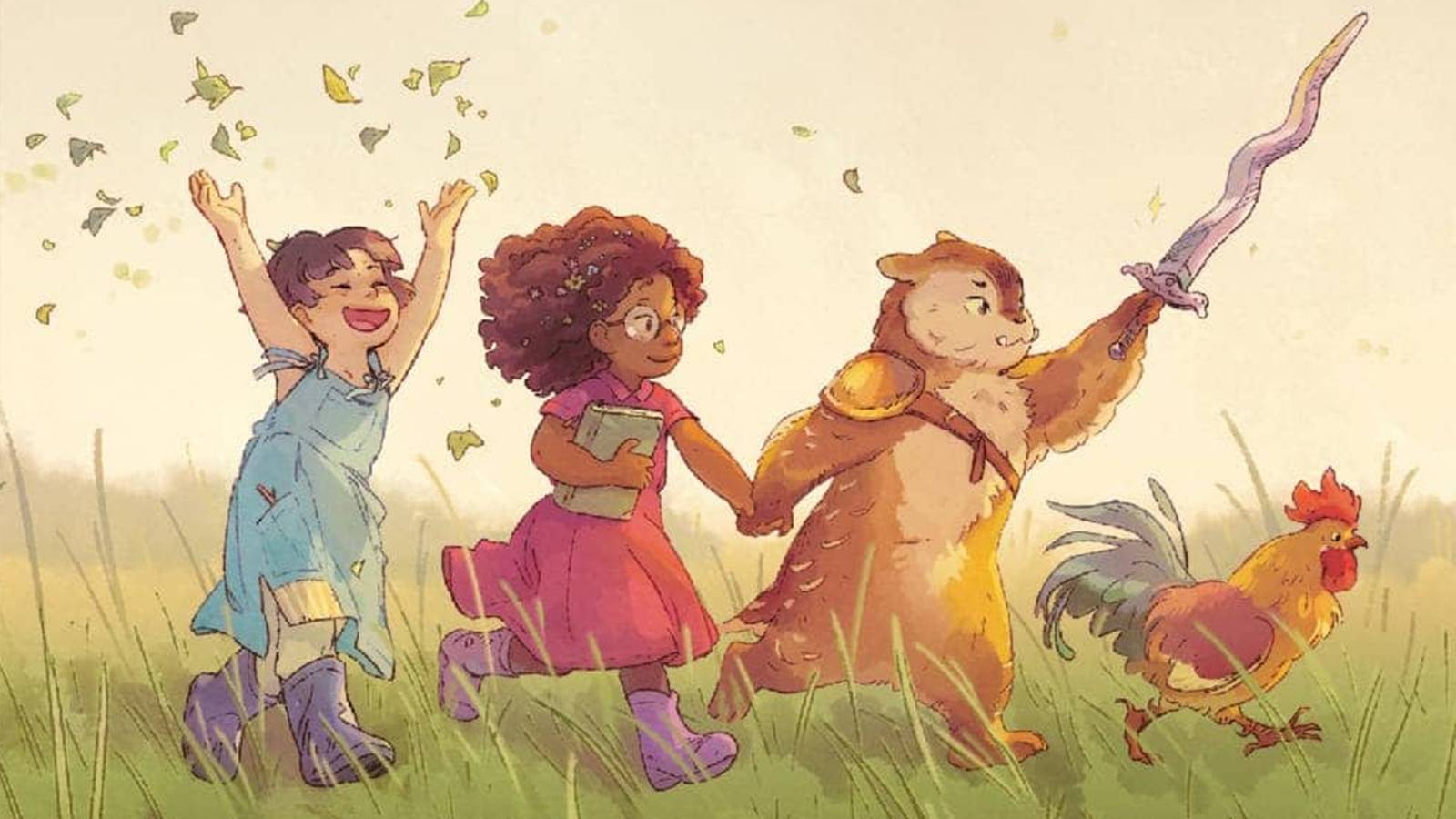
Worlds Beyond Number is a hit podcast where Brennan Lee Mulligan, Erika Ishii, Aabria Iyengar, and Lou Wilson essentially play a long and fascinating role-playing adventure as an audio drama. Mulligan narrates the podcast, and was the initial gamemaster. Ishii plays the character of Ame, a witch; Iyengar plays Suvi, a wizard; and Wilson plays Eursulon, a spirit. Taylor Moore co-created the show with the others.
Now, after the grand success of the podcast, the story is being adapted into a graphic novel, beginning with Children’s Adventure, which was the prequel to the four-season campaign, The Wizard, the Witch, and the Wild One, and is now presented here as the official prelude to the main story. Published by Skybound Entertainment through Image Comics, the graphic novel is written by Jadzia Axelrod and drawn by Sarah Webb. The Kickstarter has already raised over $2 million, and is still funding!
In a CBR exclusive interview with Jadzia Axelrod, we discuss what it is like to adapt a podcast that she is such a big fan of, as well as the tricks of adapting an audio drama into a comic book.
CBR: Well, first off, congrats on this project. What’s funny is, reading about your involvement with it, it almost feels like some Charlie and the Chocolate Factory stuff to me.
Jadzia Axelrod: I love that. It did feel like I got a golden ticket. It absolutely has been a dream project and something that I never expected. Listening to the show, I never imagined that one day they’d want to do a graphic novel and then I’d get to help bring that to reality. That is wild.
That’s just amazing. The idea that, so often, we’re all fans of different things, but to actually get the call, as it were, to work directly on something that you’re such a fan of, that’s just got to be an amazing feeling.
It is.

So, an interesting thing when we come to adaptations in comics from other media… something I’ve always looked at is Black Panther, a big blockbuster film. There are all these scenes that are these big, dramatic fights, and they’re five-, six-, seven-minute scenes. In a comic, it’d be like two panels.
Meanwhile, prose and audiobooks are almost the exact opposite. The length works completely differently. I mean, The Stand is probably a bad example because it’s such a long book, but The Stand comic adaptation is something like 36 issues to adapt that book. So how do you go about it? What’s the challenge for you as an adapter, taking this thing that isn’t as easy to adapt into the comic realm?
Yeah, I mean, there were a lot of decisions that had to be made from the get-go. One decision that I made early on was that I wanted to avoid using Brennan’s narration in the graphic novel.
Brennan’s narration is beautiful. That man can weave a dream, for certain. He really knows just the words to say and paints a beautiful picture. But we have Sarah, who is literally painting pictures. We don’t need Brennan’s words to do that.
The words can be the basis for Sarah’s pictures, and I put them in the script so that she would know what they were thinking when they were playing this game, but I didn’t want to put that in the book. I wanted the visuals to tell the story as much as possible.
So we kept narration to a minimum. We decided to tell the story primarily through dialogue and through action and really lean into that visual aspect of comics. I think that made it a very successful piece in that way. It became less about, “Oh, we’re just transcribing everything that everybody said and putting it on a picture,” and more about, “We are translating this story into a new medium.”
That’s fascinating. So, in a way, as a scripter, as someone who’s laying out and breaking the story down, it’s fascinating that you have this almost co-writer in the scripting that helps lay it out. That’s awesome.
Yeah. One of the things that’s interesting about writing comics is it’s really about choosing time. Time is represented through space on the comics page, as opposed to in an audio drama, where time is the time it takes to say anything.
Right. Right.
So those decisions about how to change, how to enhance the drama with time and the way things move, what moments need to be focused on and what moments need to be quickly moved through so that we can move on to something that’s more important, that was my call.
Also, it’s a very long podcast. Even The Children’s Adventure, which became Prelude, is several hours of audio that we had to compress down into a little over 200 pages. Some of that, obviously, is crosstalk between the players, but some of it was just stuff that couldn’t fit in the visual medium or couldn’t fit in the space that we had.
If we’d had a longer book, different choices would have been made. But the decision was to make this 200-plus pages, not 500, and so decisions had to be made.
I think the result is those changes get closer to the heart of what the story was trying to be. Doing things literally as they were in the podcast would have made it very difficult to read. By making it easier to read, we made it easier for people to get to the heart of these characters and the heart of the story.
I love that notion of time. It really is such a fascinating point. There really is no other medium where the writer can control things as much as they can in comic books. It just doesn’t exist.
Everything else, when it’s audio, you’re hearing the audio when the audio plays. I mean, you can do one-and-a-half speed or whatever, but you’re trapped by the actual physical restraints of it.
With comics, here we can tell you how you’re going to read this page by how we lay it out. That’s an amazing power that comics have that other media just don’t have. That’s really cool that it’s coming to fruition in this book.
Yeah, it’s a lot of fun to work with, especially working with an artist like Sarah, who knows this kind of stuff backwards and forwards. She’s such a brilliant artist and a brilliant comics maker. So she understood a lot of that idea of using the space to tell that story, and she did an amazing job
That was actually something I was going to ask later, so I’ll move it up. Sarah is such a talented writer herself. When you’re collaborating, you obviously have your idea of how you want the story told. Are there moments where Sarah, while laying out a page, takes a different approach, or just the way she lays out the page changes how you look at it?

Several times. I like to work with an open spirit of collaboration, and so there are many moments in the book that are slightly different, or very different, from what I described in the script, but they get to the spirit of what I was describing, just in a different way. In some cases, it’s a better way, because Sarah knows her stuff.
That’s part of the medium, and that’s what happens. It’s happened with other artists that I’ve worked with, and I don’t get upset about that. I embrace it, for the most part. As long as we’re all on the same page, telling this moment together, then how it is told is less important to me than what is told.
There’s beautiful stuff in the book. One thing I really love is the first time we see the Great Bear in Chapter Two. It’s this beautiful double-page spread. What’s amazing about it is that, up until then, the story has looked very cartoony because Sarah has that wonderful animated style where there’s not too much detail. There’s just enough to tell you what’s going on.
But that double-page spread is super detailed. It’s super… I hesitate to say realistic because it’s a giant bear, and it’s a bunch of fairies around the giant bear, and it’s a fairy forest that doesn’t quite look like a real forest. But it looks very tangible in the best way. It feels like you could almost step into that page because it’s so detailed and rendered in a way that the previous pages weren’t.
That was such a wonderful choice to really sell the power of that moment. That wasn’t in my script. I didn’t say, “Draw this more detailed than everything that’s come before.” That was something she did, and in part I’m sure because she loved doing it, but also because, by making it more real, she sold the unreality of it, which is really cool.
That’s fascinating. That actually takes me back to the audio aspect of it. Famously, there was that old radio show Kukla, Fran and Ollie, which was a really cool kids’ show. Every episode, they’d open up a closet and all this crazy stuff would come out. Well, the show came out right as television was starting, so they adapted it for TV, and it lost something because, on radio, kids could imagine all the crazy things that were coming out of the closet. Once you actually had to show it, it lost a little of its magic.
Here, even though everything is described in the audio, there are still things that are never going to be described exactly. You and Sarah are now the people who have to decide what everything actually looks like and how everything relates to each other visually. That’s something you can’t really do in audio. It’s an interesting responsibility that the two of you have with this story.
Yeah. More Sarah than me on that, of course.
Of course.
I take no credit for the visual look of these characters because that’s not my department. But yeah, there are going to be people who never listened to the show but who will read the graphic novel, which is wild. Their interaction with these characters will be through this book and not through the original audio show. So, yeah, it’s interesting.
On that same note, going back to the audio a little bit, so much of it is carried by the dialogue and the performances. How do you get that across without the benefit of hearing those performances? That’s so tricky to me. Do you have any specific tools that you use when you’re figuring out how to tell the story of a character who might not actually speak very much?
Right. That’s something that was definitely a challenge with Eursulon, who is a very terse character. Lou provides so much in his performance, and also in the way that he talks about the things the character is thinking. He’ll go into these wonderful monologues about what Eursulon is thinking, how he’s making these decisions, and then what he actually says. So there’s not a whole lot to deal with on just the surface of it.
We had to take some time to show some things that are not in the podcast but that show Eursulon‘s thought process and his feelings. There’s a beautiful moment that Sarah did so gorgeously where Eursulon does his glamour for the first time and is a little hesitant about it, about looking not like a spirit but like a person. It really shows his emotions and his uncomfortableness with that moment, just because it is new, and also it’s like, “What am I saying about myself to make myself look like this?”
It’s a beautiful sequence, and it was something I really wanted to have because we’d had Lou talk about this, but we’d never actually had a scene where Eursulon stands in the sun for a moment and… right? It was something that was contextual, but it was never explicit.
To make that explicit really gives us this wonderful insight into the character, and I’m really glad that we had the space to tell that story, to give it the grace and gravity that it deserved.

So, as a fan, it’s got to be so trippy when you get Sarah’s pages, and you see these moments you’ve heard before as a fan expressed visually. Was there any particular one that stood out where you just thought, “Oh my goodness, I’m getting to see this”?
Yeah. When we first see Sir Curran. I had put a photo of Brennan’s face in the script and said, “Sir Curran looks like Brennan Lee Mulligan.” Then to see the art where it’s like, “Yeah, it’s Brennan,” just this knight on a horse, coming down on his horse and taking his boots off, it was just a wonderful thing. It was a wonderful thing to see my imagination there on the page.
That’s great.
So now, for this project, I assume… I don’t know for a fact, but I assume that, like most TV shows or movies, there’s a bible, as it were, that doesn’t always necessarily make its way onto the screen, or whatever the medium is. But there is some sort of established bible. Is that something they had for this podcast? And if so, was there something they made available to you?
If it’s something they have, I never saw it.
Okay.
But everyone was really generous as far as the questions that I had about the larger lore and setups and how things connect. I’d ask, “Is there a reason this is how it is? Is there a reason for this?”
A lot of the witches that we see have familiars, and all of the familiars we’ve seen have been male. I asked questions like, “Is there a reason for that? Is that a thing?” And they were like, “No, it just happened that way.” I don’t know if there’s a bible, per se, because they were making it up as they went.
True, true.
But Taylor Moore has been very helpful as the official unofficial lore keeper, helping me out with why things might be the way they are.
I also had a great conversation with Brennan, Aabria and Erika about their characters and why those characters are the way they are, which really helped me define them a little more in my own head while trying to write this book.
So, yeah, they’ve been very helpful. For something that’s so big and so sprawling as the Worlds Beyond Number adventure is, everyone has really clear ideas of everything, which has been really great.
What I find interesting is, when you have something that’s been developed over time and expanded, it wasn’t planned from the beginning with the knowledge of where everything was going to end up years later. Has that had an impact on how you write the characters or play with plots, knowing where everything is eventually going?
Absolutely. Knowing where the story goes has definitely changed the way I wrote the script.
So there are things in the first book that are not in the podcast, because they’re important later, and we wanted to put those seeds in sooner so that it all comes together.
Again, this is a story they were making up on the fly, and there are a lot of things where it’s like, “Oh, right. Well, let’s say this happened back then,” and stuff like that.
For example, Wavebreaker is established in the first chapter rather than just being something that’s randomly in there. That later becomes very important and wonderful, but it doesn’t really have that setup originally.
If they were planning it out from the beginning, I think it would have been different. Since I get to plan it out, I get to make it different.
That makes sense. You see it anytime some big superhero story is adapted. They always tie things together because, if they’d known they were going to do it, they probably would have done that originally. You know, Doctor Doom probably would have been mentioned before somebody suddenly says, “Oh, by the way, here’s my old evil roommate.”
Right.
There’s a different expectation when you come to listen to an improvised story versus picking up a graphic novel. To play loosey-goosey with a graphic novel would be just as much of a crime as telling people they’re listening to an improvised story when it was actually scripted out ahead of time.
So the goal is to keep the spirit and the energy of the improvised story while allowing the things we expect from a book to be there.

Years ago, David Michelinie and Walter Simonson were doing the Star Wars comic for Marvel, and it was a shockingly good run for a book that was dealing with so much editorial direction. It was always, “You can’t do this. You can’t do that.” They were trying to come up with a plot and said, “Well, what if they make a second Death Star?” Lucasfilm came back and said, “Uh, no. Try something else.”
Has there been anything like that for you while doing this? Anything you’ve added that maybe got a little too close to something coming later?
I gave a character a name that I don’t even think is actually in the book. It’s just in the script so I could refer to that character in shorthand. I was told, “Don’t name that character because that’s the name of someone in the future who’s important.”
That’s funny.
It was like, “Cool. Just change that name.” It’s Sir Curran’s friend, who’s also a knight. I was like, “I’m going to call him this.”
They were like, “Don’t. Don’t use that.”
That’s hilarious.
They were, like, “It’s the name of another person who’s coming later” and I said, “Oh, okay. Great.”
But otherwise, you haven’t really had to change major plot points because you’re not really changing the story.
Exactly. It’s a beautifully structured story, so it’s really just me trying to make sure it all fits together and makes sense here.

So what’s it like being part of a project that’s had this degree of success? It’s just insane.
Yeah. I mean, it’s incredible. It’s really wonderful to see just how excited people are about it. I’m just amazed.
I’ve been part of Kickstarter projects before, so I’m no stranger to that, but never at this level.
They funded in FOUR minutes!
Yeah. It’s nuts. I can’t really get my head around it sometimes, but it just shows how excited people are for this book. I can’t wait for them to read it.
