


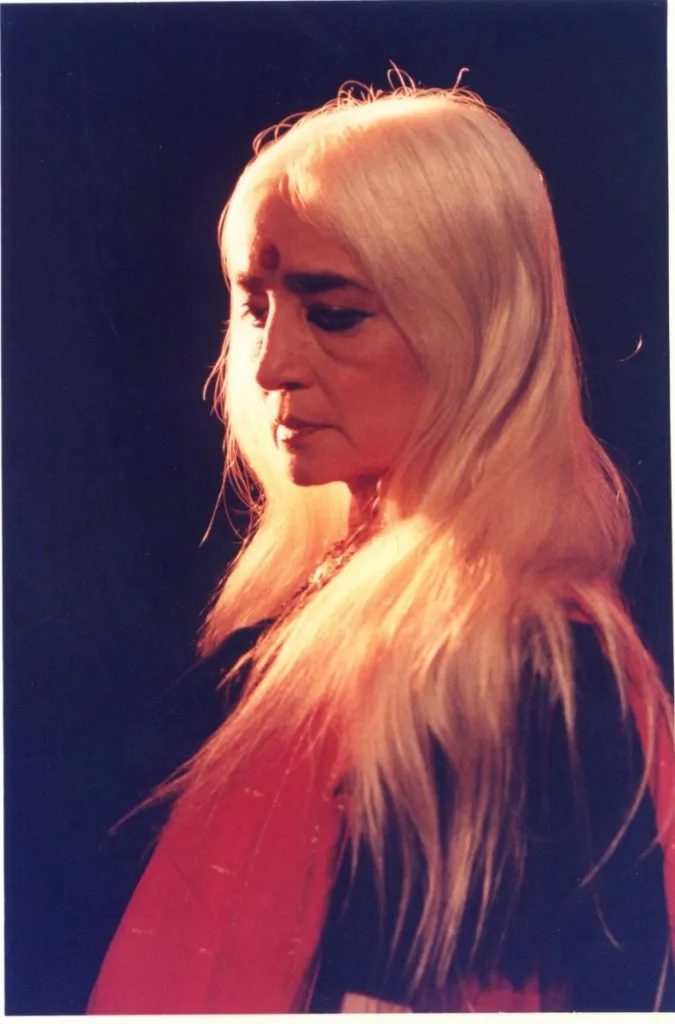
Choreography is rooted in the Greek word khoreia, meaning choral dance, and graphia, meaning writing. Over time, choreography has come to be understood as the design of a dance routine. Not many choreographers actually author dance, but the feminist icon Chandralekha was someone who did. She was a choreographer who wrote with the body like a poet. Chandralekha not only pointed out problems embedded in classical Indian dance forms established by the patriarchal ruling classes, but also offered counter-routines to recover what had been repressed. The political charge of her body of work draws into its orbit not only those who love dance but also social theorists, writers, Marxists and poets.
Born in 1928 in Maharashtra and raised in a middle-class family that moved frequently across South India, Chandralekha began studying Bharatanatyam as a teenager under the celebrated teacher Ellappa Pillai. She later trained with some of the leading figures engaged in the revival of Indian classical dance post-independence, and established herself in Madras (now Chennai), which remained the centre of her artistic life.
By the 1950s, Chandralekha was a legendary figure in Indian classical dance. However, she walked away from fame, rejecting the brahminical and nationalist values that had come to shape it. In the years following her departure, she immersed herself in writing, feminist organising and political activism. When she returned to the stage in 1984, she brought with her a radically reimagined practice — sensual, iconoclastic and uncompromisingly feminist.
Roots Beneath Roots
Indian classical dance is heavily coded by Hindu scriptures. Following rasa theory, the emotional states of the heroine (nayika) overlap with the pantheon of Indian goddesses — Durga, Kali, Saraswati, and Lakshmi — who serve as archetypes of ideal feminine subjectivity. In the essay The Militant Origins of Indian Dance(1979), Chandralekha argues that the origins of Indian classical dance are rooted in labour, combat, sexuality, collective movement, and the disciplined intelligence of the body.
The true spirit of Indian dance, emphasising martial discipline and community building, remains visible across indigenous and regional practices such as the Chau mask dance traditions of Orissa and Bengal, the Silambam stick-fighting of Tamil Nadu, and the Raibenshes and Dhali dances of Bengal. They all carry within them a living memory of the body as a site of collective force and resistance.
Reinventing Indian Classical Dance
Chandralekha’s visual grammar sets her apart as a performer. There is a total rejection of religious codification and the lavish use of ornate jewellery and costumes. She overwrites these with a refusal to submit to patriarchal and caste subordination.
In her choreographies, Chandralekha reclaims the araimandi position in Bharatnatyam dance — a basic squat stance in classical Indian dance in which dancers ground themselves through the pelvis, bending deeply at the knees and focusing on an upright spine. The araimandi stance can be traced back to its martial origins in Kalaripayattu — the ancient martial arts form from Kerala — as well as to other wrestling traditions from akhadas across India. The bent-knee position of the araimandi is foundational to many Asian martial arts forms, such as Karate, Tai Chi, and Thai boxing.
Reanimating The Female Body
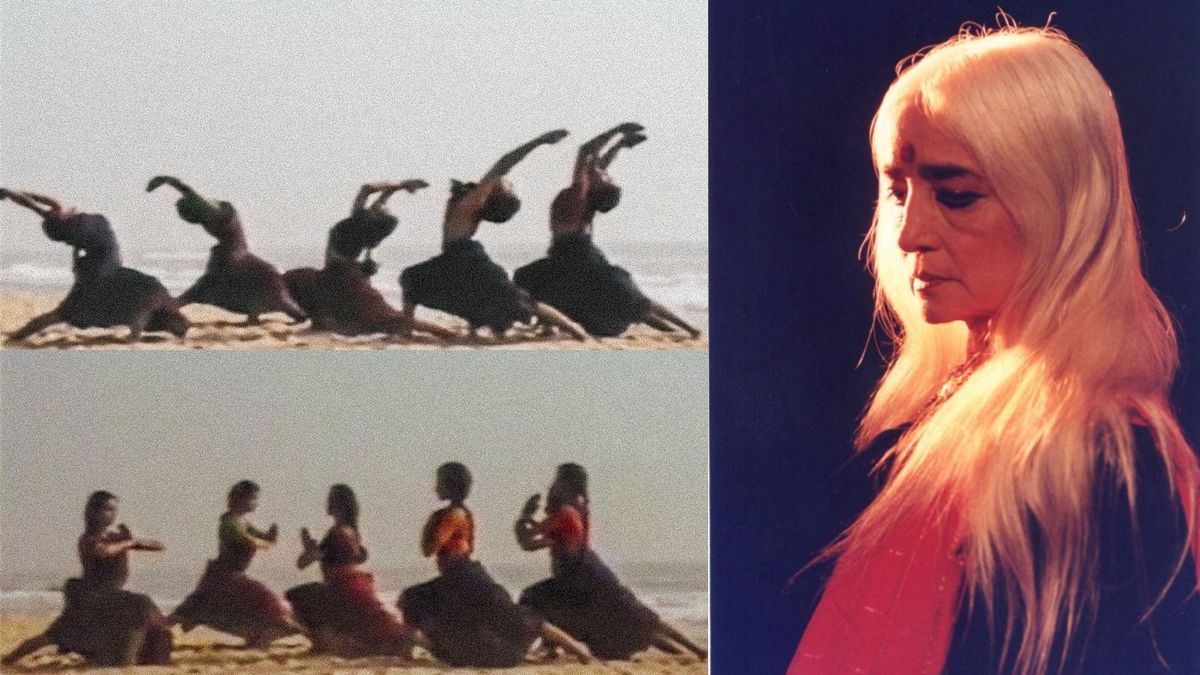
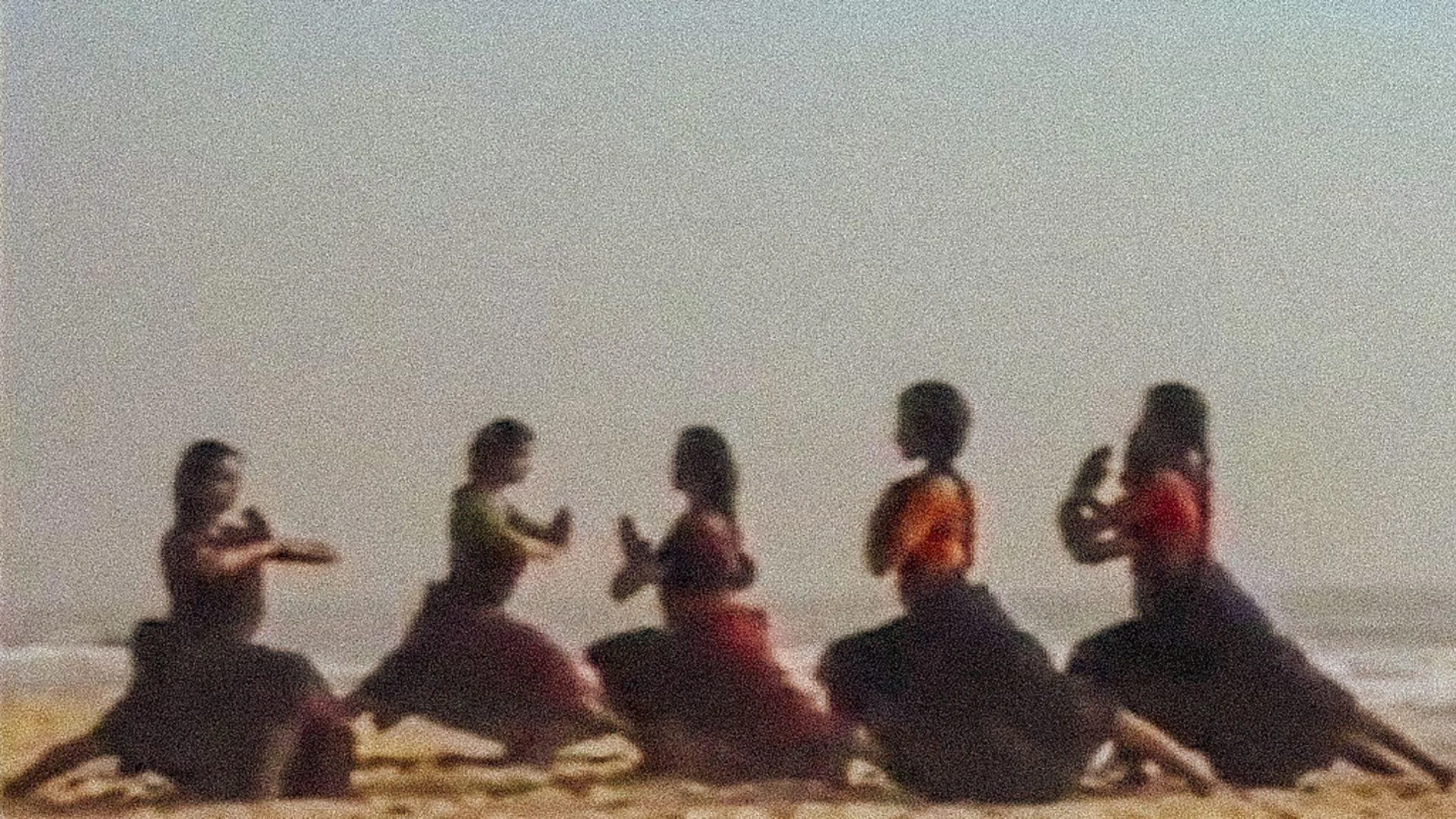
Several archives of moving images and photographs have documented Chandralekha’s artistic legacy. The Pad.ma film archives have reproductions of a 15-minute PTI television broadcast titled Tana Bana (1992). The documentary features SPACES in Chennai, an alternate experimental dance centre founded by Chandralekha. In the film, she can be seen practising with her students in the inner courtyard, called Mandala Theatre, and afterwards performing the ‘Namaskar’ at Eliott’s Beach in Chennai.
In the film, Chandralekha asks, “What is namaskar? To me, it carries the potential of the dignity of the body. What does namaskar mean? Is it just a genuflection? That you dive at someone’s feet? You go limp? NO. To me, the concept of namaskar is that all of your body will show what is the dignity of the body.” Chandralekha’s intervention through ‘Namaskar’ is also a response to the horizontal position in which women are depicted in the canons of Western art history.
Chandralekha responds to the genuflection widely imposed upon the feminine corpus by extensively training her classical dancers in martial stances of rectitude, in which the upright spine symbolises feminist ethics, political agency and the dignity of the body. Thus, a new form of namaskar emerges, grafted from the martial stances of Kalari. It is far from the soft, supplicant, gentle, rounded, and appeasing namaskar seen in the traditional genuflections of classical Indian dance.
This is most vivid in her final work, ‘Sharira’, which, in Sanskrit, means body. Created with poet and dancer Tishani Doshi, it is paired with the dhrupad — a traditional Indian musical genre which accompanies the explicitly embodied images of female sexuality. The dancer’s legs lift and part, her pelvis rising and falling, creating a triangular motif representing the yoni, the female sexual organ. In its angular form, the dancer’s body becomes reminiscent of Louise Bourgeois’s spider-mother sculpture. The slow choreography and controlled parting of the dancers’ legs bring the audience to confront female eroticism alongside the matrixial body, as the generative force of life itself.
Chandralekha’s body of work remains a living archive of resistance, one that continues to challenge how we think about embodiment, feminism and the politics of performance arts in India. For Chandralekha, choreography was the writing of dance as embodied resistance. She was a pioneer, far ahead of her time, whose work will continue to define what radical feminist practice looks like for generations to come.
