


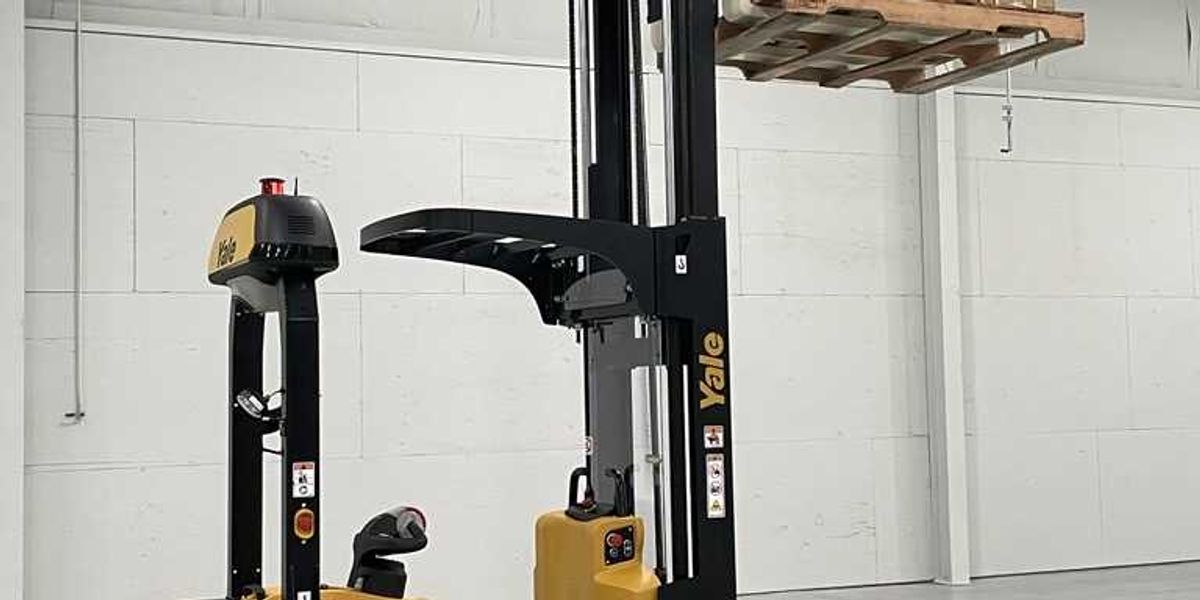
Yale Lift Truck Technologies has added a counterbalanced stacker to its Yale Relay automated lift truck platform. Yale Relay combines software, navigation technology, and specially designed trucks to help warehouses deploy and manage automated or self-driving lift trucks without needing custom coding.
Relay provides a portal where users can map their facility, define lift truck routes and waypoints, and create jobs for the trucks by dragging and dropping icons instead of writing software code. A fleet of automated Yale trucks then executes the jobs sent to them from the portal. These automated trucks are equipped with laser‑scanner (LiDAR)‑based navigation, safety sensors, and onboard controllers. This drag-and-drop model allows warehouses to deploy autonomous forklifts in their facility faster and more cost efficiently.
Yale introduced the Relay platform last year at the ProMat trade show with an automated tow tractor, which can pull carts or trailers but does not lift loads. The forklift manufacturer has now added a counterbalanced stacker which can lift pallets vertically and place them on the floor, in stage lanes, or into low‑ to mid‑level racking. Stackers are typically smaller and do not have the same lifting capacity or lift heights as a standard sit‑down forklift. The Yale Relay counterbalanced stacker is capable of handling loads up to 3,300 pounds and reaching lift heights of approximately 13 feet. This model enables warehouses to automate putaway and retrieval tasks in stage lanes, and it can pick or place pallets on conveyors, stretch wrappers, or even some low‑ to mid‑level racking positions.
Yale anticipates that it will add more lift trucks to the Relay platform in the future.
