



Are you still looking at plays and symphonies and exhibits as your starting point? A reasonable approach in 1976. Big mistake in 2026.
As an arts leader, one running an arts organization, how do you start putting together your season? It’s March, after all, and your marketing people want you to have something to tell the press shortly, right?
Do you do what leaders have done (and been taught to do) for decades: dream up a season that fulfills your needs to be popular and at the same time, scratches your itch to be artistic? Is that where you start? You start by planning your art based on your vision?
It’s 2026, folks, and no one’s buying what you want anymore. They’re buying what they need. And if you’re a nonprofit arts organization, you have no business “leading the audience” (a hackneyed phrase) by so-called “curating.”
(For-profit arts organization? Do whatever you want, as long as the money pays the investors.)
In other words, if you’re not asking your community leaders what they need before you do any kind of artistic planning, you’re just as toxic and elitist as your worst donors and board members.
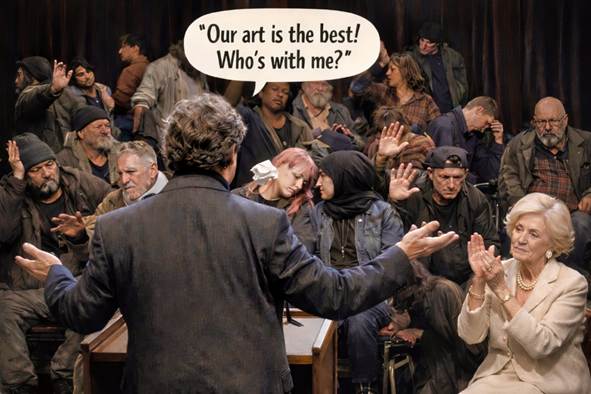
You can’t hope for change in the results of your work if you approach it the same way every year. If you’re just sending last year’s budgets out to your department heads (for a large or medium-sized organization) or doing the whole thing yourself to save time and eliminate buy-in, you will almost certainly fail in today’s world of nonprofit arts organizations that choose to serve their community first.
Simon Sinek famously wrote Leaders Eat Last. In describing the book to others, his website uses this description.
For a company to be successful, its leaders need to understand the true purpose of their organization, and use that purpose as a northstar not only in how they conduct themselves as a business, but also in how they care for those in their charge.
Servant leadership is the notion that our anthropological neurochemistry makes it natural for us to protect each other and show empathy, rather than just boss others around because of our social status. In the nonprofit world, that notion extends to the true owners and beneficiaries of the work: the community itself. The community pays the taxes of every nonprofit and has a right to determine (even if they don’t agree with the mission) whether the community is being served. The IRS even defines the kinds of activities it has determined allow that tax exemption, as we’ve quoted numerous times in this column (and which you can read for yourself if you click the previous link).
The community, then, is the owner.
Who the hell does business without asking the owner what they need first?

Because too many arts leaders (those that follow their own, phantasmagorical “artistic vision,” a meaningless, shadowy phrase that should be stricken from every arts leader’s vocabulary) are new to the idea of asking the community what they need, there are some baby steps that can be taken by even the largest of the behemoths out there.
Baby step one: ask the right person in the neighborhood, town, city, or region what they need in order to make things more equitable for all and reduce the physical and mental obstacles that keep their people back. This is not merely asking about what issues to address; it is a call to action to get those issues addressed with your leadership.
Baby step two: attack the inequity by partnering with organizations that do just that, finding ways for them to be funded by your work, and determining how you are going to measure success — not by what you did (really, that’s unimportant in the scheme of things), but by what the community did in response to your art.
Baby step three: provide proof, not by your finances or counting audience members or some sort of critical acclaim, but by issuing metrics the world can measure. You can’t measure art (and no one should be asking you to). You can measure impact. Do that.
When you come to terms with the fact that your nonprofit organization’s art is only a catalyst to progress for your community — and not the actual progress itself — only then can you begin to put together a season to solve a problem, not merely to sell tickets.

Use your board extensively to discover your community’s needs. If they’re only connected to your organization because of the money that they provide, you’ve got a rotten board. Similarly, if they’re connected even though they can provide little money, you’ve got a rotten board. These are the people who report directly to the owners of the company. They’re the ones that the community has trusted to do the right things, not the pretty or artistically satisfying things. The community wants your nonprofit to succeed, just like they want all the nonprofits to succeed. They have a financial stake in your impact. Show them you care about their health and wellbeing first and foremost in tangible ways (especially to hard-pressed beneficiaries), and the community will thank you with support instead of crumpling up paper and throwing it at you.

Related
