

11 Passengers Experience Heat Illness After GlobalX Airlines Airbus A320 Loses Air Conditioning


An Immigrations and Customs Enforcement aircraft operating for the United States had to divert and return back to the airport of departure after the air conditioner onboard the aircraft experienced issues. Reports suggest that around a dozen passengers experienced heat-related illness, which resulted in them being transported to a local hospital upon landing back at Gateway Airport.
The aircraft returned to its point of origin
Yesterday, a GlobalX Airbus A320-200
aircraft, shortly after departing from Mesa Gateway Airport in Phoenix, Arizona, according to reports from FOX10, experienced a technical issue with the air conditioning system onboard. This issue prompted the flight crew to divert the aircraft back to Gateway Airport. Reports indicate that the aircraft involved was a US Immigration and Customs Enforcement (ICE) plane.
Data from FlightRadar24.com shows that the A320, which was originally planned to fly to Alexandria, Louisiana, before the technical issue forced the aircraft to land back at Gateway 30 minutes after the initial departure.
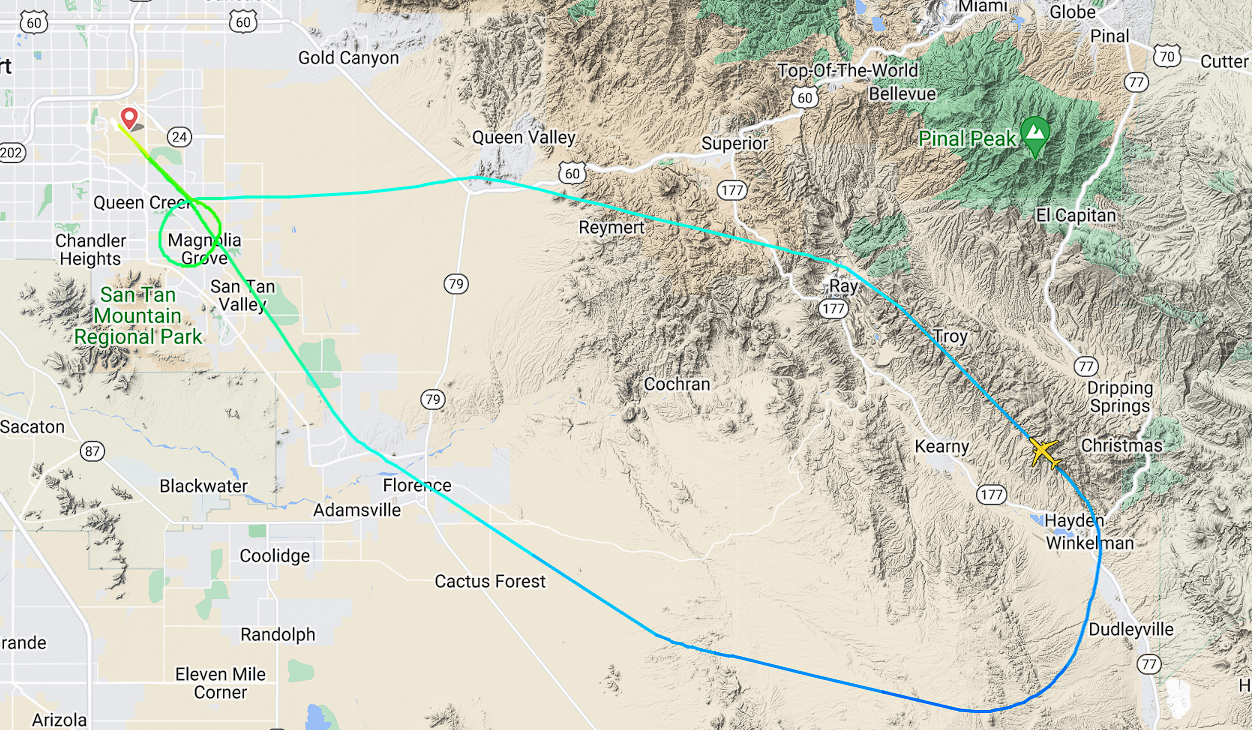
According to the GPS data available, the aircraft climbed to an altitude of almost 20,000 feet before commencing its descent back to Gateway.
While the aircraft has not flown since the incident, data shows that the aircraft is scheduled to fly to Alexandria once again later today, suggesting that the technical issue with the aircraft is expected to be rectified by then.
Simple Flying has reached out to GlobalX to know any further details regarding the incident. Any response will be updated in this article.
Passengers onboard needed medical attention
While being onboard an aircraft without air conditioning can be uncomfortable at the best of times, the high temperatures of Phoenix, Arizona, had a negative impact on the passengers aboard the aircraft. Reportedly, 11 passengers suffered heat illness and were transported to a local hospital after the aircraft landed back at Gateway Airport.
According to data reported by KTAR news yesterday, the city of Phoenix broke a 35-year-old heat record, with temperatures as high as 113 Degrees Fahrenheit (45 Degrees Celsius) was measured at Phoenix Sky Harbor International Airport
(PHX).
Considering jet aircraft are pressurized, the lack of external airflow, along with the record-high temperatures outside, would certainly have taken a toll on the passengers. If a member of the flight crew or cabin crew had been affected, there could have been serious flight safety concerns.
Additionally, an issue with the aircraft’s air conditioning system could sometimes also negatively impact the cabin pressurization of the aircraft.
How does air conditioning impact cabin pressurization?
Air conditioning onboard aircraft is essentially air taken in by the engines, which is then cooled and pressurized, and pumped into the cabin, thereby keeping the temperatures low and the cabin pressurized. The air pressurizes the cabin to around 8,000 feet* (also known as Cabin Altitude), and the air is circulated as required and is expelled from the aircraft via the outflow valve.
*Latest generation aircraft such as the Airbus A350 has an even lower cabin altitude.
Thus, an issue with the aircraft’s air conditioning system would mean that, apart from not being able to control the temperature, the lack of proper airflow could also affect the pressurization capabilities of the aircraft,
which can have catastrophic consequences
.

Photo: Sharkovski | Shutterstock
A pressurization failure can result in everyone onboard suffering from hypoxia due to a lack of oxygen. While the
use of oxygen masks onboard
should enable passengers to stay conscious and pilots to safely bring the aircraft down to a safe altitude, if the onset of hypoxia is not recognized or there is an explosive cabin depressurization, the chances of survival are quite low.
The higher the altitude, the more drastic the pressurization change and the lower the reaction time available to put on the oxygen masks.
