


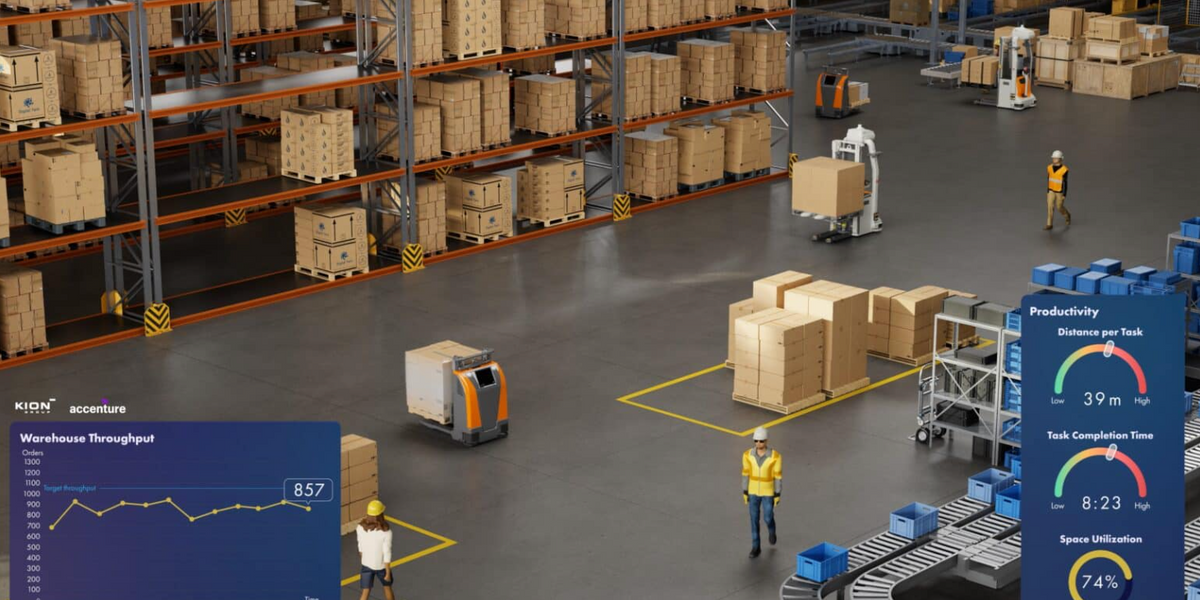
German lift truck giant Kion Group will work with the consulting firm Accenture to optimize supply chain operations using advanced AI and simulation technologies provided by microchip powerhouse Nvidia, the companies said Tuesday.
The three companies say the deal will allow clients to both define ideal set-ups for new warehouses and to continuously enhance existing facilities with Mega, an Nvidia Omniverse blueprint for large-scale industrial digital twins. The strategy includes a digital twin powered by physical AI – AI models that embody principles and qualities of the physical world – to improve the performance of intelligent warehouses that operate with automated forklifts, smart cameras and automation and robotics solutions.
The partners’ approach will take advantage of digital twins to plan warehouses and train robots, they said. “Future warehouses will function like massive autonomous robots, orchestrating fleets of robots within them,” Jensen Huang, founder and CEO of Nvidia, said in a release. “By integrating Omniverse and Mega into their solutions, Kion and Accenture can dramatically accelerate the development of industrial AI and autonomy for the world’s distribution and logistics ecosystem.”
Kion said it will use Nvidia’s technology to provide digital twins of warehouses that allows facility operators to design the most efficient and safe warehouse configuration without interrupting operations for testing. That includes optimizing the number of robots, workers, and automation equipment. The digital twin provides a testing ground for all aspects of warehouse operations, including facility layouts, the behavior of robot fleets, and the optimal number of workers and intelligent vehicles, the company said.
In that approach, the digital twin doesn’t stop at simulating and testing configurations, but it also trains the warehouse robots to handle changing conditions such as demand, inventory fluctuation, and layout changes. Integrated with Kion’s warehouse management software (WMS), the digital twin assigns tasks like moving goods from buffer zones to storage locations to virtual robots. And powered by advanced AI, the virtual robots plan, execute, and refine these tasks in a continuous loop, simulating and ultimately optimizing real-world operations with infinite scenarios, Kion said.
