Support CleanTechnica’s work through a Substack subscription or on Stripe.
Or support our Kickstarter campaign!
Despite the fossil-friendly direction of US energy policy, domestic innovators in the clean tech field just can’t stop innovating. Somewhat ironically, that’s especially true in the iconic oil and gas-producing state of Texas, where activity in the sustainable aviation fuel field has been stirring like a hornet’s nest. The latest news comes from Houston, where the startup Syzygy Plasmonics has just taken a big step towards pushing traditional kerosene jet fuel out of the picture.
The Case For Sustainable Aviation Fuel
In terms of aircraft decarbonization, sustainable aviation fuel seems like a second choice compared to electrification. Biofuels and other combustibles don’t eliminate tailpipe emissions, though they do help prevent new fossil fuels from circulating through the economy. Electrification would be the first choice, and that is already emerging in the areas of battery-electric and fuel cell-electric flight, including a new generation of electric VTOL (vertical take-off and landing) and wing-in-ground aircraft.
Still, so far the electrification movement has been confined to relatively small aircraft and shorter routes. Those short hops account for a significant amount of aircraft emissions, but the global fleet of full sized passenger planes and other upsized aircraft requires next-level propulsion systems that just aren’t ready yet.
That helps explain why investors have been pumping money into new alternative liquid fuels that can be used in existing aircraft, including fuel made from plastic waste and used cooking oil. Scaleup has proved slow, though, and in the meantime a different and potentially more effect approach to sustainable aviation fuel has emerged in the form of e-fuels, or electrofuels.
E-fuels leverage renewable electricity, green hydrogen, and captured carbon to synthesize new liquid hydrocarbon fuels that can serve as drop-in replacements for their fossil-sourced counterparts. The industry has already begun to scale up in Texas, one example being the massive Project Roadrunner facility under the wing of the US firm Infinium.
The Syzygy Plasmonics Solution
Syzygy has come up with a different variation on the e-fuels theme. The startup has developed a photocatalytic system that deploys renewable energy to produce light for a biogas reactor, now trademarked under the name Rigel™.
“Syzygy Plasmonics uses its proprietary Rigel™ photoreactor to run chemical reactions with light instead of combustion—cutting emissions and energy use,” the company explains. The catalysts are interchangeable, enabling the reactor to produce hydrogen, syngas, and other fuels and chemicals at a scalable rate from 1 ton to more than 100 tons per day.
On the sustainable aviation fuel side, Syzygy deploys waste gas culled from landfills, dairies, or wastewater, without relying on the high heat needed for conventional steam methane reforming. The technology was developed at Rice University in Texas over the course of two decades of research by Professors Naomi Halas and Peter Nordlander.
The idea of deploying light to create or break chemical bonds was first introduced by Japanese researchers back in the 1970s. That seems simple enough, but little progress was made towards commercial applications over the next 40 years. That changed after 2016, when Nordlander and Halas published their a new “antenna” system based on plasmonic metallic nanoparticles (see lots more details here).
The Oil & Gas Connection: Follow The Money
The alternative fuel field is ripe with skills and resources transferred from the oil and gas industry, and that applies to Syzygy as well. Along with Nordlander and Halas, the company was co-founded by two professionals in the industrial oil services field, Trevor Best and Dr. Suman Khatiwada. They came across the antenna solution while searching for a new business opportunity.
Syzygy soon caught the attention of the US Department of Energy, which supported the path to commercialization through its ARPA-E funding office. The National Science Foundation also chipped in with a small business grant, and then it was off to the races. By 2022, Syzygy was already into a $76 million Series C funding round led by Carbon Direct Capital, with investors including Aramco Ventures, Chevron Technology Ventures, Equinor Ventures, EVOK Innovations, GOOSE Capital, Sumitomo Corporation, and Toyota Ventures, among others.
In 2023, Syzygy also formed a strategic partnership with Mitsubishi Heavy Industries America. “This investment will help Syzygy Plasmonics to accelerate commercialization and continue its development of innovative alternative technologies, particularly those that contribute to the hydrogen ecosystem and CO2 ecosystem,” Syzygy explained.
Syzygy finally came across the CleanTechnica radar in 2024, when the company applied its photocatalytic system to crack ammonia without running into the problem of NOX (nitrogen oxide) intermingling.
A Giant Step For The Sustainable Aviation Fuel Of The Future
Fast-forwarding to 2026, Syzygy is marketing a modular system under the trade name NovaSAF™. If all goes according to plan, the company’s first commercial-scale deployment will be the forthcoming NovaSAF-1 plant in Durazno, Uruguay.
“It will leverage biogas from the Estancias Del Lago powdered milk plant and Uruguayan renewable electricity to produce synthetic paraffinic kerosene (SPK) SAF with 90% lower lifecycle emissions than fossil jet fuel while demonstrating attractive project economics,” Syzygy explained in a press statement on January 20, with SAF being short for Sustainable Aviation Fuel.
By attractive, they mean competitive with other alternative fuels. “At scale, Syzygy’s deployment model is anticipated to be cost-competitive – and even out-perform – other SAF pathways, which rely on supply-constrained feedstocks such as used cooking oil,” the company asserts.
In the same announcement Syzygy also noted that the leading global commodities firm Trafigura has agreed to a six-year, binding sustainable aviation fuel off-take agreement, indicating confidence in the company’s business model.
The Trafigura connection also indicates another fossil fuel crossover into the lower-carbon economy of the future. “We deploy infrastructure, market expertise and our worldwide logistics network to move oil and petroleum products, metals and minerals, gas and power from where they are produced to where they are needed,” the company says of itself, while noting that it is also investing in renewable energy ventures.
And, More Steps
In December, Syzygy completed the FEED (Front End Engineering Design) for NovaSAF-1. The next step is a fresh round of investment to begin construction, so it will take a while before the sustainable aviation fuel begins to flow from Uruguay. Nevertheless, Syzygy is already planning for global reach.
“With this commercial blueprint established, the company is positioned to replicate the project model globally and accelerate cost-competitive SAF production world-wide,” the company asserts.
That’s quite an ambition, considering the fossil-driven trajectory of domestic energy policy. However, it’s a big world out there, and the US is not the only market for sustainable fuels.
For that matter, an entire region of the US just doubled down on clean aviation. On January 8 the new Cascadia Sustainable Aviation Accelerator launched in Washington State, tasking itself to “rapidly accelerate production, deployment, and adoption of sustainable aviation fuel across the Pacific Northwest.”
Keep an eye on Boeing and Washington State University, which are both key stakeholders in the effort.
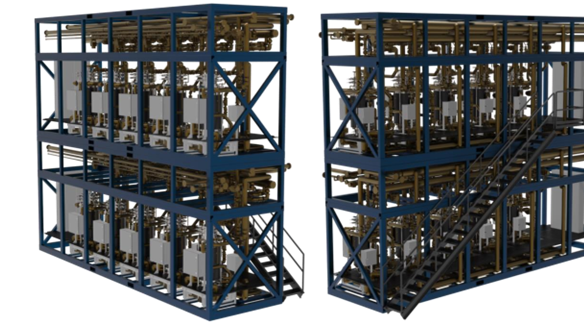
Photo: The US startup Syzygy Plasmonics is on track to scale up sustainable aviation fuel produced from waste gas in a reactor powered by light, not heat (cropped, courtesy of Syzygy).
Support CleanTechnica via Kickstarter

Sign up for CleanTechnica’s Weekly Substack for Zach and Scott’s in-depth analyses and high level summaries, sign up for our daily newsletter, and follow us on Google News!
Have a tip for CleanTechnica? Want to advertise? Want to suggest a guest for our CleanTech Talk podcast? Contact us here.
Sign up for our daily newsletter for 15 new cleantech stories a day. Or sign up for our weekly one on top stories of the week if daily is too frequent.
CleanTechnica uses affiliate links. See our policy here.
CleanTechnica’s Comment Policy