

AIDEF Tells 8th Pay Commission: Five-Unit Family Formula Justified for Fixing Minimum Pay – Indian PSU

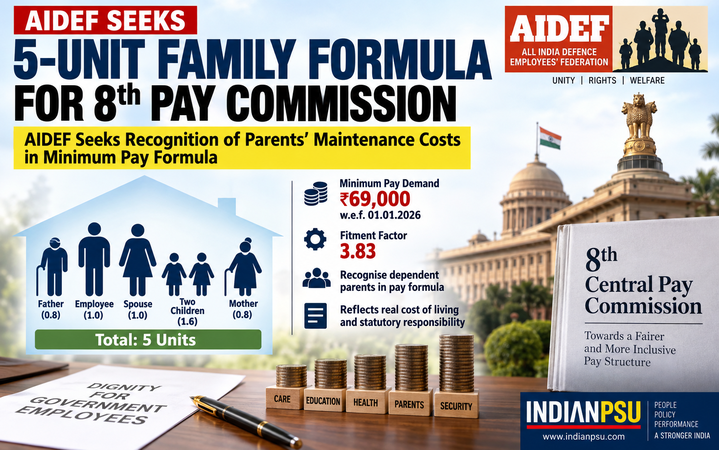
The All India Defence Employees’ Federation (AIDEF) has argued that the traditional three-consumption-unit family model used for determining minimum pay for Central Government employees needs to be reviewed, with a five-unit family framework being more relevant to present-day economic and social realities.
In a detailed note submitted to the 8th Central Pay Commission (8th CPC), AIDEF General Secretary C. Srikumar has argued that dependent parents must be recognised while determining the minimum pay of government employees. The federation has reiterated its demand for minimum pay of ₹69,000 and a fitment factor of 3.83 with effect from January 1, 2026.
AIDEF said the issue assumes greater significance in view of the statutory responsibility of children towards their dependent parents under the Maintenance and Welfare of Parents and Senior Citizens Act, 2007.
Three-unit formula leaves dependent parents out
The traditional family consumption model adopted for minimum wage calculations provides for three consumption units:
- Employee – 1 unit
- Spouse – 0.8 unit
- Two children – 1.2 units
- Total – 3 units
According to AIDEF, the model does not separately recognise dependent parents, despite the fact that a Central Government employee may simultaneously have financial responsibility for a spouse, children and elderly parents.
The federation argues that this creates a policy gap between the legal responsibility to maintain dependent parents and the methodology used for calculating minimum pay.
Maintenance of parents is a statutory responsibility
AIDEF has cited Section 4 of the Maintenance and Welfare of Parents and Senior Citizens Act, 2007, which recognises the responsibility of children to maintain their parents when they are unable to maintain themselves.
The federation has also pointed to the Act’s broad definition of maintenance, covering food, clothing, residence and medical attendance and treatment.
According to AIDEF, therefore, expenditure on dependent parents cannot simply be treated as discretionary financial support. It can involve recurring expenses related to food, accommodation, medicines, diagnostic tests, healthcare, transportation and personal care.
AIDEF proposes five-unit family model
The federation has proposed replacing the traditional three-unit model with a five-unit normative family framework that expressly recognises dependent parents.
Its proposed structure is:
| Family member | Proposed consumption units |
|---|---|
| Employee | 1.0 |
| Spouse | 1.0 |
| Two children | 1.6 |
| Dependent father | 0.8 |
| Dependent mother | 0.8 |
| Total | 5.2, rounded to 5 units |
AIDEF says the proposed framework would better reflect the financial responsibilities of employees who support elderly parents.
2026 cost of living needs fresh assessment
The federation has argued that the question before the 8th CPC is not whether the historical three-unit formula was appropriate when it was introduced, but whether it adequately reflects economic conditions in 2026 and the period for which the 8th CPC’s recommendations will remain applicable.
AIDEF has called for consideration of contemporary expenditure on food and nutrition, housing and rent, fuel and electricity, clothing, education, transportation, healthcare, communication and digital services, along with the cost of maintaining dependent parents.
It has also argued that minimum pay should provide for a dignified standard of living rather than merely subsistence.
Nutritional requirements also need reassessment
AIDEF has further argued that nutritional requirements should be assessed realistically, taking into account the nature and intensity of work.
The federation has cited dietary recommendations attributed to the Indian Council of Medical Research (ICMR), pointing to higher energy requirements for adults engaged in heavy physical work. It has cited approximately 3,490 kcal per day for adult males and 2,720 kcal for adult females in the 15–59 age group engaged in heavy work.
AIDEF says a uniform calorie assumption could underestimate the expenditure required for employees engaged in physically demanding, outdoor or field assignments.
₹69,000 minimum pay and 3.83 fitment factor
Based on its assessment of contemporary living costs and the proposed five-unit family structure, AIDEF has reiterated its demand for ₹69,000 as minimum pay and a 3.83 fitment factor with effect from January 1, 2026.
The federation has urged the 8th CPC to examine the traditional three-consumption-unit methodology afresh and consider a five-unit normative family model that includes dependent parents.
The central argument put forward by AIDEF is straightforward: if an employee has a recognised economic responsibility towards dependent elderly parents, the cost of meeting that responsibility should also find a place in the methodology used to determine minimum pay.
