


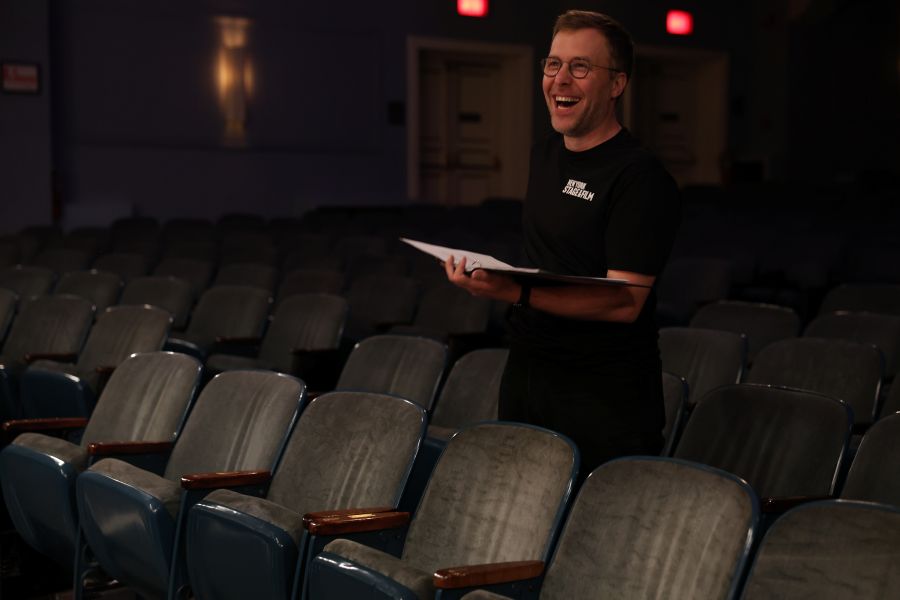
As people piled into the Symphonic Hall at Marist University in late July, you could feel the excitement in the building. Finally, the last character in the play had entered: the audience. A preshow kicked off the workshop, with a cast member asking the audience from where they’d traveled to attend the New York Stage & Film Summer Season. You could hear a cacophony of names of the various cities people had traveled from—and a soft murmur of Poughkeepsie, the upstate New York town where the new-work festival has been held for the last 41 years.
More than half of the audience had come some distance to enjoy the festival, hoping to catch the next big show before it heads to Broadway (or other places). As someone who traveled seven-plus hours by plane, bus, and train to get to the festival, I can attest that the trip was well worth it to spend a weekend immersed in new work. Taking the Metro-North Railroad from Grand Central into Poughkeepsie along the Hudson River, dotted with sailboats, was a real treat, bringing me to this theatre sanctuary.
“This is a safe haven for artists, far from the critical and commercial pressures,” said Ian Belknap, NYSF’s artistic director. His favorite thing about the readings and presentations, he added: the chance to “watch the audience watching the work.”
That’s easy to do in the festival’s intimate 130-seat space, Symphonic Hall, which brings audiences close to the actors and the newness of the pages. “Audiences’ reactions are the ‘final character’ in the development and are vital to the artist,” said Belknap. He wasn’t alone in this observation: The audience’s crucial role surfaced repeatedly in conversations over my time there.
Founded in 1985, New York Stage & Film has developed more than 1,000 new works, 20 of which have gone to Broadway, 150 to Off-Broadway, and more than 60 to regional theatres. Many of the projects on this summer’s program were being read, sung, signed, seen, and heard aloud for the first time. This year’s bare-bones table reads took place at Marist University, while closer-to-full-production presentations went up at the Bardavon 1869 Opera House. Through it all, there was an inescapable excitement in being on the ground floor of so much new work.
“It’s so wonderful to have a non-New York audience, because sometimes New York audiences can be very specific,” said Chay Yew, who directed a presentation of the musical Paper Menagerie, Lloyd Suh and Thao Nguyen’s adaptation of a short story by Ken Liu. Indeed, he said that the NYSF audience is “probably the best audience, because we don’t know how they think, and they don’t know what they’ll be seeing. So I think their reactions are purer, and I think it’s helpful for us to see where the audience is connected, where they are bored, where they are confused, and ultimately that informs the way that we see the next few steps for our work.”
There are increasingly fewer such spaces to try out new work, Yew noted. “These developmental labs have been the backbone of American theatre for some time, and in the last 10 years, they’ve been slowly dissolving. From maybe about 20 opportunities, they are now like a handful.” By contrast, he said, “New York Stage and Film has actually been consistent.”
After attending four sold-out readings with audiences of all ages and identities, it was clear to me that New York Stage & Film isn’t just a haven for risk-taking artists; it’s also a home for adventurous audiences. The audience consisted of regular theatregoers, alongside artists who were involved in developing work at the festival. Also spotted in the audience over the weekend: Mark Linn-Baker and Max Mayer, two of the company’s three founders.
With over 350 artists working on eight new plays, three new musicals, and 14 screenplays, the festival was abuzz. I was particularly eager to witness new work by one of my favorite writers, Quiara Alegría Hudes, the Pulitzer-winning playwright of Water by the Spoonful and book writer of In the Heights. I was lucky enough not only to be in the room for the reading of her newest play, Menafee, but also to sit in and observe rehearsal. Menafee, which Hudes herself directed, is based on the true-life story of Corey Menafee and illustrates how justice and integrity can lead to institutional change.
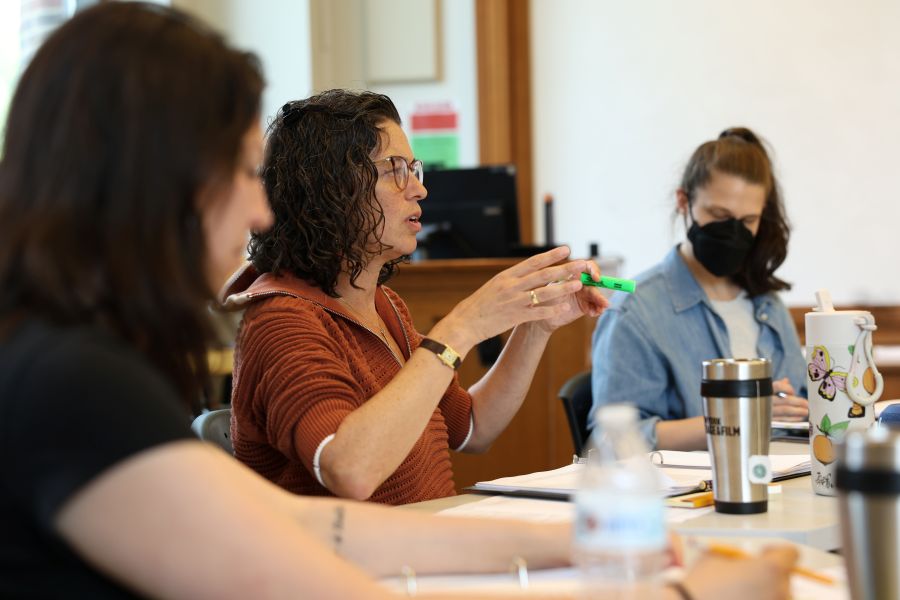
Rehearsals for New York Stage and Film completely took over the third floor of the Marist Student Center. Some workshops had been in rehearsal for two weeks, while others, like Menafee, had just five days in development at the festival before their reading for an audience.
At the start of rehearsal, Hudes and the entire cast—including Tony winner Priscilla Lopez—sat in a giant circle around each other, all in process. (Also on hand: Corey Menafee, the real-life inspiration for Hudes’s play.) The morning began with line edits, then moved to revising script pages, which led to in-depth questions from the actors.
The moment reminded me of something Belknap had told me earlier. “When I was in school, I didn’t know a living playwright,” he confessed. By contrast, at New York Stage & Film, he said, “The playwright’s intentions aren’t some vague standard. The playwright is in the room now; you know what they meant in the moment.”
Observing that Menafee rehearsal allowed me to see that moment in the flesh. Indeed, there’s a thrill in watching actors work with a playwright in real time and ask questions about the work as it’s developing. The actors are also the play’s first audience, before the readings are shared with the public. Elena Hurst, who played Q (the Quiara character) in Menafee, was able to ask questions specifically about the author’s experience. The questions the actors asked not only led them to a deeper understanding; they also prompted reflection on the part of the playwright herself. At one point, Hudes asked Ronald Peet, who played the title role, “What do you think, Ronald? You’re the one playing it.”
Said Hudes after the workshop, “It’s a distinct privilege to witness something being born. It’s exciting. New York Stage & Film has clearly developed an audience of folks who enjoy this moment of creative birth.” Hudes shared another tidbit during a Q&A after the public reading: When she found out that Menafee would be part of this year’s NYSF season, she added an eighth character, a student reporter. At the reading that night, the real-life reporter was on hand to hear the play’s first reading.
For her part, Hudes wasn’t merely sitting back and enjoying the performance. “I was listening for when the audience was listening,” she explained. “They were leaning in. They did me a solid with their attention and their laughter too. There’s a behemoth of a monologue in Act Two, and at its conclusion, the audience applauded. That was a surprise—it was almost like they were showing appreciation for the actor’s musculature, commitment, and ability at that moment, almost like applauding for a big 11 o’clock number, but in a play. These are things you don’t learn until you put the work out there.”
Also in the audience that night was her In the Heights co-author Lin-Manuel Miranda, who famously brought The Hamilton Mixtape to NYSF in the summer of 2013 (in the audience at that presentation: future Aaron Burr creator Leslie Odom Jr.), and who participated in the Menafee Q&A.
Stars or otherwise, there is something special about the audience that gets to witness a work’s first public appearance. You could visibly see the audience lean in at the reading of Kate Cortesi’s Daylight, a heart-wrenching show about a real-life prisoner, Joe Garcia, who used Taylor Swift’s music to get through his incarceration. As enthralled as I was with the story and the actor’s performances (under director Josiah Davis), I couldn’t help but look to see how it was all landing on Joe Garcia himself, who was in the audience.
The musical Boom for Real, with a score by John Legend and book by Marcus Gardley, tracks the meteoric rise and mysterious spirit of 20th-century painter Jean-Michel Basquiat. Before the reading began, director Kamilah Forbes got up to invite the audience into what she called a continuation of the rehearsal—“an exploration of the book, sharing of scenes and demos, some sung and a sharing of mythology.”
As Ian Belknap had recommended, I was watching the audience watch the play. I was particularly intrigued to see Gardley and Forbes in the back of the house, taking it all in, observing both the actors and the audience. What is theatre, after all, if it is not witnessed?
A later conversation with Forbes turned to the familiar reality: the scarcity of places to develop new work.
“When I think about spaces like The Lark Play Development Center, Sundance Theater Lab—there is a need for these spaces, and there are less and less of them in the world,” said Forbes. Without them, she continued, “New work is being built and born with no real place to be honed, to be interrogated, to be refined. It’s just sort of being written and then out in the world, and that’s not helpful for the field at large. Then you’re putting out in the world underbaked work as a finished product.”
Before audiences can become a show’s final collaborators, in other words, artists need rooms where that initial collaboration is still possible.
In yet another packed house, the audience gifted the creative team with bellowing laughs for the last show of the weekend. Trip Around the Sun, a hilarious and bittersweet play for “Parrotheads” (a.k.a. Jimmy Buffett fans) set in a Florida retirement community, written by Jake Brasch and directed by Shelley Butler. A funny show on a morbid topic, it garnered a range of reactions, from full-bellied laughs to silence to shocked gasps.
With tears in my eyes from laughing so hard, I looked around and found the audience laughing just as freely. I was witnessing a play in conversation with its first audience. Whatever happens to this Trip after the New York Stage & Film Summer Season, that shared experience had already become a part of its journey.
Cristina Marie Pla-Guzman is a performer, director, playwright, theatre journalist, and award-winning theatre educator. She is a member of the American Theatre Critics Association, a Theatre Communications Group Rising Leader of Color for Theatre Journalism, and a fellow of the Eugene O’Neill Theater Center’s National Critics Institute.
Source link
