

MSC marks First Import Rail Milestone at Adani ICD Malur, Strengthening Bengaluru’s Gateway to Global Trade

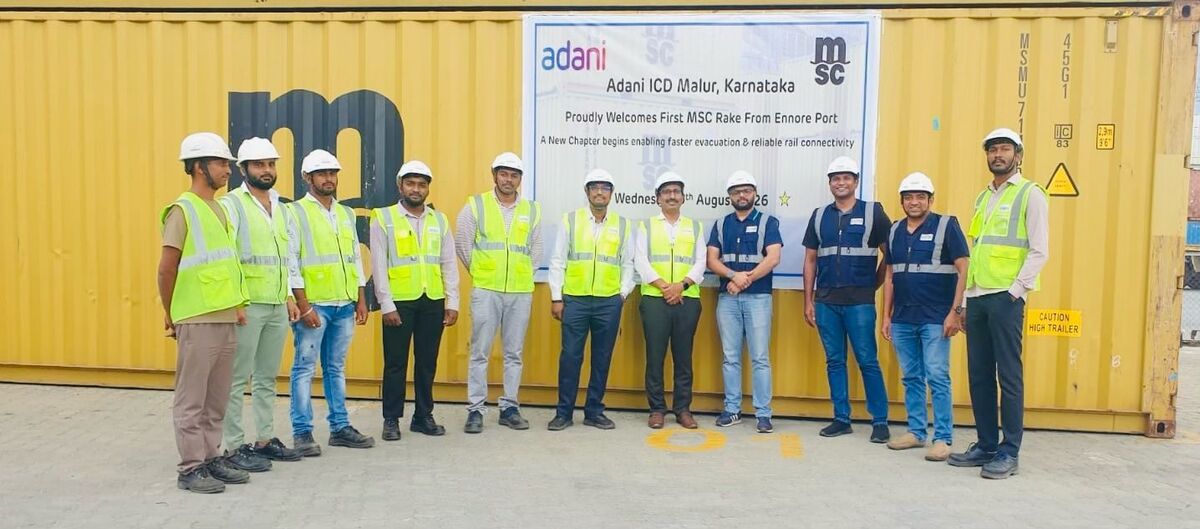
BENGALURU: A significant new chapter is unfolding in South India’s multimodal logistics landscape as MSC Mediterranean Shipping Company has flagged off its first import shipment through the newly launched Adani ICD Malur near Bengaluru, arriving as a full train rake of containers.
The landmark movement marks an important operational milestone for both MSC and Adani Logistics, signalling growing industry confidence in Malur as a strategic inland gateway for containerised EXIM cargo serving Bengaluru and the wider industrial belt of Karnataka and neighbouring states.
The successful movement comes at a time when South India is witnessing increasing demand for efficient rail-linked logistics infrastructure capable of connecting major manufacturing centres with international gateways. By moving the import containers as a complete train rake, the operation demonstrates the potential of rail-based inland transportation to provide a more streamlined and reliable alternative for long-distance cargo movement.
Malur Emerges as a New Inland Gateway
Located strategically along the Bengaluru–Chennai railway main line near Malur, the Adani ICD has been developed with its own rail siding and road connectivity through NE7 and NH44. The facility is positioned to serve the rapidly expanding industrial clusters of Karnataka while also providing connectivity to neighbouring Andhra Pradesh and Tamil Nadu.
The facility spans around 30 acres, with a further 21 acres earmarked for expansion. Its infrastructure includes terminal and gate operating systems, real-time control-tower capabilities, warehousing facilities and customs-related infrastructure, creating an integrated platform for container handling and inland cargo movement.
Adani Ports has also established Malur within its wider multimodal logistics network, with rail connectivity linking the facility to major gateways including Kattupalli, Ennore, Vizhinjam, Chennai and JNPT. The company has identified Malur as one of its locations for EXIM operations as part of its expanding logistics network.
MSC’s Move Adds Momentum
For MSC, the first import movement through Malur represents more than the arrival of another container train. It demonstrates the shipping line’s expanding inland logistics footprint in South India and its ability to connect international ocean freight with a strategically located inland terminal closer to cargo owners.
The full-rake movement can help consolidate container flows, improve rail utilisation and create greater predictability in inland transportation. For importers around Bengaluru, such connectivity has the potential to shorten the distance between port gateways and industrial destinations while reducing dependence on road-based long-haul movement.
The development also reinforces the importance of port-to-factory connectivity as India’s logistics ecosystem moves increasingly towards integrated multimodal supply chains.
Building a Rail-Driven Supply Chain
Adani ICD Malur had already demonstrated its potential earlier in 2026 when it handled an inaugural import block train carrying auto parts in a collaboration involving Maersk and Volvo Group, connecting Ennore Port with Malur. That movement was positioned as a step towards faster, more reliable and cost-effective supply chains across Karnataka, Andhra Pradesh and Tamil Nadu.
The latest MSC movement further broadens the significance of the facility by demonstrating that Malur is steadily developing into a shared logistics platform capable of supporting multiple global shipping lines and diverse cargo flows.
Adani Logistics currently operates a large multimodal network comprising logistics parks, container and bulk rail assets and warehousing infrastructure. Its container rail network connects gateway ports with inland logistics locations across India, including Malur.
A Strategic Boost for Bengaluru and South India
Bengaluru’s position as a major manufacturing, automotive, electronics, aerospace and technology hub creates substantial demand for dependable import and export logistics. A strategically positioned ICD with direct rail connectivity can bring international containerised cargo closer to these production and consumption centres.
The MSC–Adani Malur milestone therefore has significance beyond a single train movement. It reflects the gradual transformation of South India’s logistics architecture—from conventional port-centric cargo movement towards integrated port, rail, road and inland-terminal networks.
With shipping lines increasingly looking for efficient inland solutions and cargo owners seeking greater reliability, speed and supply-chain visibility, Malur could emerge as an important link between South India’s industrial heartland and global maritime trade.
Key Takeaways
• First MSC import movement: MSC has commenced its import operations through Adani ICD Malur with a full train rake of containers.
• Rail-first connectivity: The milestone highlights the growing role of rail-based container transportation in South India’s inland supply chains.
• Strategic Bengaluru location: Malur provides a direct logistics interface for Bengaluru and surrounding industrial clusters.
• Multistate hinterland reach: The facility is strategically positioned to serve cargo interests across Karnataka, Andhra Pradesh and Tamil Nadu.
• Port-to-factory integration: Connectivity with major ports strengthens the movement of international cargo deeper into the hinterland.
• Growing confidence in Malur: Following earlier block-train operations, the MSC movement reinforces Malur’s emergence as a new multimodal EXIM gateway for South India.
The Bigger Picture
The successful MSC import train is a strong indicator of how India’s inland logistics network is evolving. As containerised trade expands and manufacturers demand faster, predictable and increasingly sustainable supply chains, strategically located ICDs linked directly to the national rail network are becoming critical components of the country’s trade infrastructure.
For Bengaluru and the surrounding industrial corridor, Adani ICD Malur is increasingly positioned not merely as a container terminal, but as a critical bridge between India’s manufacturing hinterland and the global maritime supply chain.
