


Researchers from Germany’s Heidelberg University have been surprised to find that a recently unearthed 1800-year-old Roman tablet bears a multicultural group curse on its surface.
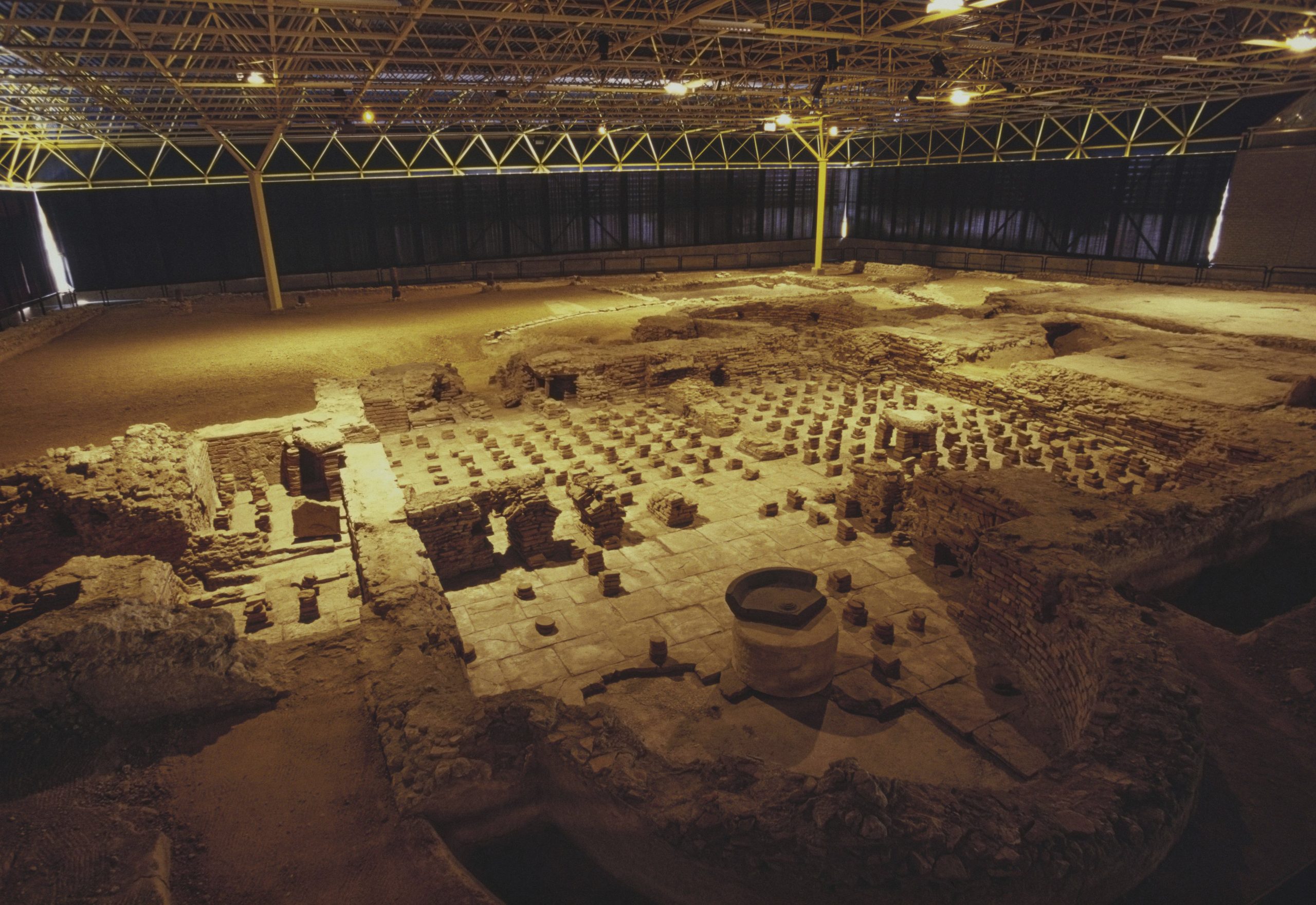
Dutch archaeologists found this curse tablet in a pit beneath Heerlen‘s town hall square. Archaeologists often frequent this area situated amid the former site of Coriovallum, a Roman military settlement along the Via Belgica, which once connected Belgium’s Tongeren region to Cologne. Today, the baths at Coriovallum remain the Netherlands’s largest visible Roman ruins.
The tiny 3.5-by-1.8-inch tablet then landed at Heidelberg University. There, crews dated the relic to the 2nd century, and determined it’s made of lead. According to press materials, Latin and Greek occultists favored this “heavy, cool-to-the-touch” material for their curse tablets, which they called defixiones or katadesmoi, respectively. Not only did practitioners find lead easy to work with, they also believed it possessed “binding” properties that, once inscribed and buried, helped inhibit one’s opponents in love, sports, and more.
Researchers examined the tablet using reflectance transformation imaging, which combines individual photos captured with varied lighting to create a rich, detailed image of any surface.
Heerlen curse tablet with an ancient Greek invocation of deities and demons in the Egyptian style. Photo: © Elke Fuchs, courtesy of the Institut für Papyrologie, Universität Heidelberg
Roman curse tablets aren’t terribly uncommon. Over 1,500 have reportedly turned up from Syria to the U.K., sometimes in troves numbering into the hundreds. This one, however, proved a bit vexing; it entreats demons and deities in a distinctly Egyptian style, using ancient Greek text, even though most tablets found throughout Northern Europe are written in Latin.
The curse itself consists of three magical symbols called characteres meant to speak the language of supernatural forces. Four names follow—two masculine names in Latin, and two feminine names in Greek—all of which belonged to slaves. “The tablet served either as a curse against these four slaves or as a curse in their name against an unnamed person,” said Rodney Ast, the academic director at Heidelberg University’s Institute for Papyrology, in press materials.
“It cannot be ruled out that one of the two women was the author of the inscription and had brought the supposed ability to communicate with divine powers through such curses with her from Roman Egypt,” added the Institute’s research associate Julia Lougovaya.
Joachim Quack, director for the school’s Institute of Egyptology, also noted that magic remained pertinent to Roman religious life as the empire grew—though harmful spells were more taboo than those meant for self-preservation.
“In the early centuries C.E., Near Eastern, Egyptian, Jewish, and sometimes even Christian traditions increasingly merged and spread throughout the entire Roman Empire of that time—a development that the discovery from Heerlen impressively underscores,” Quack stated.
The newly-deciphered tablet will go on view at the Heerlen Museum soon. Its inscription will feature in a scholarly publication, too.
