


Nearly half of Americans who use artificial intelligence to help them shop have later returned the AI-recommended item, a survey from supply chain software firm Blue Yonder has found.
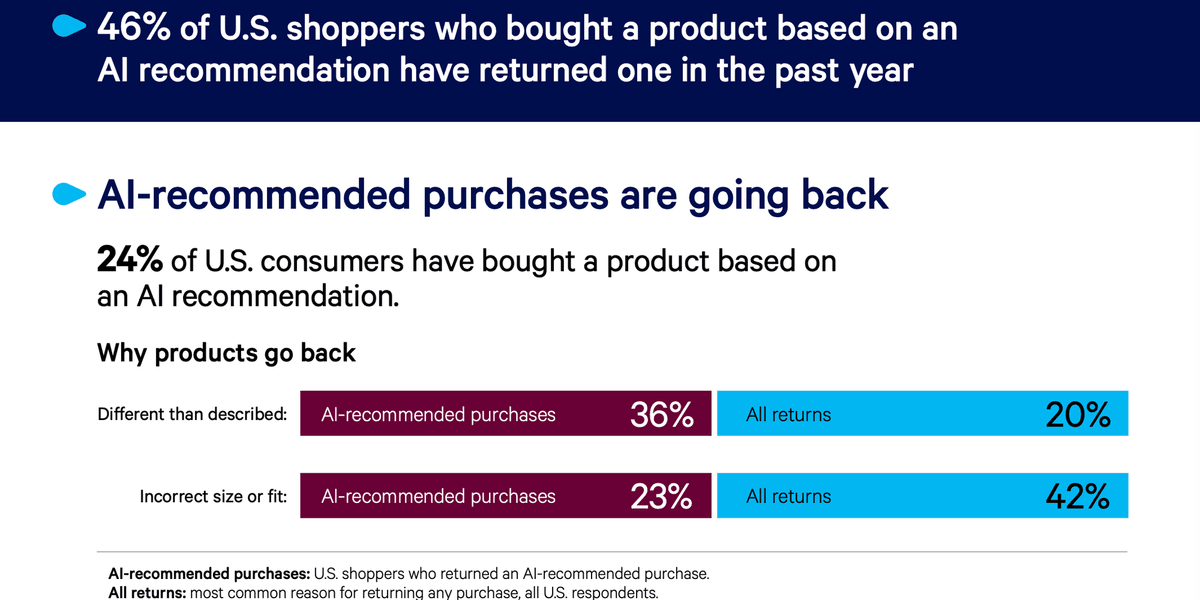
Online shoppers increasingly come in contact with an AI tool or assistant, such as a consumer chatbot. Of the 24% of U.S. consumers who have purchased a product after receiving an AI recommendation from that source, nearly half (46%) have returned one in the past year. The top reasons for U.S. shoppers returning an AI-recommended purchase are that it was different than described (36%) or was an incorrect size or fit (23%).
That order reverses for U.S. returns overall, where incorrect size or fit leads at 42% and different than described accounts for only 20%. The pattern suggests AI tools struggle less with fit than with describing products accurately.
Those numbers came from Dallas-based Blue Yonder’s fourth annual “2026 Consumer Retail Returns Survey,” which polled more than 5,000 consumers across the U.S., Australia, France, Germany and the U.K., including 2,000 Americans.
“Shoppers are taking AI’s advice faster than retailers are getting ready for it, and nearly half of them are sending something back,” said Duncan Angove, CEO of Blue Yonder. “That’s not really an AI problem. It’s a data problem. An AI assistant is only as good as the product information it can find, and most product data was written for a search bar, not for a machine suggesting products for someone. When what arrives doesn’t match what the shopper expected, it goes back in the box.”
The trend is significant because it means that retailers could soon be dealing with increasing volumes of returns, and the survey also found that shoppers continue to be highly sensitive to retailers’ policies.
Over half of U.S. respondents (51%) said that they have decided to buy from one retailer over another purely because it had a better returns policy. Nearly one-third (29%) have gone further and stopped shopping altogether at a retailer that implemented a stricter return policy in the last year. While Gen Z (47%) and Millennials (40%) were more likely to have stopped shopping at a retailer that implemented stricter returns policies in the past year, that number declines significantly among Gen X (24%) and Baby Boomers (17%).
In response, retailers are adopting new tracking technologies, such as using AI to monitor return histories and flag frequent returners. But some shoppers object: When asked about the practice, 30% called it a fair way to control costs and a quarter (25%) said it wouldn’t affect their shopping. However, 24% said it is invasive and would make them shop elsewhere.
“The instinct when returns go up is to tighten the rules,” said Angove. “But the data tells you how that ends. Flag shoppers as frequent returners and limit their returns, and eight in 10 say they’d cut back or walk away. And some of your most frequent returners are your best customers. The challenge is telling the difference between a shopper who abuses returns and a loyal customer who simply returns a lot. That takes systems that can set the right policy for each customer and handle every return as quickly and cheaply as possible. Done right, returns stop being just a cost and instead start earning loyalty.”
In addition to those challenges, processing returns can also be expensive, so many retailers are offering alternative policies. Over half (55%) of U.S. respondents have been told by a retailer to simply keep a product they wanted to return in the past year, unchanged from 2025, with 67% of those saying it made them more likely to shop with that retailer again. For retailers, a keep-it refund often makes economic sense when the cost of shipping and processing a return exceeds what the item could be resold for, provided they can spot the shoppers who would take advantage of it. Survey respondents said they would also accept store credit for a future purchase (51%), a discount or partial refund (31%), or a discount on a future purchase (28%), while only 21% would not accept any offer in exchange for not making a return.
