


A reflection on how the poets Richard Siken and Anne Carson responded to losing their language.
Did you know LARB is a reader-supported nonprofit?
LARB publishes daily without a paywall as part of our mission to make rigorous, incisive, and engaging writing on every aspect of literature, culture, and the arts freely accessible to the public. Help us continue this work with your tax-deductible donation today!
I HATED WASHING the dishes as a child. I was not tidy. My handwriting was chaotic, moving in and out of cursive. Legible only to me, that’s what I most liked about it. Its privacy. My mind moved faster than my fingers. I gave up on neatness, spelling, and consistency to get everything down before my mind moved on. But bright kids were supposed to be neat. The only thing I failed at school was the binder check. At random times, the teacher picked up everyone’s school materials. I was queer but didn’t know it; I knew only that I needed out of that town if I wanted to live. Getting an A in math and an A in English and an A in PE and an A in earth science was how I would do it. Notebook check: If loose notes and papers fell out, we failed. Loose papers, stickers, pencils, gum wrappers, a moldy sandwich crust, and a Lisa Frank slap bracelet fell out of my binder once. My neon embarrassment. If a tidy binder or neat handwriting was required to get out of that town, I would be stuck there now.
Anne Carson is a poet. In a 2024 essay, she detailed her experience with Parkinson’s disease. The disease is taking away her handwriting, her primary mode of writing. Carson describes writing as her primary mode of thinking. Richard Siken is a poet. In a recent book, he detailed his experience during and after a debilitating stroke that erased not only his memory but also his knowledge of grammar, of language. We wake up every morning and our memories remind us of who we are. I wake up many mornings anxious, but at least I know why. We are what we’ve lived, and how we reacted to it. The mind writes this all down in clear but mutable handwriting. The mind writes this down in cells because cells are all we are, and all we have with which to remember.
Poets, like memory, deal in the image. I was a messy child. I’m not myself without this knowledge. Picture me in the schoolyard, on a cement basketball court, in the rain because it was always raining, with mountains you could not see because of the clouds, and buildings across the street you could not see because of the rain. If I miss the free throw, I might not get an A in basketball, and if I don’t get an A in basketball, I might not get an A in PE, and if I don’t get an A in PE, I might never get out of there. Watch the ball leave my hand, the shocking orange of it against the gray of everything else, spinning against the wind. Hand in the cookie jar. Do you think I missed?
In the 17th century, René Descartes charted the dualistic relationship between the physical body and the mind. One of the 20th century’s most cruel discoveries was, of course, that the mind, and therefore consciousness, is made from the body. I am nothing but neurons and their connections. The human body contains some 40 trillion human cells, and our brain alone holds nearly 90 million neurons. A neuron is an electrified cell that can pass information along.
I realize now that not everyone can draw a neuron from memory. Cells are generally round or maybe oblong, garbage bag–like things filled with material. Some are motile cells in our immune system, searching, grabbing forward with a front edge, and pulling their back end away. Neurons are not motile once they form, but the information they pass is. Neurons stay put, like trees. From their oblong cell body, something like 100 spindly dendrites search out of one end, where signals come in, and there’s one long, thin axon where signals go out. The axon—and remember it is a single cell—can extend for inches, feet, even a meter; the longest axon in the human body extends from the top of the back to the bottom of the big toe.
Anything we sense––a photon of light, a molecule of smell, a touch––gets transmitted as bits of information to neurons and passed along to the brain. Anything we want to do gets sent from the brain, via neurons, to our muscles. Where our neurons meet our muscles, the latter may contract. I type these words on the keyboard as an end product of some millions of neurons communicating with my muscles, and my memory, which somehow understands that various movements involving my index and middle fingers will construct words. As a former pianist, I don’t even look at my hands.
Richard Siken’s 2025 book I Do Know Some Things recounts not only his stroke, the horror of it, but also the recovery. Most of us build language when we are still too young to remember the process. Through the haze of nostalgia, we might imagine language acquisition as delightful magic, but Siken’s horror at not knowing words with which to build the world around himself might better reflect what children feel.
Siken rebuilds the word and world from nothing, and writes it down. A poet can make us see common words anew, challenging and breaking the language we are given. Siken’s book, then, extends this work of the poet, or undermines it. It asks what a poem by a body-mind being destroyed can give us. It asks whether words can describe, and hold, the loss of meaning. Words about losing words, language about losing language.
In the poem “Metonymy,” Siken writes: “I said black tree when I meant night.” In “Bed,” he writes, “There were few nouns. They wouldn’t connect. I didn’t know fan. […] It would have been funny except for the yelling.” In “Landmark,” he writes, “There isn’t a word for it, moonlight, slippery. There isn’t a word for it, moonlight.”
Because the cells that make up the mind are material, they can degrade or die. When neurons degrade, starve, or die, the essential connections our minds make to our muscles start to sputter. In amyotrophic lateral sclerosis (ALS), for example, motor neurons degrade and die, cutting the communication that allows muscles to move. For reasons researchers don’t understand, the cranial motor neurons that move the eye are not impacted, which allows computers to use eye movements to type and facilitate movement. The impact of a stroke depends on what type of cells are damaged, and in what region of the brain.
In Siken’s poems in the present tense, we inhabit the moment of destruction. Imagine seeing the moon and not knowing what to call it. At my dear friend’s birthday party for her two-year-old, late in the lit hours of the day, the moon came out across the blue sky. Her daughter, and then all the children, started to cry. The moon wasn’t meant to be out during the day; it frightened them.
“Go home, moon!” she started to shout. Her mom asked her where the moon belonged; in the night sky, she replied. And then all the children were shouting. We laughed, but in the children’s eyes were tears and horror. Their childhood minds had not yet built a world where the moon sometimes showed itself during the day.
The brain is a careful, robust, and fragile place. The brain, the space of it, evolved over more than 500 million years, since the evolution of the simplest animals. Mice have brains and men have brains and worms have brains and birds have bird brains. Brains have structures, and all brains have neurons. Their electrification takes energy. Energy, in animals, requires oxygen. For an animal, there’s only one type of dead you can be: brain-dead. In college, I learned that the molecular definition of death was when neurons in the brain and body stop being electrified. It is these electrical signals, after all, that make the heart beat and muscles contract, release, and contract again to pull air into and push air out of the lungs.
After his stroke, Siken kept a notebook where he wrote down words and what they meant. His collection pulls poem titles from the words in his notebook. Writing, by hand, became a part of his recovery.
Words are the first metaphor, the word standing in for the object. If words lose their primary meaning, then metaphor has left the room. How to get into the room of metaphor again? We write. “A doorknob is a rock for the hand. It opens a hole in the wall,” Siken writes, and I can feel the rock in my hand. There is no metaphor here, only a search for the meaning that comes before metaphor.
These poems are found early in the collection, not long after the stroke. In interviews, Siken talks about the book as moving chronologically from the injury to the search for early memory, to remaking words, and, toward the end, to the more complex formations of language like humor, love, resentment, and desire. Because without language and without memory, there is only the image.
In a 2025 essay for the London Review of Books updating the earlier piece, Anne Carson writes, “When I was diagnosed with Parkinson’s disease a symptom particularly mortifying to me was that my handwriting disintegrated.”
The body will make a scientist of us all, particularly in the moments when it fails us. And it will fail. “Of course everyone is striving all their life,” she writes. “And none of us will win against mortality.”
Like Siken, Carson is writing from the inside of neurodegeneration. Siken’s type: fast, with function that can recover. Carson’s: slow, degenerative, with disintegration that can only be slowed.
“I think of handwriting,” Carson writes, “as a way to organise thought into shapes. I like shapes. I like organising them.” But “now the upright strokes bend or break or go in all directions, vowels shrink to blobs, slant loses its smooth smart angle, it all looks just embarrassing.”
For Carson, the fragmentation of her handwriting is not merely aesthetic: “The precisely controlled movements of handwriting lead to patterns in the brain that promote learning. The brain opens, deepens and enriches itself. There is in it (speaking subjectively) an exhilaration and a feeling of homecoming.”
Parkinson’s is a lifelong degenerative disease. Mortality appears to Carson, now in her seventies, as a black doorway: “You begin to notice the black doorway is always there, at the edge, whether you look at it or not. Most moments contain it, most moments have a sort of sediment of black doorway at the bottom of the glass.” She might not die of it, but unless biomedicine changes the game, Carson will die with Parkinson’s. Siken’s stroke could well have killed him. Sometimes, survival is more harrowing.
In her three-part essay “Thret,” a long piece from her 2024 collection Wrong Norma that’s at least partially about the joys of thinking, Carson writes: “We call it thinking when data coming in from the world passes through and out of the brain different than when it arrived.” Our mind acts on the world through thinking. Again, in the same piece, Carson writes: “Matching wits. It’s the best thing in life.” Following a reading of this piece, Carson described the thinking that occurs between reader and writing as matching wits. Memory is data, and thinking is what we do with it. Thinking, of course, requires memory, and memory requires neurons. Humiliating.
“That’s the immortality of poetry,” Carson said in conversation with critic Michael Silverblatt. “It doesn’t mean you live on after death; it means there are moments of time in your life where you forget you are mortal. You forget time. I think language can do that for us.” I do not long for the singularity, to have an intact mind forever. It is through my mind, because it is not forever, that I can feel, that I have felt, the moments in time Carson describes above.
Parkinson’s is a disease of starving neurons. The cells appear to be starving themselves. Dopamine is a neurotransmitter—it activates the space between neurons to allow communication between them—and Parkinson’s impacts neurons of this flavor in a specific region of the brain (the substantia nigra) that is critical for muscle movement. For unknown reasons, a protein in all brains (alpha-synuclein) misfolds and aggregates in people with Parkinson’s disease, although whether this is a cause of the disease or simply correlated with it remains unknown. When it comes to Parkinson’s, like many other neurodegenerative diseases, there is much thinking that remains to be done.
Carson is not new to the topic of disintegration. She has been writing about neurodegeneration specifically, including the science of it, for decades, starting at least with “The Glass Essay” in 1994. In this piece, the speaker isn’t necessarily Carson, but there is a father with dementia. In later work, including “A Lecture on Corners,” Carson writes about her father specifically.
Here is the father with dementia in “The Glass Essay”:
My father lives in a hospital for patients who need chronic care
about 50 miles from here.
He suffers from a kind of dementia
characterized by two sorts of pathological change
first recorded in 1907 by Alois Alzheimer.
She continues:
He uses a language known only to himself,
made of snarls and syllables and sudden wild appeals.
Once in a while some old formula floats up through the wash—
You don’t say! or Happy birthday to you!—
but no real sentence
for more than three years now.
The problem of memory is impossible. Every day, at 43, I wake up, and many things are the same: the bed, the dog, the person next to me, the sunlight coming in at a similar but not identical angle, the sound of the alarm on my phone. Every day, at 43, I wake up, and many things are different: the color of my boxer briefs, the weather outside the window, the tasks I know the day will hold. Memory should write down each day with perfect specificity and recall potential, but any hard drive—and the brain is a hard drive—can only hold so much space. So many days to write down. So, the files must be compressed and processed, and the photographs my eyes take so many times a second cannot be kept. The color of a car changes, as does the month he said that horrible thing to me, and the year in college when I read that book that changed me forever. Without memory, our thinking becomes unmoored. We remember, among other things, words. Without memory, language loses itself.
Carson’s focus on her father’s use, and loss, of language returns in “Lecture on Corners.” One day, as Carson prepared a salad for dinner, her father “drifted through the room in his vague way, in his fedora, and over his shoulder, as he left, he said, ‘The letters of your lettuce are very large.’ And he laughed. I laughed. It was a good evening.”
Carson’s fierce control of her language—typical for a poet—contrasts with that of her father, always tight-lipped but now not in command of the few words he does say. The more he loses language, the tighter grip she seems to want to maintain on her syntax.
As she considered her father, Carson turned toward the microscopic. When God forsakes us, we can search for meaning in our cells.
“Corners,” she said in her lecture,
make personalities out of persons, maps out of surveillance, and a healthy brain into a demented one. Brain cells depend on nutrients delivered by a cell transport system that has straight lines like a railroad track. The tracks are normally kept straight by a brain protein called tau, unless its function is disrupted by plaque, which tangles, disrupts, and disables the lines. Then clumps and corners form and the brain starts to starve a bit. The starving brain is surprised. It doesn’t know itself or know the world. It keeps arriving at difficulty.
The brain will make scientists out of us all, but our methods may well differ. Like Carson, I am a molecular biologist; I seek order by looking within. If I can determine which cells are sick, maybe I can straighten them out, maybe I can heal. Zooming in on the body, zooming into the body, gives meaning to the chaos of a life.
Siken, on the other hand, cannot stand to look inside. Again, the brain will make scientists of us all, but our methods will differ. In a poem recounting a meeting with a clinician about his recovery (entitled “Heat Map”), he writes:
The neurologist takes out a folder, a picture. He points at my brain with a finger, says here. It looks like a map of a city on fire, a snapshot of weather. It creeps me out. He keeps saying damage. […] The breach, the rupture, the picture of it—there are things we shouldn’t have to see. Why would anyone want to see the inside of anything? I think about my brain. The metaphor of it. I think about my heart. The metaphor of it. I think about looking at the earth from space. No monkey was ever supposed to see that. Nauseating.
“Why would anyone,” Siken asks, “want to see the inside of anything?” Perhaps if the neurologist, or the scan, was offering the reassurance he was so desperate to hear—that he would not have another stroke—looking inside would be worth it. But no: There is no certainty to be found in that scan.
Those of us who work in science know how futile it can be to search for definitive answers there. Science cannot predict; it can only observe. We observe populations and always find outliers. The 19-year-old with no preexisting conditions whose COVID-19 lands them in the hospital on a ventilator, the child with a rare cancer. And why did Siken have a stroke? And why did Carson, after watching her father die of neurodegeneration, have her own body manufacture Parkinson’s disease? You might hypothesize that it was something in their genes, their DNA, handed to them at birth, and that would be a partial truth at best. Maybe it would be comforting. You might want to believe that they ruined themselves with bad living, but even that logic is false. Some drink a bottle of gin a day and live to 102.
“Why would anyone want to see the inside of anything? I think about my brain,” Siken writes. What comforts me might well destroy you.
In her 2025 LRB essay, Carson writes that Parkinson’s “turns off certain genes in the cells of the brain, no one knows why. This leads to decreased levels of a brain chemical called dopamine and to unusual electrical rhythms.” She quotes a psychiatrist describing the central dogma of information flow (e.g., the “transcription function”) in biological systems and then summarizes: “What I take from this is that the brain has its own handwriting, which depends on a certain protein.” Yes. The brain uses information in the book that contains our genetic material, and it writes out what functions a cell should perform. In Carson’s brain, as she puts it, this writing had begun to confuse itself, and to confuse her hand.
Description may well be the beginning of control. When the latter is not to be found, the former may become primordial. The need to see not just the image of the body, the shaking hand holding tightly to a pen, but also what lies underneath: the cells, the proteins, the genes, the regulation.
Perhaps Carson and Siken agree, in the end: “[N]o one knows why.” For Carson, whose primary method is thinking, it is worth looking inside the problem. For Siken, whose currency is the poet’s image and its emotions, looking inside overwhelms with feeling and lands him in disgust.
I’m a 43-year-old faggot in a sagging body; I am a monkey in a spaceship, watching the sun over the earth. I’m not far off, in my own mind, from the future the father in André Aciman’s novel Call Me by Your Name (2007) predicted for all of us: “[A]s for your body, there comes a point when no one looks at it, much less wants to come near it.” The moon is on my left, bright. A hole in the sky. Slippery. My body and brain will rot while I still live. Who will love me then? Worse, who will want me, want to touch me? The sun over the Pacific is beautiful, beautiful—O pioneers!—it is beautiful because it is all there is. The moon out before the sun sinks—Go home, moon!
Both Carson and Siken, considering the brain as it loses itself, write about how reality becomes an active choice. As memories dissolve, postmodernism takes over; the constructed is reality. The table is not a table, the bed can’t name itself as such, and a clear day in November existed that never existed.
Here is Siken in the poem “Strata”:
We tell ourselves the story of a bright day in November. It isn’t accurate but we have to live as if some things are true. Landfill, I have a question for you, about the bones of things. Library, I have questions about the bones. Because everyone will die, die. Everyone will die. We rise into language for only so long before we fall back down into silence. It’s a small window, the span of time in which we get to say what we know.
I will return later to language, but for now, I’ll talk about memory and its discontents. Carson, too, in “Lecture on Corners” edits things a bit. “Memory,” she writes, “can edit reality in some such way, and then the edited version is too good to let go.”
The science of memory proves the poets correct: even the healthy brain will edit the past. In a famous experiment conducted in the 1970s, “persons who witnessed an automobile accident involving a green car were exposed to information that the car was blue. On a subsequent color recognition test, most subjects shifted their color selection in the direction of the misleading information and away from the actual perceived color.”
Our brain constructs the world, and our brain can be deconstructed by forces we don’t understand and cannot change. For Siken, early in his recovery, moonlight was an unnameable thing, entering through the window, inexplicable, confusing, aggressive. “There isn’t a word for it, moonlight,” he writes.
In a later poem, “Volta,” Siken writes of waiting for a beloved other—lover? friend?—to turn back toward love and not away from it. “I expected it to swerve, that’s the promise, the twist at the end, how it pulls against the way it drives, black ice in moonlight.” Here, moonlight on black ice is image but also metaphor; the relationship doesn’t twist back toward what it could be. There’s no acceleration in the gut, like a car on black ice in moonlight. Metaphor has returned. Metaphor has returned! The volta, or turn, does not arrive, but we—poet and reader—know again what the word means, and how painful it is when the turn we are expecting, hoping for, and then needing refuses to arrive.
Metaphor. Language. In the next poem, “Strata,” Siken writes that “everyone will die,” and then defines death as “fall[ing] back down into silence.” A loss of language, of words and their syntax. Electrified cells. Death. Neurons make living possible. Language makes living real. Was Siken dead for the months he lost his language? No, of course not. To a scientist, death comes only when neurons depolarize and so cannot send or receive information.
I am a writer. The period of my life co-constitutive with language is the only one I would want to live. I’m not afraid of death. I am afraid of dying because it will likely hurt, but that fear is not existential. Once, five years ago, I almost had a child and then I didn’t have a child. Grief. I wrote it down, and the writing gave the grief somewhere to go. No one can write from the other side of their own death. So, my existential worry: I am afraid of dying because the dead can no longer write.
Grief is pain, and pain is slapstick. We laugh. “I have a sense,” Carson writes in “Thret,” that “most grief is also deeply and horribly humorous but we’re not supposed to say so.”
An image: When I was in college, and the temperature was -30, and I fell on a patch of ice, I started laughing before I even hit the ground, before anyone could even laugh at me. I only laughed harder when my hip hit the concrete. We played a Rorschach test with the basketball-sized bruise as it turned from purple to yellow to brown. I saw a Canada goose. Annie saw a hamburger, which was weird because she was a vegetarian. Maggie saw the Pope.
In the poem “Beet Soup,” Siken writes about a memory returning after his stroke, a memory of his grandmother recovering from a stroke. They cooked soup together. “We will need to do a lot of chopping and we don’t trust each other with the knives.” The poem ends: “I add the vegetables to the broth, she adds the pepper and the dill, and together we stir the bright, built world.” The memory, the poem, the words, the book, every day our eyes pop open: a new bright, built world.
Writing, a container for our grief, including its funniness. When we have a stroke and somehow survive it. When we lose our handwriting to Parkinson’s. When we lose a child. Language is worth staying alive for. Writing is perhaps the pleasure I will miss most when I am no longer here, if I can miss anything at all.
But I can rephrase this. Matching wits is the best thing in life. Writing is the first thing I don’t regret. It is my life, and the part I cherish. I hate my anxious brain. Writing requires my brain, and I am forced to cherish that too. I trust my hands with a knife. My memory holds so much hurt: that man; my childhood dog gone; my mother; that woman; I broke my toe, and the pain was so bad I vomited. Without my memory, no words.
Siken and Carson remind me of this. I remember the child who could not organize his binder. I remember the color of the Lisa Frank slap bracelet, and the feel of it, hard and soft, wrapping around my wrist. Thank you, memory. This beautiful essay. It matters how you, my reader, receive these words. But not to me. To me, this essay has already been my pleasure. The moon out in the blue sky, horrible, horrible, but I can remember it. Someday it may no longer seem so terrible. Even with bad handwriting, I can write. Even with forgotten language, slippery moonlight. If my brain is imperfect, the essay will be imperfect, but all essays are. They attempt. They think. The thinking doesn’t have to end. Until it does, but before that, this. This bright, built world, and I can make it for myself.
Swoosh—I got an A in PE. I remember the orange against the gray. I got out of that town. As Joni Mitchell put it, “Don’t it always seems to go / That you don’t know what you’ve got till it’s gone?” But no, Joni: I know how much I will miss language when I lose it. Siken and Carson lost their language, and their writing from the other side reminds us of its magic. Language. They show us that they can even survive lost language through writing, imperfect writing. “We rise into language for only so long before we fall back down into silence.” I’m not dead yet. I get to say what I know. I know the pleasure of looking inside my body for answers impossible to find there. I know the feeling of touching other bodies for pleasures only they can give. I do not always control that. But I can grant myself this page. Every day that I sit and think and think and write can become a day worth remembering, even when it hurts.
¤
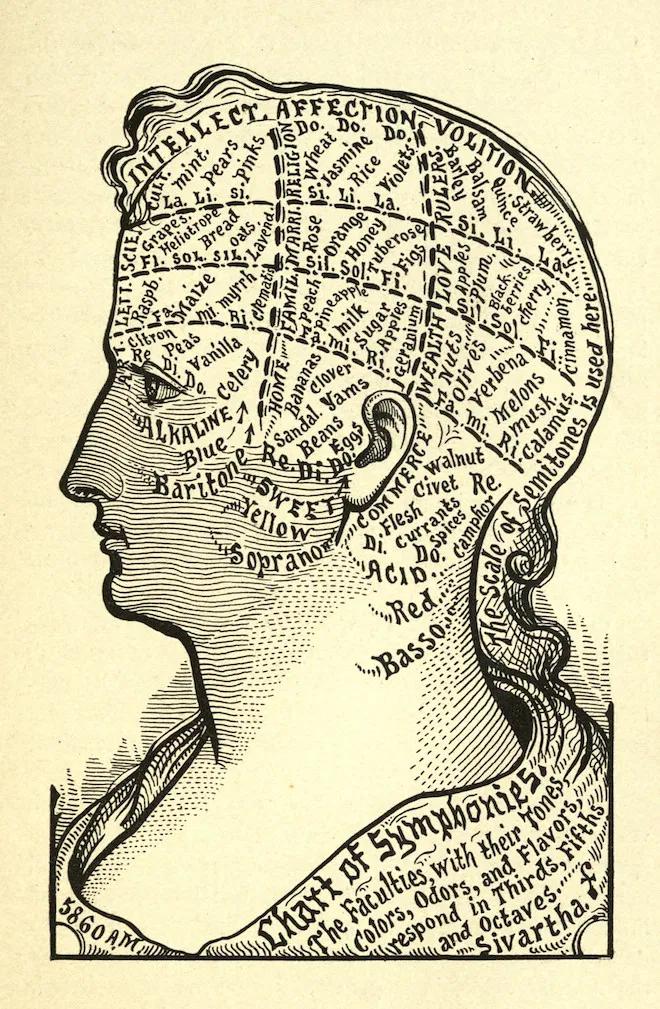
Featured image: Alesha Sivartha, Diagram from The Book of Life: The Spiritual and Physical Constitution of Man, 1898, is in the public domain. Accessed April 2, 2026. Image has been cropped.
LARB Contributor
Joseph Osmundson is a scientist and writer whose book Virology: Essays for the Living, the Dead, and the Small Things In Between (2022) was a finalist for the Lambda Literary and National Book Critics Circle awards in nonfiction. His memoir of nearly having a child, Spawning Season: An Essay in Queer Parenthood, will be published by Bloomsbury.
Share
LARB Staff Recommendations
-
Joe Osmundson lyrically deploys circuit metaphors to describe how new anti-virals are re-wiring the gay dance circuit in post-AIDS New York.
-
From the perspective of her own experience as a neurologist, Pria Anand critically reads Michael Erard’s “Bye Bye I Love You: The Story of Our First and Last Words.”
