

Crude Prices Fall Sharply After US-Iran Deal, But Immediate Fuel Price Cut in India Unlikely – Indian PSU

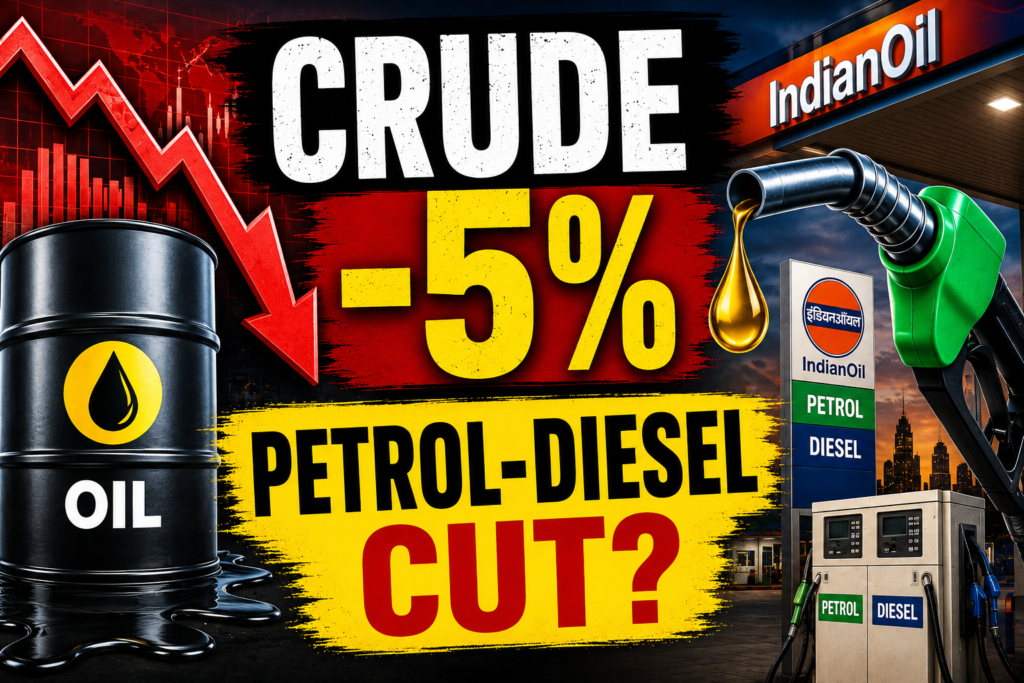
A sharp decline in international crude oil prices following the breakthrough US-Iran agreement and the reopening of the Strait of Hormuz has renewed expectations of lower petrol and diesel prices in India. However, industry experts believe that state-run oil marketing companies (OMCs) are unlikely to rush into reducing fuel prices as they continue to grapple with massive under-recoveries accumulated during the recent geopolitical crisis.
Global benchmark Brent crude fell by nearly 5 per cent on Monday to around $83 per barrel, while US crude prices also declined significantly after fears of supply disruptions in the Gulf region eased. The development has provided relief to oil-importing nations like India, which meets nearly 90 per cent of its crude oil requirement through imports. The decline in crude prices has also strengthened the Indian rupee and boosted investor sentiment in domestic markets.
Despite the sharp correction in global oil prices, petrol and diesel rates remained unchanged across the country on Monday. Oil marketing companies have maintained fuel prices at existing levels since the last revision in May, even as international crude prices moved lower.
Massive Losses Still Weigh on OMCs
The primary reason behind the likely delay in any fuel price reduction is the financial stress faced by public sector OMCs. According to industry estimates, Indian Oil Corporation (IOC), Bharat Petroleum Corporation Limited (BPCL) and Hindustan Petroleum Corporation Limited (HPCL) continue to incur substantial losses despite multiple fuel price hikes implemented since mid-May.
Reports indicate that after four rounds of fuel price increases, OMCs are still facing under-recoveries of approximately ₹12 per litre on petrol and ₹21 per litre on diesel. Estimated losses for the June quarter could range between ₹74,000 crore and ₹84,000 crore.
A senior government official had earlier indicated that even after the recent fuel price hikes, state-run OMCs were collectively losing nearly ₹600 crore per day. Prior to the price revisions, daily losses had reportedly touched ₹1,000 crore.
Why Lower Crude Does Not Immediately Mean Cheaper Fuel
Industry analysts point out that OMCs purchase crude oil and maintain inventories over several weeks. As a result, the benefits of lower crude prices are not immediately reflected in their procurement costs. Much of the inventory currently being processed was purchased when crude prices were significantly higher.
Moreover, companies are expected to prioritize restoring marketing margins and strengthening their balance sheets after months of financial strain. Historically, OMCs have used periods of lower crude prices to recover past losses before passing the entire benefit to consumers.
Relief May Come If Crude Remains Soft
While an immediate reduction in fuel prices appears unlikely, sustained weakness in crude oil prices could eventually create room for consumer relief. Oil Minister Hardeep Singh Puri had recently expressed confidence that oil and gas prices are expected to soften in the coming months as global supply conditions improve.
Analysts believe that if Brent crude remains in the $80-85 per barrel range for a few weeks and geopolitical tensions remain under control, OMCs may consider modest reductions in petrol and diesel prices. Until then, the immediate priority is likely to be recovery of the substantial losses incurred during the recent surge in global energy prices.
For consumers, therefore, the sharp fall in crude oil prices is undoubtedly positive news. However, relief at the fuel pump may take longer to materialise as India’s state-run oil marketing companies focus on repairing their finances after one of the most challenging periods in recent years.
