

HD Hyundai’s ₹40,000 Crore Shipyard Proposal Intensifies Global Race for India’s Naval Modernisation – Indian PSU

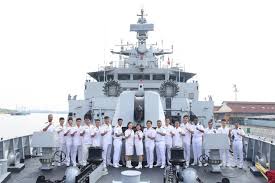
India’s naval modernisation drive has entered a decisive phase, with global shipbuilding majors stepping up aggressive proposals to secure a role in the country’s future warship programmes. South Korea’s HD Hyundai Heavy Industries has proposed setting up a massive $4 billion (approximately ₹40,000 crore) greenfield shipyard in Thoothukudi, signalling its long-term commitment to India’s maritime ambitions.
The move comes close on the heels of Japan’s unprecedented offer to co-produce its advanced Mogami-class frigate in India, underlining an intensifying global contest to partner India in its defence manufacturing push under the ‘Make in India’ initiative.
Mega Shipyard with Strategic Intent
HD Hyundai aims to position itself as the anchor partner for what could become one of India’s largest shipbuilding ecosystems. The proposed facility is expected to cater to both commercial and naval shipbuilding requirements, with a reported production capacity of up to 4 million gross tonnage (GT).
The project also envisions a sprawling industrial ecosystem, including a 3,000-acre vendor cluster that may feature global steel major POSCO. The strategic coastal location of Thoothukudi offers natural advantages such as deep-sea access and efficient logistics, making it ideal for large-scale vessel construction, outfitting, and sea trials.
While commercial shipbuilding is a key component, the primary strategic objective is to address the Indian Navy’s growing requirement for next-generation surface combatants.
HDF-6000 Frigate Anchors Korean Pitch
HD Hyundai Heavy Industries has offered the HDF-6000 (HD6000) frigate, a 6,500-ton platform designed specifically for the export market and recently showcased at MADEX 2025.
Often described as a “mini-destroyer,” the HDF-6000 is based on the proven hull design of South Korea’s KDX-II destroyer and integrates modern stealth features along with advanced combat systems.
The warship is equipped with a 76mm main gun, a 48-cell Vertical Launch System capable of deploying surface-to-air missiles and supporting ballistic missile defence roles, and eight anti-ship missile launchers. It also features advanced close-in weapon systems and anti-drone defences, reflecting evolving naval threat environments.
With a length of approximately 139 metres and significant endurance capabilities, the platform is positioned between conventional frigates and larger destroyers, offering a versatile option for blue-water operations.
Strategic Competition Benefits India
The parallel proposals from South Korea and Japan highlight a growing strategic competition among leading shipbuilding nations to gain a foothold in India’s expanding naval ecosystem.
For India, this rivalry presents a significant strategic advantage. Competing offers are likely to translate into better terms in technology transfer, enhanced localisation, and more competitive project costs. It also provides India with an opportunity to diversify its defence partnerships while accelerating domestic shipbuilding capabilities.
Towards a Maritime Industrial Ecosystem
India’s approach to naval modernisation is increasingly shifting from direct acquisition to building indigenous capability. Large-scale investments such as the proposed Thoothukudi shipyard align with the broader vision of creating a self-reliant defence manufacturing ecosystem.
If realised, the project could not only meet domestic naval requirements but also position India as a global hub for shipbuilding and maritime exports.
As global players intensify their engagement, India’s naval expansion is no longer just a procurement story—it is evolving into a strategic industrial transformation with far-reaching geopolitical and economic implications.
