


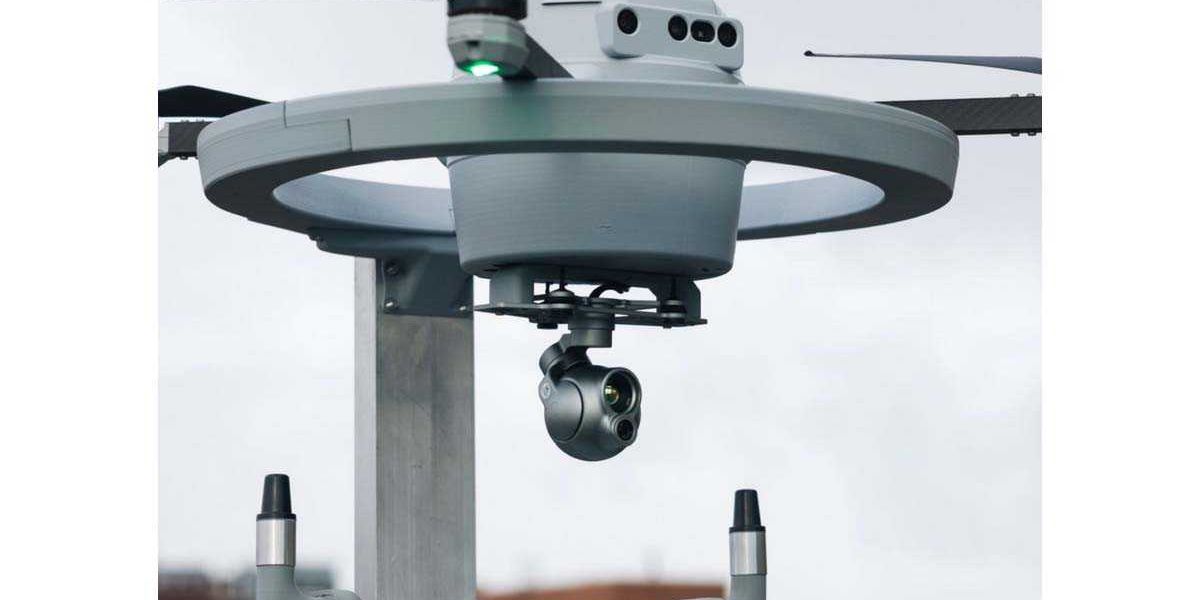
At a manufacturing facility in Detroit, the latest in drone technology is taking flight—and company leaders have their sights set on the supply chain.
Drone developer and artificial intelligence (AI) platform Birdstop counts airports, municipalities, and public safety departments among its earliest customers but is quickly moving into logistics as trucking companies and warehouse owners seek high-tech answers to their security challenges. Those companies are adopting Birdstop’s drones to monitor warehouses, yards, and truck stops and alert stakeholders and authorities to potential thefts and other hazards.
That work illustrates the growing use of drones beyond the four walls of the distribution center (DC), where inventory management drones tend to get the lion’s share of attention. Amid easing testing and usage regulations and a government push for homegrown drone technology, U.S. manufacturers are making strides across the industry. For example, last December, the Federal Communications Commission (FCC) banned the use of all new foreign-made drones and components over concerns the equipment poses an unacceptable risk to national security—a move that has accelerated demand for domestically made drones, according to Birdstop and others.
Birdstop’s recent partnership with Detroit-based truck parking and lot management company TSPS Inc. provides a glimpse of the industry’s forward momentum.
EYES IN THE SKY
Birdstop was founded in 2018 in the Bay Area but relocated to Detroit last fall to take advantage of local manufacturing expertise and talent. The company builds its drones in a riverfront building that was once home to a department of the United Auto Workers union and counts the auto industry as a key customer: Its growing client base includes some of the large holding lots that house vehicles post-manufacturing. Those lots can span from five to 100 acres and are prime targets for theft, according to Birdstop’s Doug Muhlbauer, a senior software engineer with the company.
Birdstop’s autonomous drones deter theft by first detecting suspicious activity from a perch, or dock, high above the lot, using sensors, cameras, and AI-driven software. When an incident alert sounds, the drone takes off within three seconds, hovers above the incident, and streams live video back to a manned console. Muhlbauer explains that the deterrence is twofold: first by letting thieves know someone is watching and then by capturing up-close video of their activities, which is passed on to authorities.
“If you’re sneaking into a lot to steal a car and a drone flies over you and loiters—that’s a deterrent,” he says, noting that many thieves will abort their mission at the sound of the hovering drone, which travels at about 60 miles per hour and has four large propellers. “But if you are determined and keep going, we can get video of that incident.”
The same equation works in warehouse yards and truck lots, where theft is also a growing problem. Theft led to $725 million in losses in 2025, according to cargo theft prevention network CargoNet—that’s up 60% from 2024—with most instances occurring at truck stops and warehouses or DCs. Because of their size, those locations can be tough to monitor with human patrols, stationary cameras, and even traditional drones that conduct scheduled, periodic flights. Birdstop’s drones are different because they continuously monitor those large spaces from above and respond to incidents immediately.
“[Our drone] sits on a perch or docking station, [and] all of the sensors operate 24/7,” says Muhlbauer, explaining that Birdstop views itself as an AI company whose platform “happens to be on a drone. The drone [goes into action] when we need to get a closer look—[essentially], we take the sensor package to the area.”
Those advantages caught the attention of Detroit-based truck parking and lot management company TSPS Inc., which started using the technology to monitor two of its locations this past spring. The partnership combines drone-based sensing with a real-time parking platform to tackle two big trucking industry problems: truck-parking shortages—which contribute to driver fatigue, inefficiency, and safety risk—and cargo theft from truck lots.
The companies have deployed drone systems at two of TSPS’ Oasis Parking locations in Detroit. Perched atop the truck stop’s roof and on light posts, the systems capture aerial imagery and telemetry data processed using AI and computer vision models to detect trucks and identify available parking spaces. Those insights are integrated into a visualization platform and made available through the TSPS platform, providing real-time info on parking availability.
The “birds” also keep an eye out for suspicious activity.
“We’re not only tracking what trucks are in and out of the stop, what spaces are available, [and the availability] of outlets and electricity,” Muhlbauer says, “but also people sneaking into the lots and any type of curious behavior that they want us to identify.”
Birdstop has also begun working with security companies that monitor warehouses and yards. In one example, a company needed a way to monitor a large warehouse that had limited access points for manned patrols—essentially, it needed a real-time system that could monitor a remote area of the building before a patrolman arrived to make sure that patrolman wouldn’t be ambushed. Muhlbauer says Birdstop’s drones provide those real-time alerts.
AI ADVANCEMENTS FUEL DEMAND
Birdstop’s growing logistics business builds on its early work in another key segment of the transportation industry: airports. Some of the company’s earliest clients use the technology for both theft detection and to prevent another big aerial challenge: bird strikes. Airports across the United States and Europe are using the technology to monitor and secure airspace, including detecting and stopping birds from interfering with air traffic.
“[They are] using onboard AI to track bird flights, [identify] their location, and compare that to the broadcast location of the airplanes,” Muhlbauer explains. “[So they can] alert the tower to potential strikes.”
AI advancements like those are fueling demand for surveillance drones, which some research outlets say is expected to grow nearly 12% annually over the next several years. Government, military, and public safety outlets are driving much of that demand, but so is logistics as companies seek to monitor, secure, and protect critical infrastructure.
