


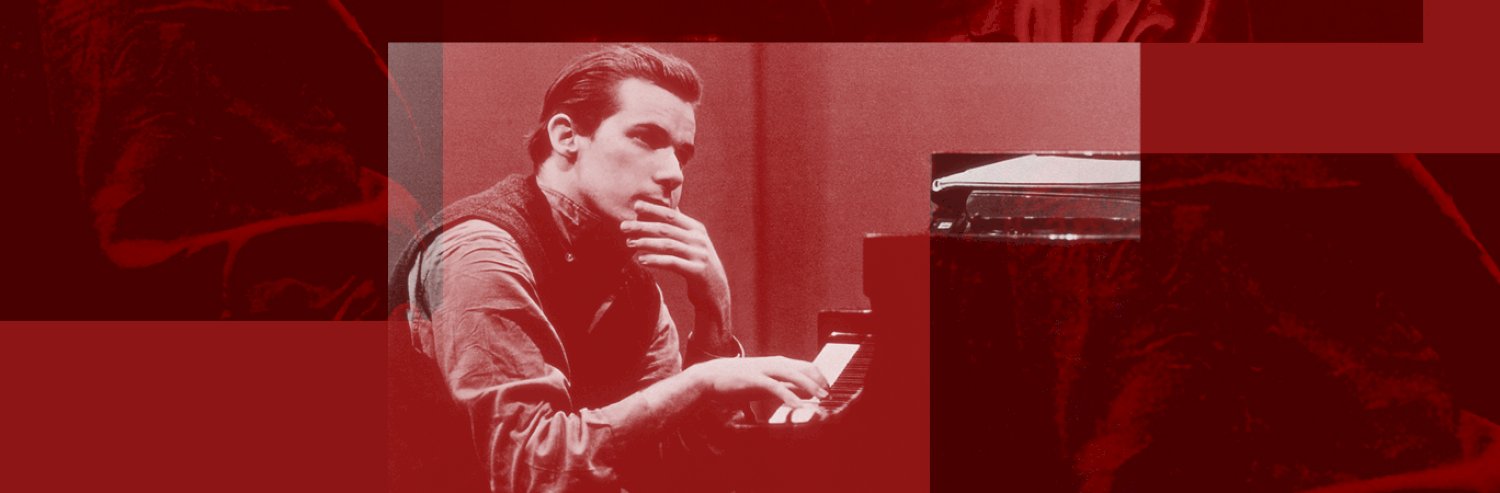
My friend Elizabeth Corey, a pianist as well as a political philosopher, tells me, “You can’t unhear Gould.” A simple but important statement. The music of Canadian pianist Glenn Gould (1932–1982) is so distinctive, so memorable, even today so surprising, that once experienced, it stays in your mind and can easily become the frame of reference by which you evaluate other pianists.
This is true even when you think someone else plays certain pieces of music better than Gould does. If I could listen to only one pianist play Bach, it would be Murray Perahia, not Gould. But when I first heard Perahia’s Bach, I had been listening to Gould’s Bach for a quarter of a century, so that for every minute in which I am lost in Perahia’s playing, there is a second in which I think, Hmmm, Gould wouldn’t have played it that way. And even when I say that to praise Perahia, which is usually the case, Gould remains the benchmark for my judgments. This is equally true when I listen to András Schiff or Jeremy Denk.
Listening to Murray Perahia play Bach was good for me because it taught me that articulation (no pianist has more precise articulation than Gould does) and attack (no pianist attacks a piece more forcefully than Gould does) are not everything. Through listening to Perahia play the English Suites, for instance, I learned the value of subtle changes in tempo and dynamics, in coloration; from him I learned how wonderful it is to hear Bach played elegantly. But I was able to learn those lessons, to hear those excellences, because I had previously internalized Gould’s way with Bach—which is to say, because I couldn’t unhear Gould.
In 1956, seventy years ago, Columbia Masterworks released Gould’s debut recording of Bach’s Goldberg Variations—then rarely performed—and thus inaugurated a period of several decades during which lovers of classical music regularly found themselves unable to unhear Gould. Perhaps they lamented this, but they shouldn’t have, even if they legitimately despised Gould’s playing. When Gould refused to use the sustain pedal in situations in which every other pianist in the world used the sustain pedal, when Gould (regularly) played certain pieces faster than anyone had ever played them, or (occasionally) decided that an unprecedentedly slow tempo was the right one, every listener was forced to consider the choice, to reflect on the reasons for its wrongness, or even, sometimes, to admit its rightness. Gould’s eccentricity and perversity are tonics for the jaded listener.
The first thing anyone notices about Gould’s playing is the precision of his articulation, and that articulation is so precise that you might—not that you should, but you might—think of him as mechanical, if you didn’t also see him. The contrast between the exactness of his playing and the romantic flamboyance of his body movements while playing—the closed eyes, the arching of the neck, the twisting of the shoulders and torso, the constant raising and lowering of the elbows—all point to something very different from the disciplined and minutely organized sounds that he makes with his fingers. Gould famously despised playing in concert and retired from public performance as soon as his financial situation allowed, but he had a style of performing made to be seen—if only on a television screen.
Everything important about the relationship between Gould’s fingers and the rest of his body can be seen in Glenn Gould: Off the Recordand Glenn Gould: On the Record, two half-hour documentaries made for Canadian television in 1959. The first film shows Gould primarily at his family’s cottage on Lake Simcoe, north of his hometown of Toronto, but the second shows him recording Bach’s Italian Concerto at the famous 30th Street Studio of Columbia Records, typically called “the Church.” (The studio’s first life was as a Presbyterian church, dedicated in 1875 but abandoned for a number of years before Columbia bought it in 1948 and turned it into one of the most desirable recording locations in the world. Alas, the building was demolished in the early 1980s.) There’s a wonderful scene in that second film when Gould is playing the Concerto’s slow movement, which he begins by playing with his left hand while conducting himself with his right. Howard Scott, the session’s producer, sitting with his colleagues in the soundproof control room, mimes Gould’s gestures with evident delight, but soon is looking at the newspaper and chatting about matters musical and unmusical while Gould, at the piano, looks like Bernini’s Saint Teresa in ecstasy. He can’t hear the people in the recording booth, but you get the sense that even if he could, he wouldn’t care, would anyway be lost in harmonic contemplation.
Possibly the most debated topic among those fascinated with Gould—rivaled only by the question of his sexuality or lack thereof—is how calculated his public self-presentation was. Was he genuinely that eccentric, or did he realize how his mannerisms looked to others? In my judgment, both are true: In public, he behaved just as he did when spending the winter in his lakeside cottage, with only his dog for company, but he also understood the benefits of being seen to behave as he did. He was a lucky man in that respect: His weirdest personal traits also happened to be highly bankable. By the time he retired from public performance, he could count on people being able to listen to his performances and vividly imagine what he looked like while playing.
Another wonderful moment in that second film: Gould stands next to his piano, in a loose white shirt, far too big for him, which is covered by a sweater-vest. He has kicked off his shoes and stands in socked feet as he takes a big drink from a bottle of Poland Spring water. (He hated and feared tap water and would not trust even New York City’s legendarily excellent tap water.) Then he sits down at the very low chair that he always brought to recording sessions and performances, a chair so low that when he plays, his hands are at mid-chest height. He’s sitting far enough from the keyboard that he can drape one leg over the other—he’s not going to be using any pedals, true, but who has ever seen a professional pianist make an actual recording in that posture? Howard Scott announces a new take of the first movement of the Italian Concerto. Gould cocks his head at the recording booth and corrects Scott: He’ll be playing the third movement. Scott makes the requisite announcement, immediately after which Gould’s hands drop onto the keys and begin moving with terrifying speed. All through the take, as his hands dart over the keyboard, his left leg remains dangling languidly over his right. Yes, once again it’s the kind of outrageous tempo for which he was known in those days. Other pianists could be precise in their articulation, but at that tempo?
After his stylistic preferences—the hyper-articulation, the disdain for pedals, the eccentric tempos, the tendency to hum or sing along with his playing—Gould is best known for his dislike of concert performance and his corresponding fondness for the comforting world of the recording studio. In the first of the two documentaries, Gould explains why he hates even attending concerts. First, he feels “claustrophobic” in a large hall filled with people—though not when he’s watching a movie, he says parenthetically and shrewdly, because the movie theater encourages every member of the audience to think of the viewing as a solitary thing. Second, he is afraid that the performer will mess up something. He’s not usually afraid for himself, he says, except when playing in his native Toronto, but he’s reliably terrified for other performers.
When performing, he also prefers the recording studio to the public stage; it’s a more controlled environment. In an interview recorded for the remarkable 1993 movie (half drama and half documentary) Thirty-Two Short Films About Glenn Gould, the great violinist Yehudi Menuhin says that Gould was right to note how variable the concert environment is for listeners: The sound can be bad, one’s sightline can be poor, other members of the audience can behave badly. All true. But then, Menuhin says, that’s “the variability of life.” To reject that is, in some way, to make yourself “artificial,” and that’s what Gould did, Menuhin believes. He then adds that he is not of Gould’s creative stature.
It’s an interesting caveat. Menuhin, a great artist by any measure, seems to be saying, “I accept the variability of life because I’m a normal person. But Gould was operating at a different and higher level of creativity and artistic imagination. Maybe the rules had to be different for him.” Whether that’s true or not, there does seem to be a great divide between those for whom live music experienced in person is the sine qua non, and those who prefer listening in a controlled environment, probably in their own homes. In Reinventing Bach (2012), that extraordinary account of the history of the recording of Bach’s music, Paul Elie admits to belonging to the latter camp. I do too, but somewhat unwillingly. It is true that I have had enough of sitting in a concert space next to people who talk to others or to themselves, who can’t stop fiddling with their phones, who cough and snort as though in the final stages of tuberculosis; but I also worry that by allowing this frustration to keep me away from the public performance of music, I am growing closer to the fabulously neurotic Gould than is ideal for my humanity. Just as I can’t unhear his playing, I also can’t forget his strangeness and the fierce absoluteness of his opinions. Menuhin’s embrace of “the variability of life” is both riskier and more human.
The attitude toward Gould I most admire is that of his older contemporary Sviatoslav Richter, the Russian who has as strong a claim as any to have been the greatest pianist of the twentieth century. (The relationship between the two pianists is thoroughly documented by Kevin Bazzana in his book Wondrous Strange: The Life and Art of Glenn Gould.) Richter was as reticent and stoic as Gould was opinionated and flamboyant. Richter disliked the recording studio and greatly preferred to play for other people—though in small venues, which he would often book just days ahead: Playing for large crowds alienated him. Gould once played for seven thousand people in Lexington, Kentucky; in a space that big, any subtleties of performance would, of course, be completely lost.
But when Gould played the Goldbergs at Tchaikovsky Hall in Moscow, in May 1957, the audience of fifteen hundred applauded him for half an hour, and the last person still applauding after everyone else had worn themselves out was Richter. (On the same tour, Gould set aside his dislike of concert attendance long enough to take in a Richter recital, which he found “staggering.”) Richter then and there vowed never to record the Goldbergs or even play them in public—but he didn’t stop playing and recording Bach.
Gould began recording Book I of Bach’s The Well-Tempered Clavier at “the Church” in 1962 and completed Book II at his own private studio, in Toronto, in 1971. It can be no accident, I think, that Richter recorded the entire work in late 1972 and early 1973. Like everyone else, Richter could not unhear Gould, but his recording strikes me as a response to Gould’s version, dramatically different and yet somehow recognizably in the same spirit. Richter’s Well-Tempered Clavier is the greatest I have ever heard—yet I do not think it would exist in its current form without the example of the unique and unforgettable Glenn Gould. A musical presence that entered the world seventy years ago continues in force today.
Reprinted from The Hedgehog Review 28.2
(Summer 2026). This essay may not be resold, reprinted,
or redistributed for compensation of any kind without prior written permission. Please contact
The Hedgehog Review for further details.
