


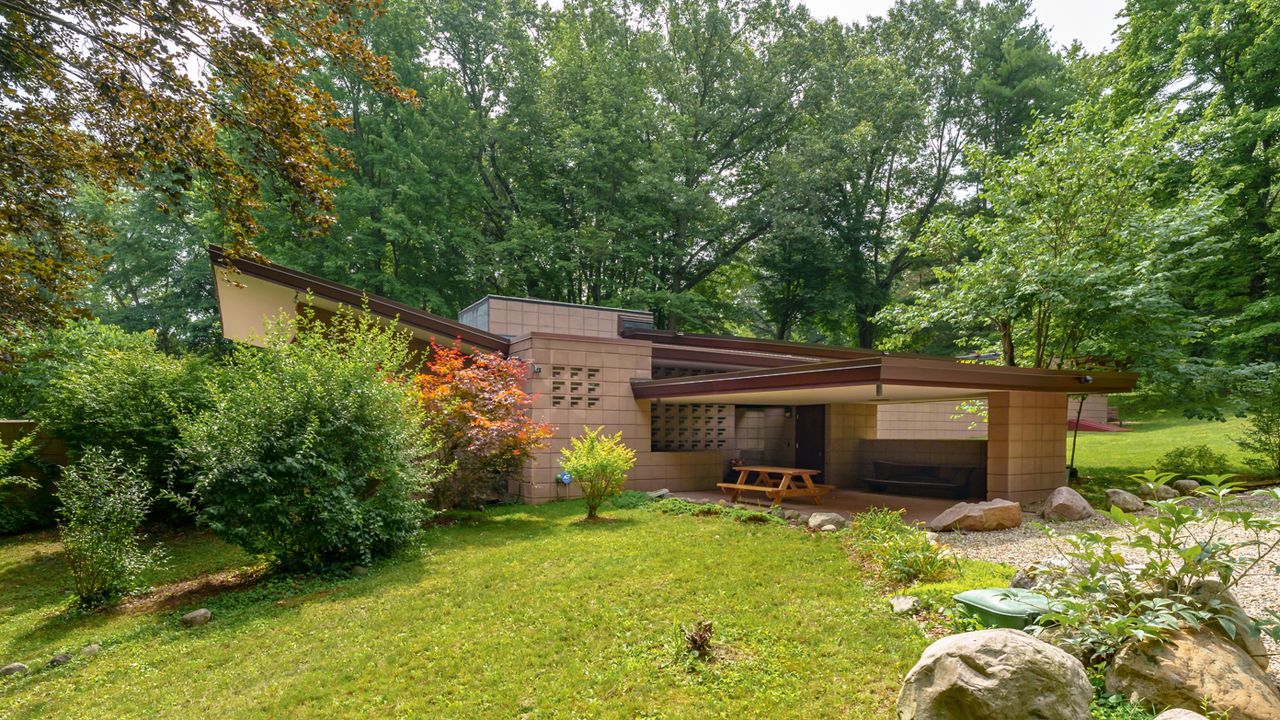
In January of last year, the Weisblat House, a three-bedroom Usonian in Galesburg, Michigan designed by Frank Lloyd Wright, hit the market for $2.3 million. It sat for months without a sale. By August it was down to $1.5 million; in October it was pulled from the market; then relisted for $1.44 million in December. It’s still waiting for its next steward.
This is a notable change from a few years ago, the ones following the pandemic, when a boom in the Frank Lloyd Wright market occurred. Homes by the starchitect were selling quickly and often over the asking price, sometimes within days. It was a trend strongest from 2021 to 2023, but a few lingering instances stretched into 2024, says Victoria Krause Schutte, a real estate agent with @properties who specializes in historic homes and has sold several Wright residences. “A couple of years ago, really well-prepared Wright properties sold very quickly,” she adds. “There were historically low interest rates and a lot of liquidity, even in the luxury market.” When the Weisblat House was pulled from the market in October, the owners began working with Krause Schutte, who is now listing the home.
Now the tides are shifting, and a post-pandemic frenzy for Wright designs has softened, experts say. “It’s a cooler market right now,” according to Brian Proctor, who is listing Wright’s Lewis Spring House in Tallahassee, Florida. (The home has been for sale since September of 2025, but has yet to find a buyer. ) “I followed some other Wright properties in the papers that sold recently, and they all were under asking.” Wright’s Hickox House in Kankakee, Illinois, which was on the market for over a year before it sold for $330,000 under asking in March of 2025. The Winn House in Kalamazoo had a similar story: it took a year to sell and went for $1 million under asking.
While sellers benefited at large in the first few years following shutdown orders, it was a particularly opportune time for Wright owners looking to off-load. The architect’s passion for combining design and nature meant that many of his residences were built in rural areas. Because of their pedigree, they now tend to be among—if not the most—expensive property available in the communities in which they’re located. In Galesburg, for example, where the Weisblat House is listed for over $1,000,000, the average home is valued at $186,000.
