


On December 19th, a Norwegian Boeing 737-800
operating as flight DY430 suffered a runway excursion while landing at Molde Airport (MOL) in Norway. The aircraft came to rest only 50 feet (15 meters) from the water’s edge of the Fannefjord. There were no fatalities, and all 171 occupants were able to safely evacuate the aircraft.
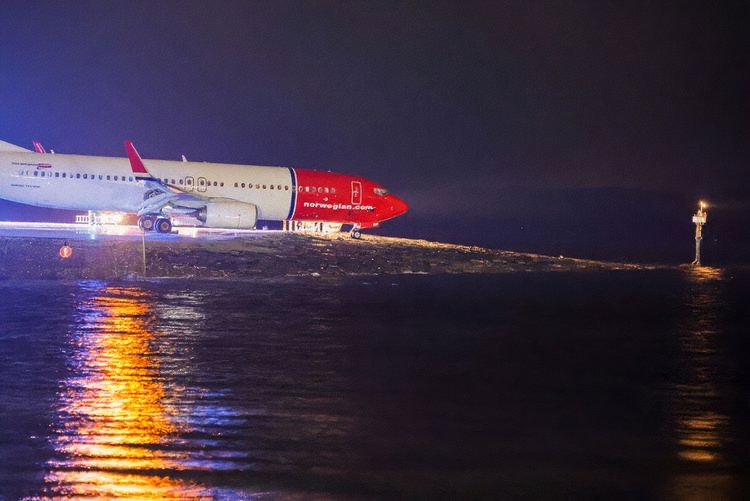
Photo: The Aviation Herald
The history of the flight
Norwegian flight 430 was carrying 165 passengers and had six crew members on board. According to FlightAware data, the aircraft was 47 minutes behind schedule when it departed Oslo Gardermoen Airport (OSL) at 6:02 p.m. CET. The 737 climbed to a cruise altitude of 32,000 feet where it remained for a few short minutes before the aircraft began its descent towards Molde. The flight flew a mostly direct route on a north-westerly heading between Oslo and Molde and flew a normal profile.
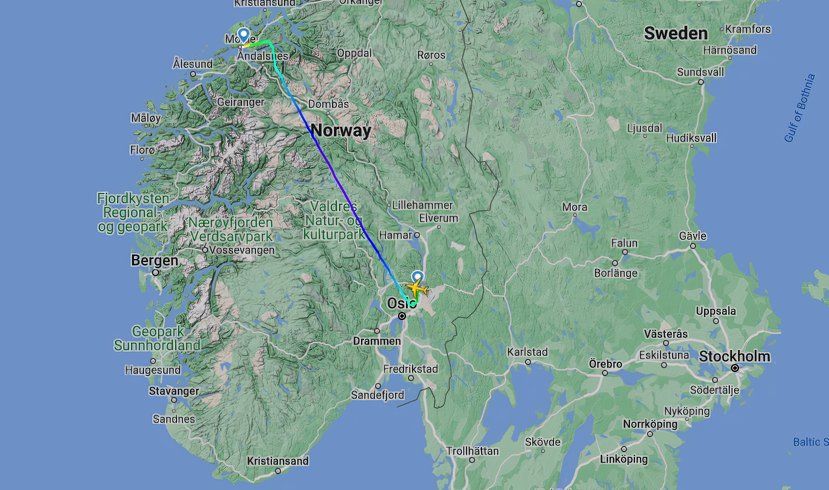
Photo: FlightRadar24
The weather at Molde near the time of the incident indicated winds out of the West North West from 290° at 12 knots and variable between 260° and 320°. A broken ceiling started at 2,500 feet Above Ground Level (AGL), though there existed a scattered cloud deck as low as 1,200 feet AGL. Light rain and snow showers were passing through the area as the aircraft made its approach to runway 25. According to ForeFlight data, Runway 25 has a displaced threshold of 328 feet and a Landing Distance Available (LDA) of 6,499 feet. There is a turn pad past the threshold of Runway 07 that ends next to the water of the Fannefjord.
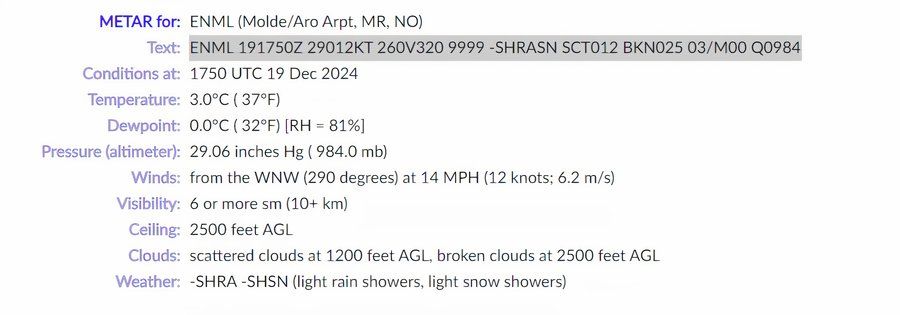
Photo: Aviation Weather Center
The landing
The aircraft was cleared to land on Runway 25 and touched down at approximately 19:03 p.m. The 737 was unable to stop in the remaining distance and continued past the Runway 07 threshold before coming to a stop just off the surface at the edge of the turn pad. It came to rest 500 feet past the end of the runway, and within 50 feet of the water’s edge. The passengers safely evacuated the aircraft via the evacuation slides. Though it was reported that some passengers were trying to leave the airplane with their luggage, the evidence suggests a quick evacuation was carried out with no injuries. The airport emergency services quickly responded to the incident.
According to a report made by The Aviation Herald, Norway’s AIBN (Accident Investigation Board Norway) verified on December 20th:
“When a Norwegian flight with flight number DY430 was landing at Molde Airport in a westerly direction, the aircraft entered a snow squall at an altitude of between 50 and 100 ft. After landing, the commander noticed that it was slippery and experienced that the aircraft had poor braking effect. At the end of the runway, it hit a runway light before coming to a stop near the sea approximately 10 meters after the runway’s asphalt edge.”
The aircraft
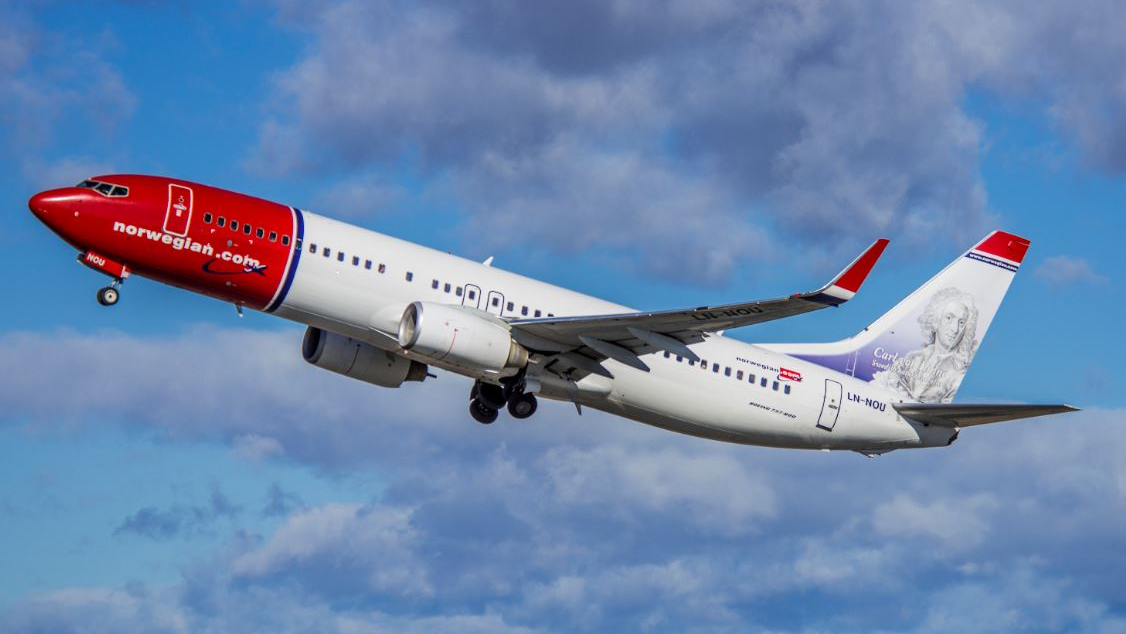
It is currently unknown what kind of damage occurred to the aircraft though it appears to still be at Molde Airport at this time. According to Airfleets.net, the aircraft involved is an 11.2-year-old 737-86N, MSN 38044, that made its first flight on September 25, 2013. It then spent several years flying for Garuda Indonesia
. It was stored in August 2021 before being registered as LN-NIP and commencing operations with Norwegian in July 2022.
Related
Norwegian Adds 17 Routes Including 3 To The UK
Norwegian has added 17 new and returning routes to its network (I have posted a map as a reply).
Focusing on the UK, three routes are coming, two to London Gatwick. I have not yet gone through Norwegian’s other Gatwick routes to see what, if anything, has been reduced to enable the two routes or if they will use new slots.
– Copenhagen-Newcastle: twice-weekly from May 2. The city pair last had regular flights by SAS in 2017. Norwegian is a new carrier in Newcastle. The point-to-point market has 7,000 annual point-to-point passengers before demand is stimulated from lower fares and nonstop service.
– Ålesund-Gatwick: twice-weekly from April 11. The city pair was last served in 2016 when Norwegian operated to/from Gatwick. This means Ålesund will have UK flights again, with London having around 18,000 point-to-point passengers. It is London’s second-largest unserved Norwegian city after Kristiansand.
– Riga-Gatwick: three times weekly to four times weekly from March 30. It is a brand
A brief summary of Norwegian’s recent activities
Norwegian operates an all 737 fleet that primarily connects Scandinavia with the rest of Europe. After a turbulent few years surrounding the COVID pandemic, Norwegian has been making positive gains and has a good profit forecast for 2024. In October 2024, the airline saw record numbers. AeroTime reported in November 2024:
“Capacity for Norwegian, measured in available seat kilometers (ASKs) increased by 10% over the same month in 2023, while the load factor reached almost 87% overall.”
Overall, Norwegian has been doing much better with punctuality, load factors, and profits painting a much healthier picture for the airline than a few years ago.
