


When the Eurovision Song Contest final kicks off in Vienna on Saturday evening, not even the row over Israel’s presence can match the existential crisis gripping host broadcaster ORF.
Last March, harassment claims by a female employee against ORF director general Roland Weissman, which he denies, prompted his resignation. That triggered an opaque compliance probe, months of intrigue, claims of widespread bullying and revelations of unethical management behaviour.
Above all, the scandal has exposed once more how ORF management structures are chronically susceptible to political interference.
“This is the greatest scandal in ORF history and a wake-up call for every country in Europe that hasn’t depoliticised its public media,” says journalist Barbara Tóth, who has led reporting on the ORF crisis in Austria’s Falter magazine.
Without radical change of existing structures, she warns, Austria’s far-right Freedom Party (FPÖ) will “take full control” of ORF if they take office after the next general election.
The Austrian government has promised a reform convention in September to make ORF “transparent, closer to the people and regional”: in other words a public broadcaster of the kind dreamed up a century ago in the fragile calm after one World War and before another.
Starting with the BBC in 1922, the idea of public broadcasting took hold because there was technology reliable and cheap enough to make it a reality.
The rest of the 1920s saw sparks, from Belgium to Lithuania, light up the airwaves over Europe. Though they are now as old as David Attenborough, many European public media outlets are now more likely to resemble the endangered species the centenarian broadcaster has highlighted in his documentary career.
The second century of European public media looks less certain than its first as its original competition – from private broadcasters – is eclipsed by heated rivalry from deep-pocketed streaming platforms. Netflix, Apple TV and the others have fragmented audiences and, with smartphones and tablets, podcasts and on-demand consumption, pulverised the very linear broadcasting format that public media invented.
A 2025 survey for the Public Media Alliance showed younger Europeans are now twice as likely to watch Netflix as public sector media.
Then there are the scandals over financial profligacy and bespoke contracts that, as in RTÉ, have direct echoes in sister public broadcasters across the Continent and overshadow hours of quality output.
In this long-running battle, not even the heavyweights are safe, and the BBC vs Nigel Farage grudge match could enter unchartered waters when the broadcaster’s charter expires in December 2027.
Even before then, drastic change is looming across the English Channel if France elects a right-wing populist president in April.
The stage has been set after a six-month parliamentary inquiry in effect put public media journalists and managers in the dock.
[ The French revolutionary: can a veteran firebrand stem France’s far-right surge?Opens in new window ]
The inquiry’s self-styled interlocutor Charles Alloncle, a 32-year-old conservative ally of populist National Rally (RN) leader Jordan Bardella, turned the normally dull French parliamentary inquiry ritual into a supercharged spectacle with viral social media clips of journalist testimony.
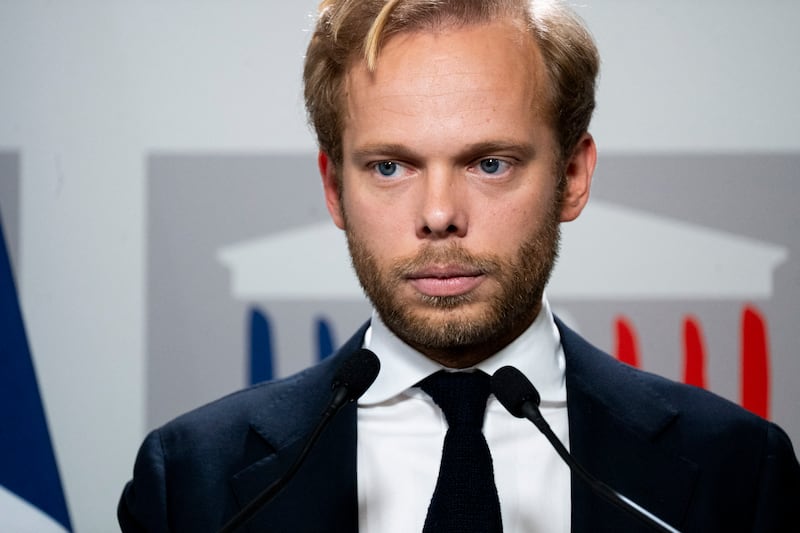
Some inquiry members refused to sign off on Alloncle’s final report last week, calling for a 25 per cent cut to the €4 billion public media budget, since 2022 financed largely from a share of VAT receipts.
The populist RN embraced the report’s findings, saying public media is “no longer a space of impartial information, but a tool of influence in the service of a particular camp”.
But French journalist Richard Senejoux, of the media magazine Télérama, says the inquiry and its report have released a “slow poison” into the debate on public media, where ongoing public support is countered by “whispers” over cost and perceived bias.
“The populists have won, whatever happens,” he said. “Marine Le Pen [of RN] said again that she will privatise the public service media if her party wins the next presidential election.”
Across Europe – Reform in the UK, Austria’s Freedom Party (FPÖ) or the Alternative for Germany (AfD) – populists make similar claims: public television is too left-wing, too “woke”, too far away from the reality of the people funding it.
Though some European public-media defenders concede some truth in this criticism, they disagree with the scale of the problem, point to internal correction mechanisms and still high levels of trust in European public media.
Defenders of public media say populist attacks are motivated less by anger at perceived media bias or profligacy and more by the nature of public media as a keystone of democratic checks and balances.
“Part of the nationalist-populist rule book is to silence critical journalism, and public service media that is critical of all is a key part of that,” said Renate Schroeder, director of the Brussels-based European Federation of Journalists.
“Yes, some public broadcasters are old dinosaurs, with too many people, and slow, but I also see huge reform under way and fresh efforts to reach out to younger people.”
Despite what she describes as sustained attacks on public media, she points to a recent Swiss vote as proof that populist campaigns are not always destined to succeed.
Last March, after a lengthy and emotional public debate, 62 per cent of Swiss voters rejected an initiative to slash the public media licence fee by 40 per cent to 200 francs (€218) annually.
The next challenge for public media looms already next September across the border in Germany, with an election in the eastern state of Saxony-Anhalt. The far-right AfD leads polls there, with 41 per cent. If it takes power in state capital, Magdeburg, the local AfD has promised to cancel the state’s contract with local public broadcaster MDR as political leverage in a campaign to make it “slimmer, financially consolidated and … depoliticised”.
Politicians will always try to have influence on state-owned media. Our job is to limit those attempts as strongly as we can
— TV news host Wojciech Szelag
The AfD hopes for a domino effect across Germany’s wider ARD public broadcast network, while critics fear its real aim is tighter editorial control. Ronald Gläser, an AfD Bundestag MP for Berlin, dismisses such arguments and says ARD stations have brought themselves into disrepute by abandoning impartiality for what critics like him call “Haltungsjournalismus”, journalism with a particular moral stance.
“That is not what people pay their public media charge for, and it is why so many people are rebelling,” said Gläser. Even before the AfD zeroed in, private media organisations in Germany succeeded with legal cases to prune public media back to size, in particular forcing it to curtail text-based web offerings they viewed as unfair competition.
Many would welcome further pruning, from an end to the obligatory household charge to the privatisation of ZDF, the second public station, echoing a successful second station spin-off in Denmark.
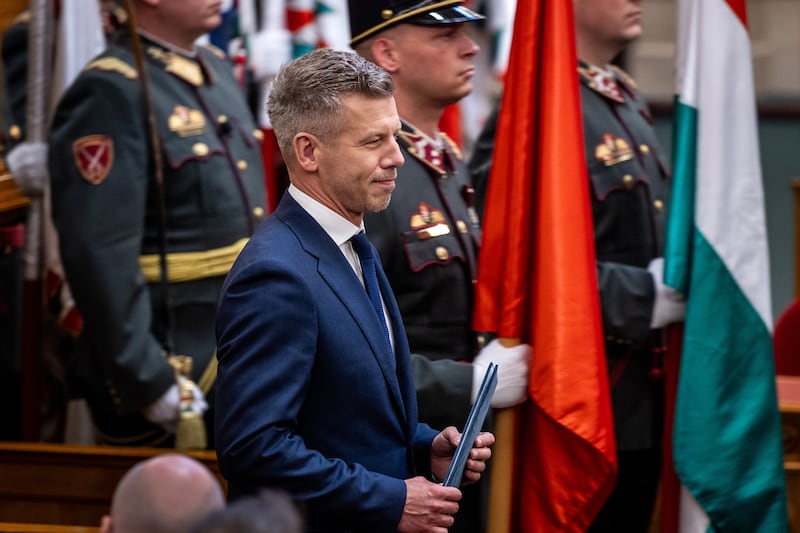
Far greater challenges loom down the Danube in Hungary, meanwhile. A reverse rebellion is under way as new prime minister Péter Magyar has promised root-and-branch overhaul of the “factory of lies” he said public media became under his predecessor Viktor Orbán.
Before and during his election campaign Magyar was either demonised or ignored by public broadcaster M1. In a post-election interview on the station, Hungary’s prime minister-elect noted “how strange this is given the last time I was invited on public media was more than a year and half ago”.
Just how difficult it can be to reverse public media capture can be seen in neighbouring Poland. Two years ago, in February 2024, television news host Wojciech Szelag made global headlines just weeks after he joined the country’s public broadcaster, TVP.
On his evening talkshow on TVP Info, its rolling news channel, Szelag apologised for Polish public television’s recent “shameful” role in spreading “hateful words” towards LGBT people.
It was a spectacular break with the previous eight years, where TVP served as a propaganda and agitation outfit for the ruling Law and Justice (PiS) party. Its leader Jaroslaw Kaczynski’s regular rants – about the “madness” of LGBT people or the “pure evil” of opposition leader Donald Tusk – were broadcast uncritically and amplified by Polish public media.
Within a week of Tusk becoming prime minister in December 2023, he fired all public media chiefs and restarted TVP Info with new faces. Szelag, who stayed on, says the two years since have been challenging: trust remains low and potential studio guests remain wary of appearing. And some Tusk supporters, he says, are upset that TVP Info is not now broadcasting propaganda for their side.
Has Szelag experienced renewed political interference?
“Politicians will always try to have influence on state-owned media. Our job is to limit those attempts as strongly as we can,” he says. “But I think we can honestly say we did our best and every day we do our best.”
[ Poland is an EU success story. So, why is it facing growing calls for ‘Polexit’?Opens in new window ]
Things look less hopeful across Poland’s northern border in Lithuania, where the ruling coalition, stung by regular critical reporting by public broadcaster LRT, approved a state funding freeze until 2029.
Last December president Gitanas Nausėda, in a thinly veiled attack on the government, said any legal changes “must comply with the principles of political neutrality, responsibility and transparency”.
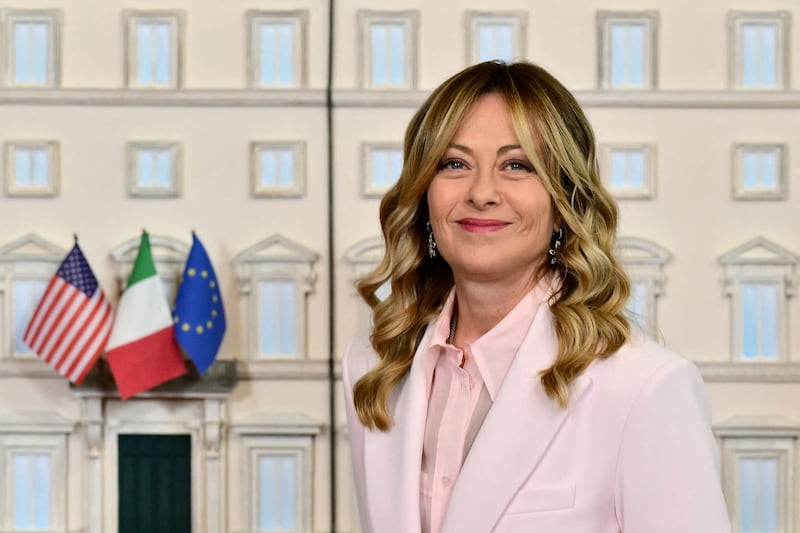
In Italy, the far-right Meloni government has replaced key staff in state broadcaster RAI, while attacks on journalists reached a new high of 118 last year, including a car-bomb attack on investigative journalist Sigfrido Rancucci.
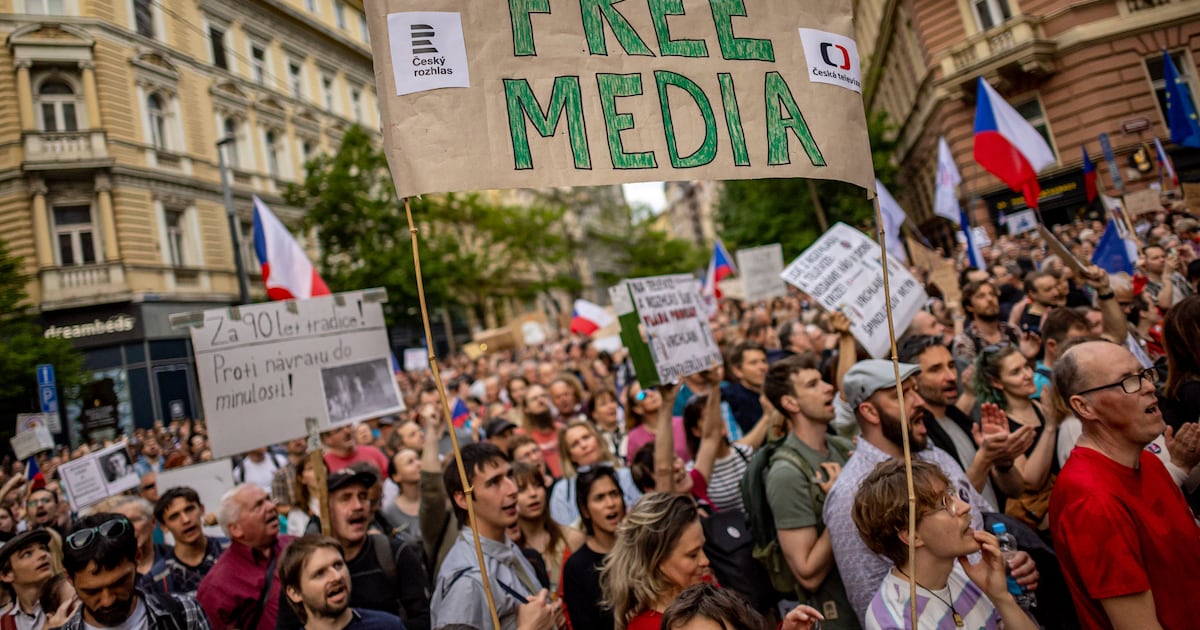
Growing too, though, is public pushback against perceived political meddling. Thousands of Czechs filled Prague’s old town square a week ago to protest against a government plan to shift public media financing from a licence fee to direct budget funding. Estimates suggest the move would result in a 16 per cent effective budget cut overnight to public television and radio, a shift described by Reporters without Borders as a “chaotic” effort to “pull the rug out” from under independent public media.
For the International Press Institute, the growing challenges facing Europe’s public media outlets bode ill for the EU media freedom act (EMFA), in force since last August. It grants safeguards to protect journalists from surveillance, safeguard editorial independence and require transparent public media finances, but many EU member states have yet to transpose it into national law.
Austrian media researcher Florian Saurwein has covered public media challenges for 30 years and is as wary of the critics’ downfall framing as he is of the democracy-in-peril narrative pitched by public media itself.
The greatest danger remains not that public media will be abolished, he argues, but captured by the political power of the day.
“I think public media outlets will survive and thrive if they give up trying to provide something for everyone,” said Saurwein, senior communications research associate at the University of Zürich. “In an era of growing disinformation, they need to make trustworthy information their trademark.”
