

Regional orchestra has brought classical music to northeast Oregon and southeast Washington for nearly 30 years

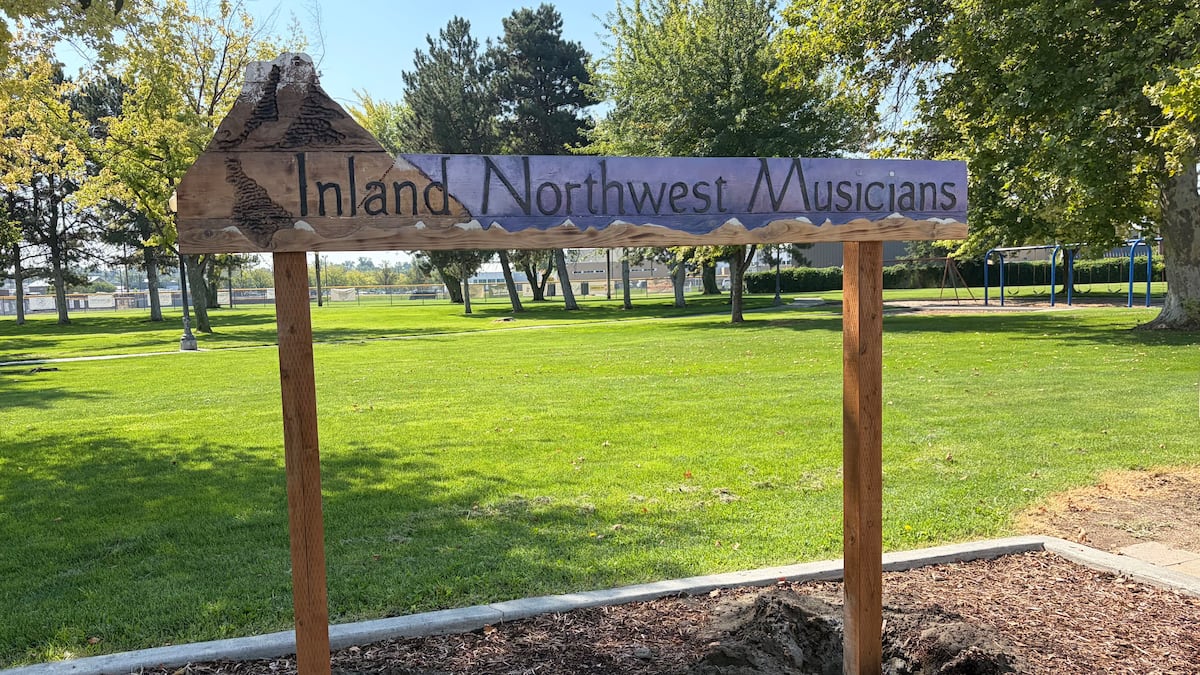
A sign for the Inland Northwest Musicians in McKenzie Park in Hermiston, Ore. on Aug. 20, 2026. The regional orchestra has been bringing classical music to nine counties across northeastern Oregon and southeastern Washington since 1999.
Gemma DiCarlo / OPB
Listen to audio from OPB journalists
The Inland Northwest Musicians have been performing across nine counties in northeast Oregon and southeast Washington for nearly three decades.
The group formed in 1999 to bring classical music to communities that may otherwise not have access to it. It consists of three ensembles: the Inland Northwest Orchestra, the Inland Northwest Chorale and the Willow Creek Symphony, a preparatory ensemble for new musicians of all ages.
Lee Friese is the music director and conductor for all three ensembles. Alice Massey is a founding member of the group and serves as concert master of the orchestra. Payton Baxter has performed with the Willow Creek Symphony since she was 12 years old and now manages the group.
They all join us to talk more about bringing classical music to remote corners of the state.
Note: The following transcript was transcribed using AI tools and validated for accuracy, readability and formatting by an OPB volunteer.
Dave Miller: This is Think Out Loud on OPB. I’m Dave Miller. The Inland Northwest Musicians have been performing across nine counties in Northeast Oregon and Southeast Washington for nearly 30 years. The group formed in 1999 to bring classical music to communities that may otherwise not have access to it. It consists now of three ensembles, including one for new musicians of all ages. Lee Friese is the music director and conductor for all three ensembles. Alice Massey is a founding member of the group and serves as a concertmaster of the orchestra. Payton Baxter has performed with the Willow Creek Symphony since she was twelve years old. That was 10 years ago. She now manages the group. Welcome to all three of you.
Lee Friese: Thank you very much.
Alice Massey: Thank you.
Miller: Payton, first, how did you first hear about Inland Northwest Musicians?
Payton Baxter: I had a friend who was playing flute with them in Willow Creek Symphony. She invited me and I was like, yeah. I read a book that was called “Rooftoppers,” and that introduced me to cellos. I also actually went to the Young People’s Concert that we do yearly…
Miller: You attended as a member of the audience…
Baxter: …as an audience member, yes. I was a student and I went with my class, so that was really fun. I was inspired to pick up the cello, but I didn’t even know where to start. I had no idea what to do, so my friend helped me, she introduced me and then I came to the rehearsal unannounced. I did not tell anybody that I was gonna come and then I was there.
Miller: You were twelve, you barely played the cello?
Baxter: I didn’t play anything at all.
Miller: But you went to this orchestra rehearsal, and what’d you say?
Baxter: I just kind of sat down and I was really, really shy. So I didn’t talk at all, I just sat down and tried to play, but I was playing completely wrong. Everything I did was wrong.
Miller: I’ve got to say, I mean, I believe you when you say that you were shy, but it takes a lot of bravery to do what you did, especially as a shy person. But to show up with an instrument you couldn’t play and say quietly, “I’m here.” So what happened?
Baxter: Well, my dad took me and so he was a support for me, and I also had my friend there, so it was intimidating, but I was very welcomed. I was welcomed by everybody. Lee came up to me and he started talking to me and I was like, shy and nervous, but…
Miller: Lee, do you remember that?
Lee Friese: Oh, I certainly do, yes!
Miller: What is your approach to the Willow Creek piece of these three ensembles for emerging artists?
Friese: That’s an interesting label, emerging artists. The Willow Creek Symphony is basically intended for people who are learning an instrument for the first time, absolute beginners, and they do need to have some measure of capacity in order to function in an orchestral ensemble, with their instrument as well as being able to deal with the printed page. But we also know that there’s a vast number of people out there who played something when they were in school. What did you play, by the way?
Miller: Violin, then I switched to viola.
Friese: Uh huh, and do you?
Miller: Do I? Do I still play? I do sometimes, not very well, but yes, happily.
Friese: If it were here, you very well could be joining our Willow Creek.
Miller: OK, I should have brought it.
Friese: Because that’s exactly the point, that we can give folks who’ve been involved the opportunity. It’s still there, it’s inside of us, that we found a reason to do it to start with, and it stays with us and it gives the adult later in life the opportunity to come back and relearn.
Miller: Alice, why did you want to start this regional music group?
Massey: Well, there was a group of musicians back in 1999 who wanted something new. These musicians, singers, orchestral musicians had been part, and many still are part of other groups as well as in the Northwest musicians, but we had a clear vision of what we wanted. And it just started around kitchen table discussions about what we wanted to create. But that vision being, we wanted something that was inclusive as what Lee and Payton were describing. We wanted something for all musicians of all capability levels. Very accomplished musicians as well as near beginners or adults who were coming back to an instrument or back to singing after years of not, and so we wanted that. We wanted it to be a regional program, and so we designed that at all levels, we designed our bylaws so we have a board of directors that represents nine counties. We perform in a nine county service area of Oregon and Washington.
I think mainly I would describe it as, we didn’t want any barriers. We didn’t want a community to not have access to music because it was tiny in size or remote in location. We didn’t want audience members to not be able to come because of the cost of buying a ticket or having to travel somewhere to attend a concert. So, from almost the very beginning, all of our concerts have always been free. We never charge admission. So I would say, yeah, just having a place where music is for everybody. That was kind of our motto at the very beginning, “Good friends make the best music.”
Miller: Have you made friends in this, Payton?
Baxter: Oh, many, all of my friends pretty much. It really helped me branch out and be more social. Lee has been here by my side since the beginning. I pretty much immediately started taking lessons with him after that first rehearsal, and I’ve learned so much from him, including how to talk to people better because I pretty much didn’t talk at all.
Miller: OK. When you started this, you wouldn’t have wanted to be on a radio show being interviewed?
Baxter: No, not at all. No.
Miller: And you think part of that change is from being in these ensembles.
Baxter: Certainly, yeah. You know, it was hard to learn to be a part of a community like that. I don’t know why, but it’s just hard to get involved sometimes, but with Inland, they just really made it easy and fun and I looked forward to making music and being with other people. It’s really been a great experience in my whole life.
Miller: Alice, my understanding is that you’ve been playing and performing and also teaching music for a big chunk of your life. What has taking part in Inland Northwest Musicians meant to you? I ask this because, unlike Payton, who was sort of starting out, music was already intertwined deeply in your life. So I’m curious what you’ve gotten from this?
Massey: I would say, foremost, a feeling of family. I love the Northwest. I’ve lived here for coming up on 50 years. My family, we all live far apart, as many families do now, geographically. We’re close emotionally, but they’re far away. But Inland Northwest Musicians are my local family, I would say that network of not being socially isolated. I still work full time in a remote job, which I love. I love my work, but it is remote, so I’m often sitting in a room by myself at home all day, working online and doing that, so that can be isolating.
And just having a sense of community… Anybody who’s ever participated in an ensemble, whether it be a choir or an orchestra, knows that part of the joy of it is participating in something where you’re creating something much bigger than yourself, and our ensembles, what we’re able to do artistically at a high level is so much bigger than the sum of its parts, and that’s just incredibly exciting. Anybody who’s ever done it knows that the first time you are able to experience being in a choir with 40 or 50 or more other voices raising your voice in song, or being part of an orchestra and hearing that last note reverberate through the hall, there’s just nothing like it. It’s so nourishing, and we all know, I think, what music does for our health and for our brains and the social connection that it gives us. So we very much have a feeling of family.
Miller: Am I right, Lee, that it’s not just, for many people, a question of a feeling of family, but literal family? That there are multi-generational members in some cases in these groups?
Friese: Absolutely, we have several families where there are four or five different members of the same heritage that are part of the ensemble.
Miller: Spanning two or more generations?
Friese: At least, yes, oftentimes more than that actually.
Miller: So, sometimes grandparents and grandkids in the same orchestra.
Friese: Absolutely, absolutely.
Massey: At the same time.
Miller: In the same section?
Massey: Yes, well, in the same ensemble at the same time.
Friese: You know, in addition to our three large ensembles, we now are developing some small ensemble activities as well. And part of the reason for that is that it gives us another way of reaching some of the communities that are not served with other live music activities.
When I first moved to the Pacific Northwest – I’m from Ohio originally, and I realized that there are a lot of communities that are just out there, and so I thought about, why? Why are they out there? And what I realized was that the people were living there because they wanted to. That’s where they wanted to live. But then I also realized that it shouldn’t mean that they needed to be bereft of enhancement and enrichment activities. So that was a natural thing to begin to develop the program that we’re currently doing.
Miller: It means a lot of driving, I imagine, if you’re serving nine large counties across two states. Do some people have to drive two hours or more to go to a rehearsal?
Friese: Yeah, absolutely. We have a family of musicians from Enterprise, which is near Wallowa Lake, and it’s about a two-hour drive every rehearsal.
Miller: Payton, my understanding is that you’re one of the people who is in the orchestra with other family members?
Baxter: I am.
Miller: What has that been like for you?
Baxter: Oh, it’s been great. I drive my family to the rehearsals, so we get to spend time on the way there, on the way back. We get to chat about it. We get to spend time and think about it, practice together sometimes, my brother and I. My mother plays as well. Sorry, I didn’t mean to forget that, but she does play. They both play violin, so we’re all strings.
Miller: Do you ever think about young people when you perform now for Young People’s Concerts? Do you imagine somebody in the audience like you were 12 years ago or when you were young and you saw these musicians?
Baxter: I hope so. I hope to make an impact on somebody else like it impacted my life so greatly. It’s my dream really to impact somebody.
Miller: Alice, what do you hope that audiences will take away from your performances?
Massey: Oh, goodness. I hope that they are moved by what they hear and I know that they are because they show us that in their appreciation.Yeah, I just hope that they are moved by the experience and that they understand this is something they can do as well. And that it’s an inviting place. We always share with our audiences at almost every concert, we joke about it a little bit, but we tell them often in our opening remarks before each concert that their presence as an audience is what makes this a concert and not a rehearsal, and so they are just as important to this whole experience as being on the stage as a performer, so I think that inclusivity is really important to us.
Miller: Payton, we just have about less than a minute left. What are you looking forward to this season?
Baxter: Oh, so many things. It’s gonna be a great season. We’re gonna do an event for 9/11. We’re gonna do a remembrance event in Hermiston. We’re looking forward to that a lot. And we’re gonna do our usual Young People’s Concerts – always something to look forward to, alongside a bunch of other concerts. We’re gonna do a bunch of choral concerts, a bunch of orchestra concerts, we’re gonna integrate our new smaller group ensembles. We’re really excited about that. We haven’t got it set in stone yet, but we’re very excited.
Miller: Well, Payton, Lee, and Alice, thanks very much.
Friese: Thank you for having us.
Massey: Thank you so much.
Baxter: Thank you.
Miller: Payton Baxter is the manager of the Willow Creek Symphony. She has played cello in it since she was 12 years old. Lee Friese is the music director and conductor for all three ensembles that together make up Inland Northwest Musicians. Alice Massey is a founding member of the group and serves as a concertmaster of the orchestra.
“Think Out Loud®” broadcasts live at noon every day and rebroadcasts at 8 p.m.
If you’d like to comment on any of the topics in this show or suggest a topic of your own, please get in touch with us on Facebook, send an email to thinkoutloud@opb.org, or you can leave a voicemail for us at 503-293-1983.
