


Companies have spent years strengthening their supply chains against disruption, but the Zurich-based insurance firm Swiss Re says many of them have overlooked one of the biggest risks by focusing only on their own operations, instead of partners’ weaknesses too.
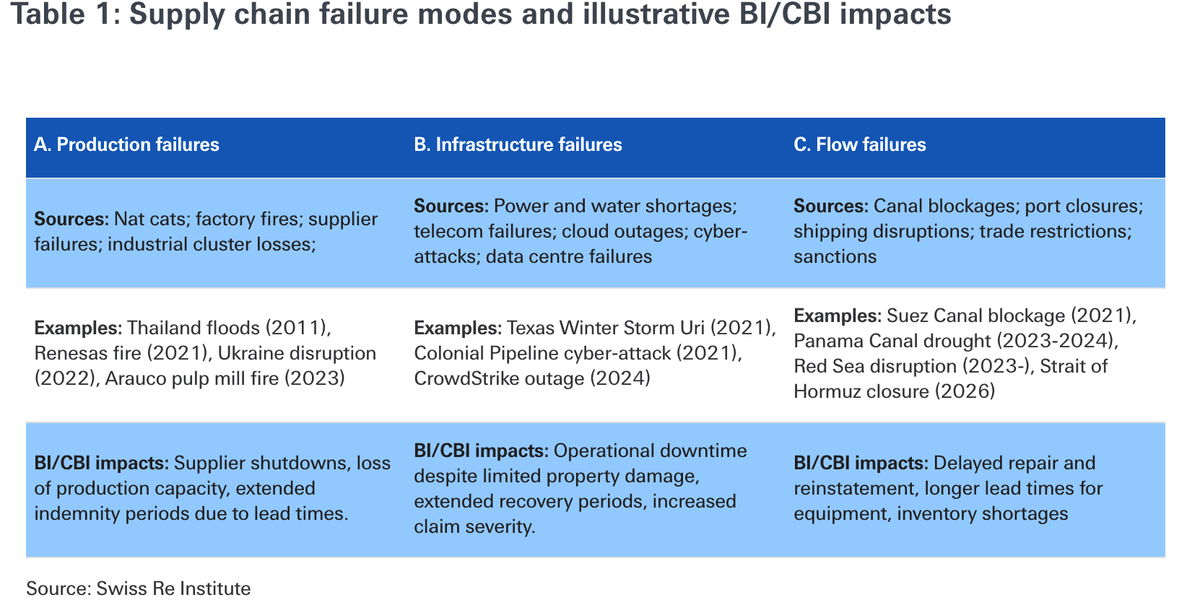
As climate events, geopolitical tensions and infrastructure disruptions become more frequent, business interruption increasingly stems from dependencies beyond a company’s own operations, the company said in a report titled “Emerging Risks: Hidden Dependencies in Global Supply Chains.”
“Businesses have become much better at understanding the risks to their own facilities. The next challenge is understanding the dependencies beyond their own operations that can determine whether they recover quickly or face prolonged disruption,” Adrian Hall, US CEO, Swiss Re Corporate Solutions, said in a release.
“Supply chains today are more interconnected than ever. A disruption at a supplier, a power provider or a transport hub can have consequences well beyond the location where the event occurs. Better visibility into those dependencies helps businesses make more informed risk management decisions and build greater resilience over the long term,” Hall said.
The study found that 43% of Fortune 500 Europe companies report assessing physical risk to their own facilities, but only 7% publicly disclose extending such assessments to supplier facilities, and fewer than 2% disclose assessing the wider infrastructure they rely on.
That gap means that many risks may remain unidentified until a disruption occurs. And those events are coming more frequently—the ongoing Middle East conflict has been the fourth major global supply shock in six years, highlighting the wider disruption environment in which business interruption (BI) or contingent business interruption (CBI) losses may occur.
In that environment, infrastructure failures, logistics bottlenecks, shipping delays, or trade restrictions may delay repairs, replacement equipment or inputs, thereby compounding the severity of an insured BI or CBI event, the report said.
To address the issue, companies can increasingly use advanced tools to model downtime and infrastructure dependencies at scale. However, Swiss Re warned that such models are only as good as the underlying input data, and the report found that many companies still lack the supplier, infrastructure, and logistics data needed to assess these risks fully.
