


My play The Marriage: The Mahlers in New York was just premiered (as a work-in-progress) at the University of Michigan/Ann Arbor. It’s my good fortune to be working with a terrific actress and director: Esther van Zyl and Jack Tamburri. We next produce the play (this time with lighting design) at the Colorado Mahlerfest on May 14.
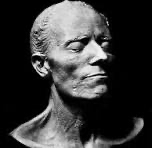
To evoke the terminally ill composer, I have interpolated the closing minutes of his Ninth Symphony – itself (as Leonard Bernstein liked to stress) a musical enactment of death. I’m also influenced, in this passage, by Mahler’s exceptionally expressive death mask, which Alma found “smiling” and “forgiving,” and in which I detect a shaft of radiance:
My play adapts my 2023 novel (with the same name), in which both Mahlers speak in the first person (a stream of consciousness) in addition to being intimately observed in the third person. I have done the same on stage, using only two actors (I myself play Mahler, for now). I rejected using costumes and sets, and the physical “action” of the play is minimal.
I am sure in opting for a kind of staged reading I was influenced by the most powerful experience I have ever had in a theater. This was in the 1970s, when I attended a touring presentation by a group of distinguished British actors reading classic British texts. The evening ended with Sir Michael Redgrave gripping a podium with palsied hands while reciting the closing verses of Tennyson’s Idylls of the King – the passage in which the mortally wounded Arthur instructs that the sword Excalibur be returned to the Lady of the Lake. A barge with three queens then marks the end of Camelot. (The close of Longfellow’s The Song of Hiawatha is a New World variant, with Hiawatha passing into “the purple mists of evening.”) Anything additional to Redgrave’s recitation could only have weakened its unforgettable impact.
***
My play makes me newly conscious of the degree to which Mahler, marrying Alma, was keying on the legendary marriage of Richard and Cosima Wagner. He was 50 years old, she 26. Gustav was 41 and Alma 22 when they wed in 1902. But Alma proved no Cosima. In my novel, I have the critic Henry Krehbiel, Mahler’s New York nemesis, cruelly observe: “Mahler may be reckoned a Wagner epigone. He modeled himself after his great predecessor, who both composed and conducted, and who additionally directed an operatic enterprise dedicated to radical innovation. Even Mahler’s marriage was emulative.”
Alma’s affair with Walter Gropius almost destroyed her marriage to Gustav. She finally resolved: “I cannot imagine life without Mahler.” In Cosima’s case, a similar sentiment took the form of leaping in Richard’s open grave and subsequently refusing to eat or to leave her room. Alma would never have done anything like that – her need for Mahler was a product of indecision. In complete contrast to Cosima, she was someone who did not know herself. A key to her character, I found (in writing my novel), was her response to a couple of women who knew what they wanted: the soprano Olive Fremstad (the Callas of her day) and Natalie Curtis (who collected Native American songs out West). In my play, Alma’s last words are:
“It has been only three and one-half years since we first arrived in this ‘New World,’ embarking on a fresh chapter in our embattled lives. How is it possible that I yet remain so hollow and indistinct?”
If my depiction of Alma (as virtually every reviewer reported) seems exceptionally empathetic, it’s partly because I have situated the Mahlers in a challenging new environment in which the rigors of the marriage were newly exposed: Alma was overwhelmed by her husband’s needs.
But Henry Krehbiel’s dour analysis, in The Marriage, is unsparing:
“As [Anton] Seidl was a Wagner disciple, Mahler may be reckoned a Wagner epigone. He modeled himself after his great predecessor, who both composed and conducted, and who additionally directed an operatic enterprise dedicated to radical innovation. Even Mahler’s marriage was emulative. Wagner coupled with Cosima von Bülow when he was fifty years old and she only twenty-six; her sole role was to serve his genius. Mahler married Alma Schindler when he was forty-one and she only twenty-two, and his expectation, obvious to all around him, was that he would be wholly honored and supported by a reverent spouse. There the analogy ends. Both Wagner and Cosima were experienced in life and previously wed; she already had a pair of daughters. Mahler by contrast was unworldly and Alma unready. When Wagner died, Cosima mourned for nearly half a century. Mahler, by contrast, prolonged Alma’s reputation as a collector of exceptional male specimens.
“The oddness of this couple remains an inscrutable topic. They arrived as outsiders and they remain so. Neither one has acquired the language or customs of the island natives. Alma has spent many of her days being ill or tending to her husband’s illnesses. He in turn has engaged primarily with himself. Above all, he is persuaded that his immortality as a composer will in time be recognized. Last fall, his ‘Symphony of a Thousand’ triumphed in Munich, and yet it cannot yet be said that this or any other Mahler symphony has acquired membership in the timeless pantheon.
“Wagner composed his Ring des Nibelungen knowing it was not yet performable and nonetheless convinced that in future decades its fate would prove his prescience and vindicate his genius. But this was no mere exercise of the ego, for Wagner the lonely artist equally knew the affairs of men. His practical intelligence was as ingenious as his artistic intelligence was deep. Seidl told multitudes of such stories and would that I or someone had written them down. How many times he remembered his mentor’s capacity to inspire and instruct even the most reluctant singer, winning their trust and appreciation. In Vienna in 1875 – Seidl would have been in his middle twenties – Wagner, rehearsing Lohengrin, took over the part of Elsa. Seidl would recall this vignette with a special delight and amusement. The soprano cast for the part, so often an anodyne accessory to the drama, was young and new to the company. Wagner not only demonstrated each expression and movement of the arms and hands; he so embodied her rapture, throwing himself into Lohengrin’s arms, that the entire company clamored to acclaim him. During the bridal cortege, as related by Seidl, Wagner descended the steps of the Minster with arms outstretched, the palms turned toward the audience, his countenance uplifted, his eyes radiant, not once glancing at the stairs underfoot. When the others onstage fairly shouted their enthusiasm and crowded forward to acclaim this picture of girlish exaltation, Wagner earnestly warned them away, saying ‘That will do, children, that will do.’ No exercise of the imagination could possibly situate Mahler in Wagner’s place in this anecdote, for he was in comparison a man entrapped within himself, with scant regard or understanding for how others might perceive or react to his own deportment.”
Profuse thanks to Ken Kiesler and Mark Clague at the University of Michigan School of Music for supporting this project.
“The Marriage” will next be staged at the Colorado Mahlerfest on May 14; information is here.
For more on the Colorado Mahlerfest, click here.
