


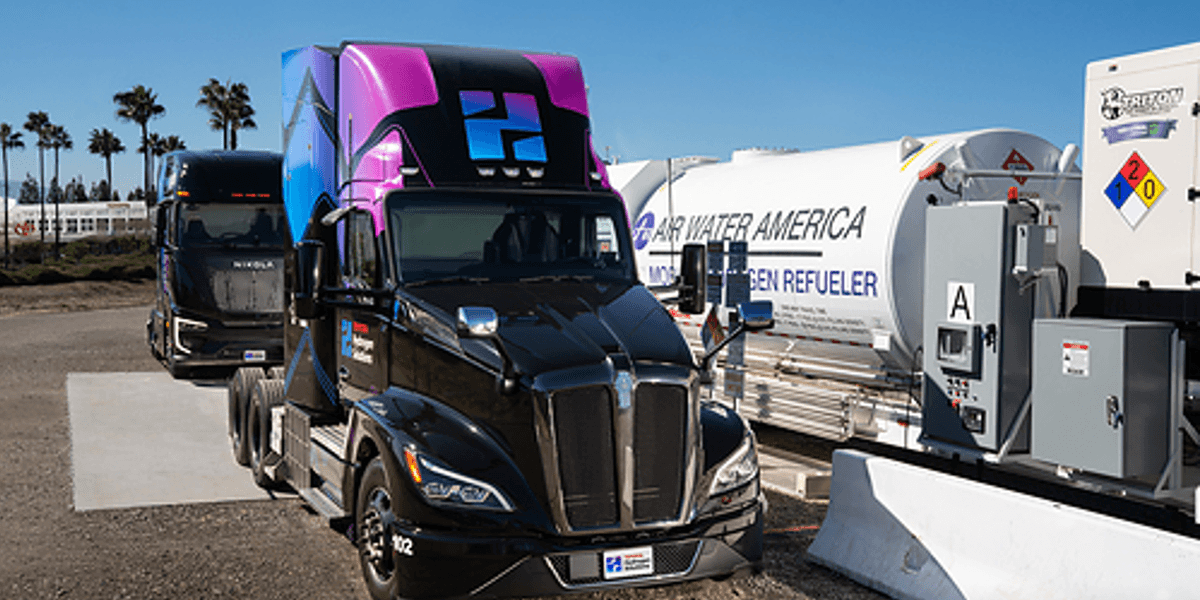
Toyota Motor North America says it has installed two mobile hydrogen fueling devices at its largest parts distribution facility in the U.S., allowing heavy-duty trucks to be refueled in about eight minutes for a range of up to 450 miles.
With the tanks and fuel ready, Toyota’s commercial logistics fleets plan to use the mobile fuelers to support Toyota operations by fueling heavy-duty fuel cell trucks hauling freight from the Port of Los Angeles to Ontario, and throughout the region. A permanent station is planned to be built at the location, which Toyota calls its North American Parts Center California (NAPCC).
The station will initially fuel heavy-duty trucks commissioned through Hyroad Energy and will later integrate heavy-duty trucks with Toyota’s own certified fuel cell powertrain. Production Toyota-powered trucks are expected to hit the open road for commercial operations in 2027.
In a public-private partnership, Toyota is collaborating with the U.S. Department of Energy’s National Laboratory of the Rockies (NLR) in Golden, Colorado, to research several initiatives, including 70 MPa high-flow hydrogen fueling for heavy-duty trucks.
High-flow fueling allows trucks to accept hydrogen fuel at speeds up to 300g/s, or about five times faster than the rate of conventional light-duty fueling technology. It allows heavy-duty trucks to carry energy into the vehicle at an equivalent speed of a 20 MW fast charger. Refueling times are comparable to modern diesel-powered, heavy-duty trucks. Unlike a diesel powertrain, however, fuel cells emit only water.
The company supports the research through its Toyota Hydrogen Headquarters (H2HQ) division, which is the lead office in North America for the development, engineering, commercialization, and business operations of Toyota’s hydrogen fuel cell technologies. Based in Gardena, California, H2HQ works collaboratively with Toyota’s R&D offices in Michigan and Texas, as well as business units in Japan and internationally, to create zero-emissions fuel cell technologies that enable energy independence, innovation, and the movement of people, goods, energy, and information.
