


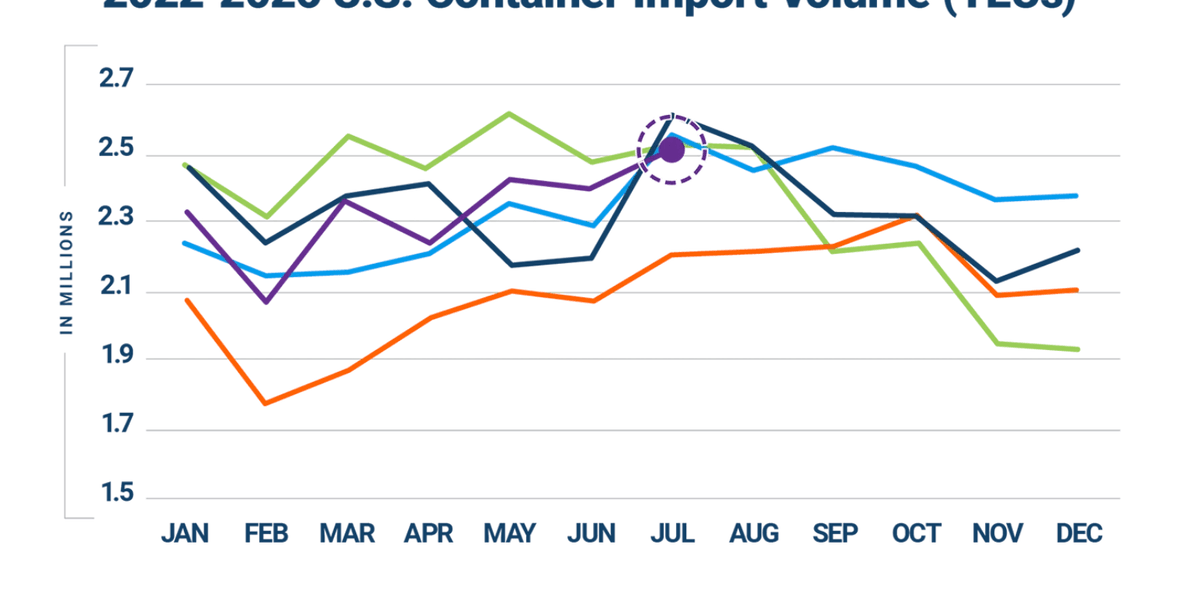
U.S. maritime imports are showing resilience in the face of ongoing trade policy and geopolitical uncertainty, according to the July update of logistics metrics monitored by Canadian supply chain software firm Descartes.
By the numbers, July 2026 U.S. container import volumes increased 4.5% over June to 2,508,310 twenty-foot equivalent units (TEUs), reflecting typical month-over-month seasonal growth, Descartes said in its August Global Shipping Report for logistics and supply chain professionals.
Year-over-year, July imports were down 4.3%, but Descartes said that’s a misleading comparison, since last year’s numbers reflected “suspected aggressive frontloading” in July 2025 when volumes reached 2,621,910 TEUs, triggered by trade policy combined with seasonal demand. For the first seven months of this year, volumes were down a slight 0.9% compared to the same period in 2025, but up by 14.1% compared to the same period in pre-pandemic 2019.
Tracing specific trading partners, July’s results point to a broad-based strengthening in import activity across major sourcing markets, led by China, Descartes said.
July U.S. containerized imports from the top 10 countries of origin (CoO) increased 4.9% month-over-month for a combined increase of 83,706 TEUs. China recorded the largest volume gain, increasing 58,655 TEUs (7.2%) to its highest monthly total since July 2025. Other notable increases came from Hong Kong, up 7,191 TEUs (9.5%), Germany, up 6,174 TEUs (11.1%), Japan, up 5,728 TEUs (10.9%), South Korea, up 4,701 TEUs (5.1%), and India, up 3,974 TEUs (3.8%). Vietnam also posted a modest increase of 2,721 TEUs (1.0%), while Thailand was essentially unchanged. The only declines among the top 10 sourcing countries were Indonesia, down 2,943 TEUs (4.9%), and Taiwan, down 2,474 TEUs (4.4%).
“July’s import growth shows that demand remains resilient amidst a highly complex and challenging operating environment,” said Jackson Wood, Director of Industry Strategy at Descartes. “As changing tariffs, elevated Middle East maritime risk, tighter Panama Canal draft restrictions and continued Red Sea disruption continue to affect costs, capacity and schedule reliability, having flexible sourcing and routing strategies will help U.S. importers respond quickly as conditions evolve.”
