


On Saturday January 18, a  United Airlines Boeing 767-400ER
was forced to return to Newark Liberty International Airport
following a mechanical failure onboard.
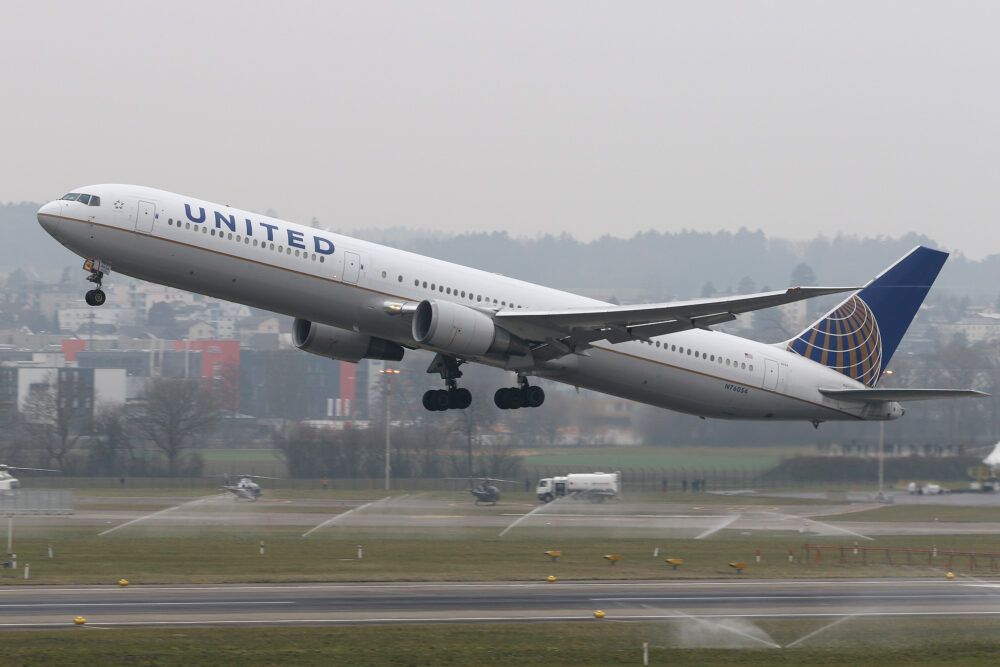
The 767-400ER was the lowest selling variant, with only 38 built. Photo: Getty Images
Business and leisure travelers looking to get away from the wintry Northeast to tropical San Juan
Puerto Rico were in for a surprise, when their flight on Saturday – United Airlines flight 2143 – was forced to return to Newark following some sort of onboard mechanical failure. Flight 2143 left gate C104 and took off out of runway 22R at Newark on time at 10:04 local time. As the flight passed 10,000 feet, the aircraft made a left turn towards the Atlantic Ocean as part of the standard route to Puerto Rico.
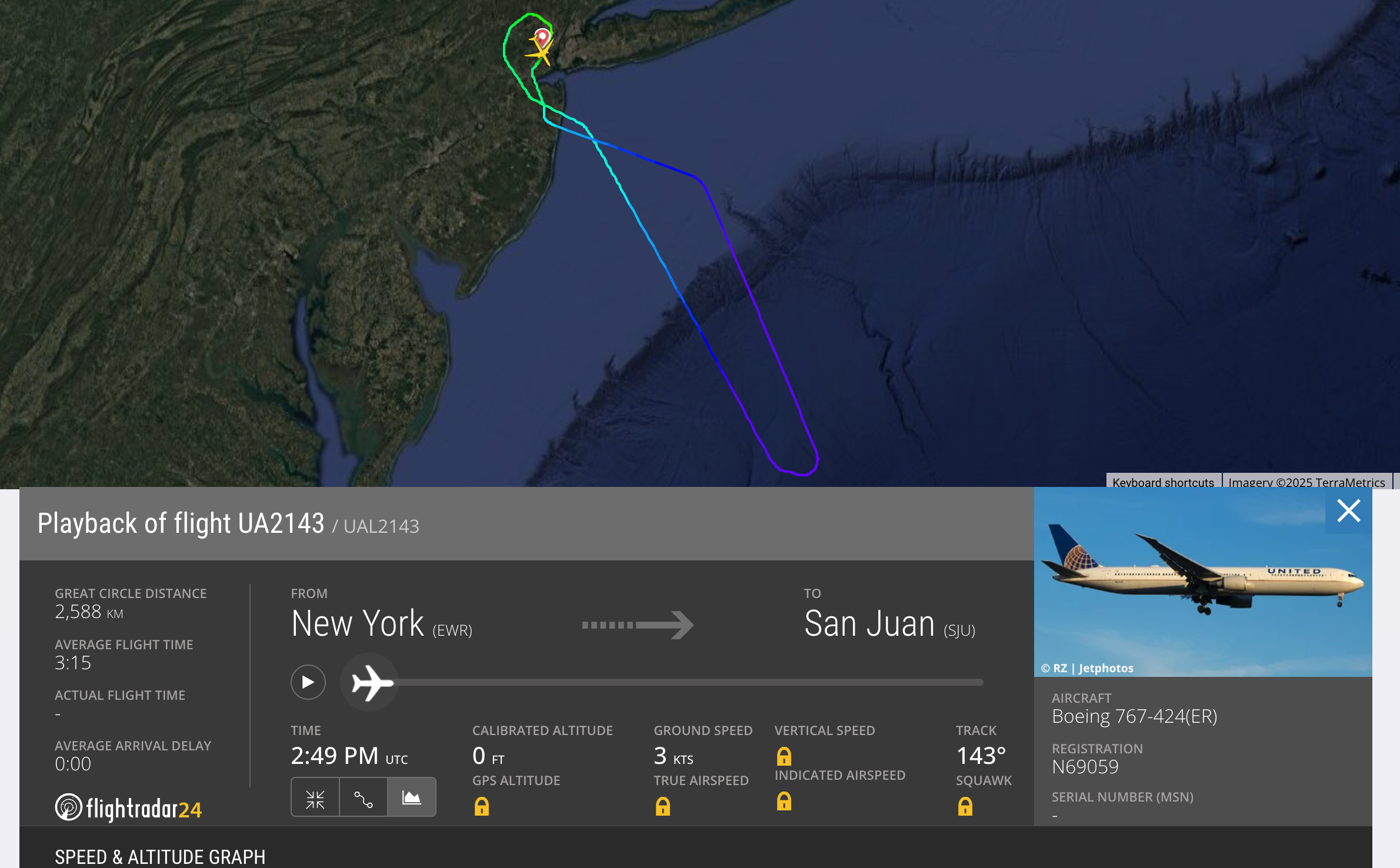
Image: Flightradar24, flightradar24.com
After the flight reached its cruising level at 31,000 then 33,000 feet, some kind of unspecified mechanical issue became apparent, as the pilots of the flight requested to divert back to Newark. Shortly afterwards, the aircraft executed a 180 degree turn just 10 minutes after reaching cruise.
The mechanical issue with the 767 apparently wasn’t severe, as the aircraft was vectored into the normal traffic pattern that arrival traffic takes when landing into Newark from the North. After a flight time of just 26 minutes, flight 2143 made an uneventful landing back at Newark on runway 22L. The aircraft arrived back at Terminal C, this time at gate C125.
The aircraft involved in the mechanical mishap, N69059, was originally delivered to Continental Airlines
in 2002 before merging into the United Airlines fleet following the famous UA-Continental merger in October 2010.
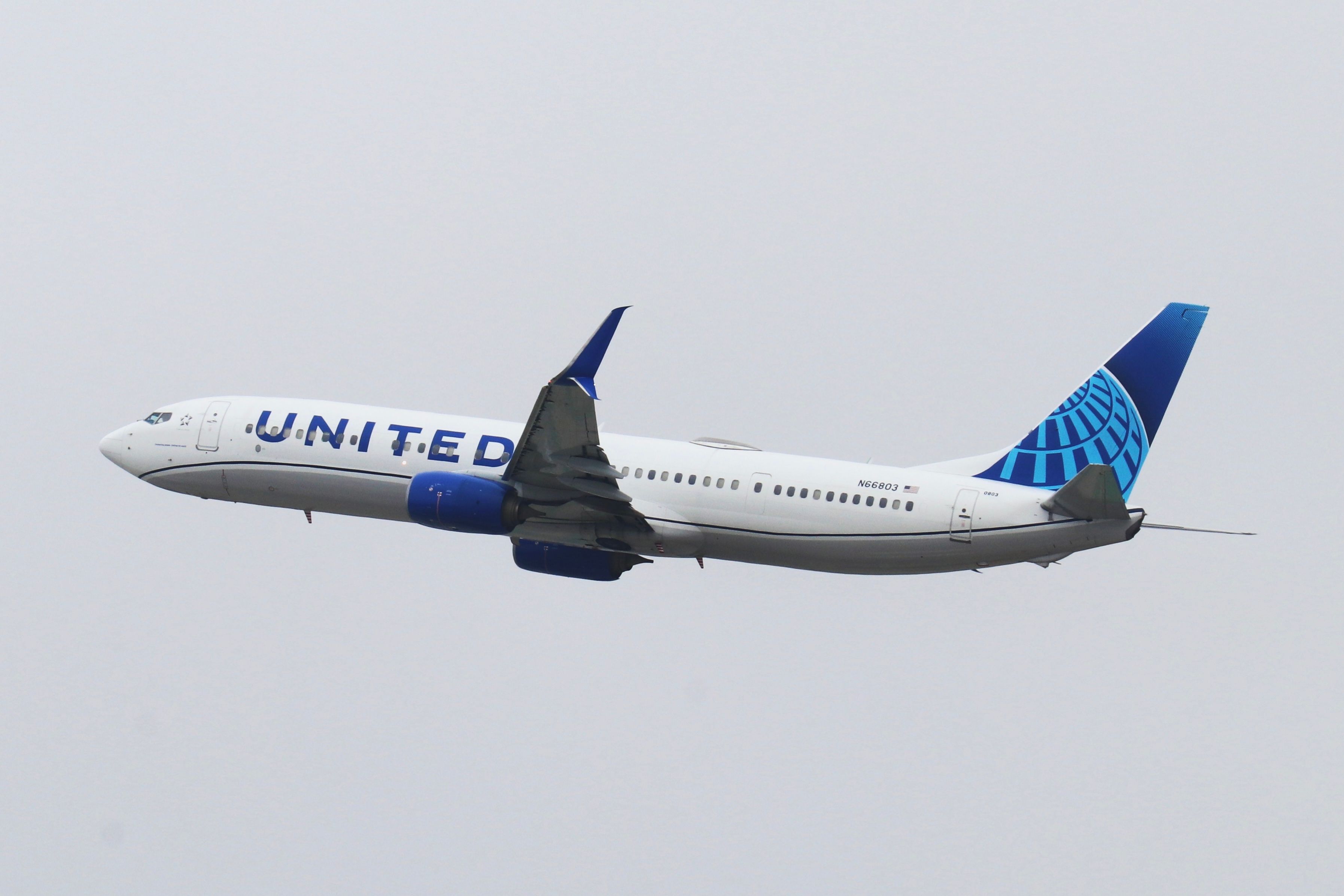
Photo: Tim | Wikimedia Commons
Replacement aircraft to the rescue
A spokesperson for United Airlines stated to news website nj.com that a new aircraft, another Boeing 767-400ER registration N76055, was arranged to fly the 230 passengers of flight 2143 to San Juan. The delayed flight once again took off from Newark at 15:11 local time, landing in San Juan at 19:25 local time after a 3 hour and 15 minute flight, around seven hours after the flights’ scheduled time of arrival at 12:47.
The replacement aircraft that flew to San Juan, has a nearly identical history to the 767-400ER that returned to Newark, being delivered in 2001 and merging into the United Airlines fleet in 2010.
No further details were provided by the FAA or United Airlines with regards to what caused the mechanical issue.
In almost every case, the pilots of an aircraft will try to find a solution to an issue before returning or diverting, as if an issue is not detrimental to the safety of the pilots and passengers of a flight, and can be solved in air, the piltos will do so. Diversions almost always cause a hassle for both airlines and passengers alike.
Photo: United Airlines
Hub-and-spoke proves to be of benefit
Carriers operating the hub and spoke model instead of point-to-point are usually better equipped to handle mechanical malfunctions and flight cancelations. This is because these airlines concentrate their maintenance operations, parked (unused) aircraft, and pilots near these hubs. So, if a flight from one of these hubs needs to return to that hub airport, a replacement aircraft can be easily sourced as compared to a point-to-point airline.
For flights that divert back to United Airlines hubs, the US airline can typically provide replacement aircraft that are not scheduled to fly for whatever reason. This is why the airline has had higher rates of customer satisfaction in recent years when compared to other carriers like  American Airlines
or Spirit Airlines
.
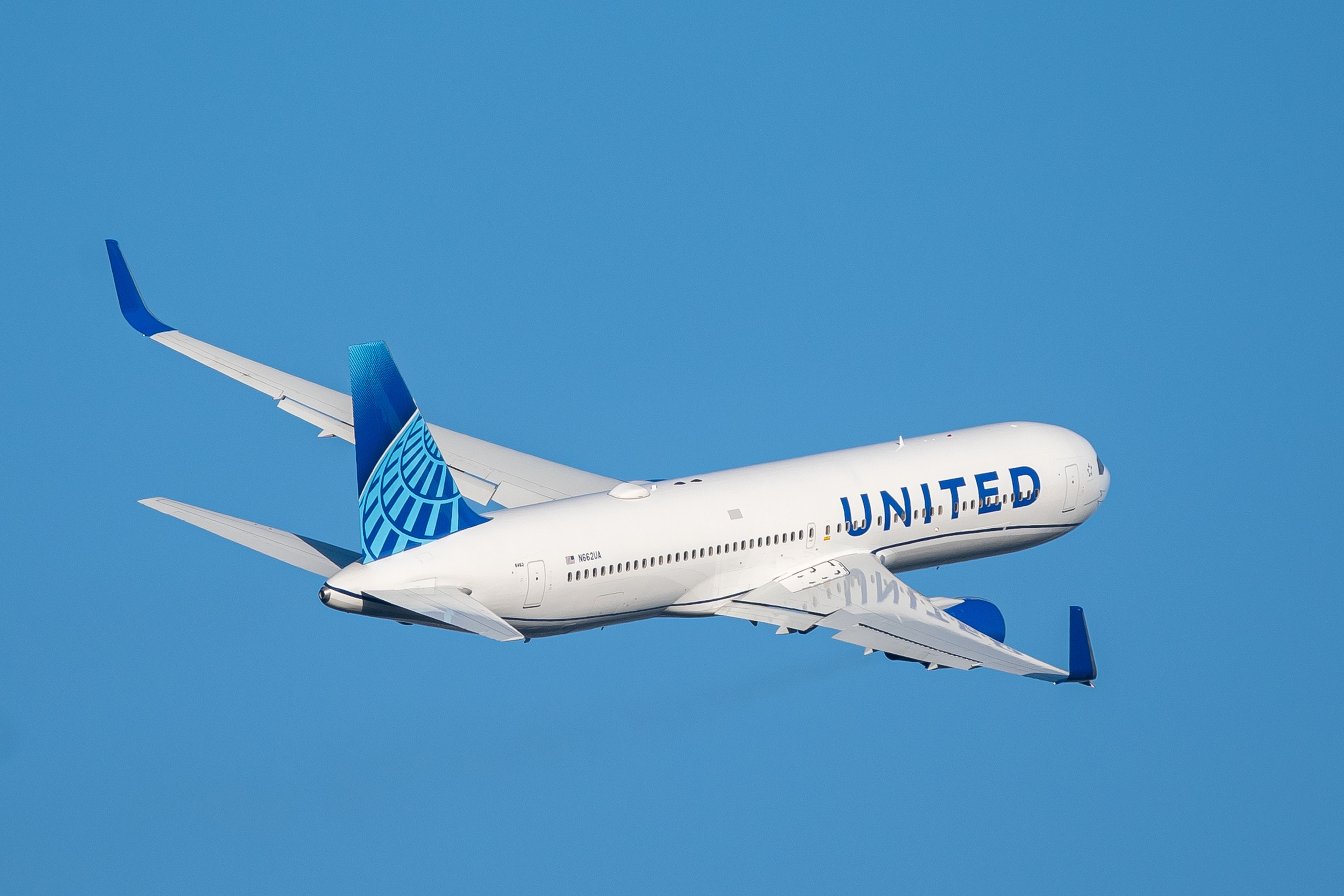
Photo: Q world | Shutterstock
Despite inheriting them from Continental Airlines in 2010, United Airlines still operates its fleet of 16 Boeing 767-400ER’s as an alternative option to the carriers’ high capacity Boeing 777
s and high-efficiency Boeing 787-8 and -9 aircraft. The US carrier primarily operates its -400ER’s from its East Coast hubs of Washington Dulles International Airport
and Newark to European destinations such as Dublin and Lisbon. The carrier also operates the aircraft type on routes where United Airlines has contracts with companies to transport cargo in the holds of such aircraft. Such is the case on the carriers’ Newark to San Juan route, hence the 767s.
