


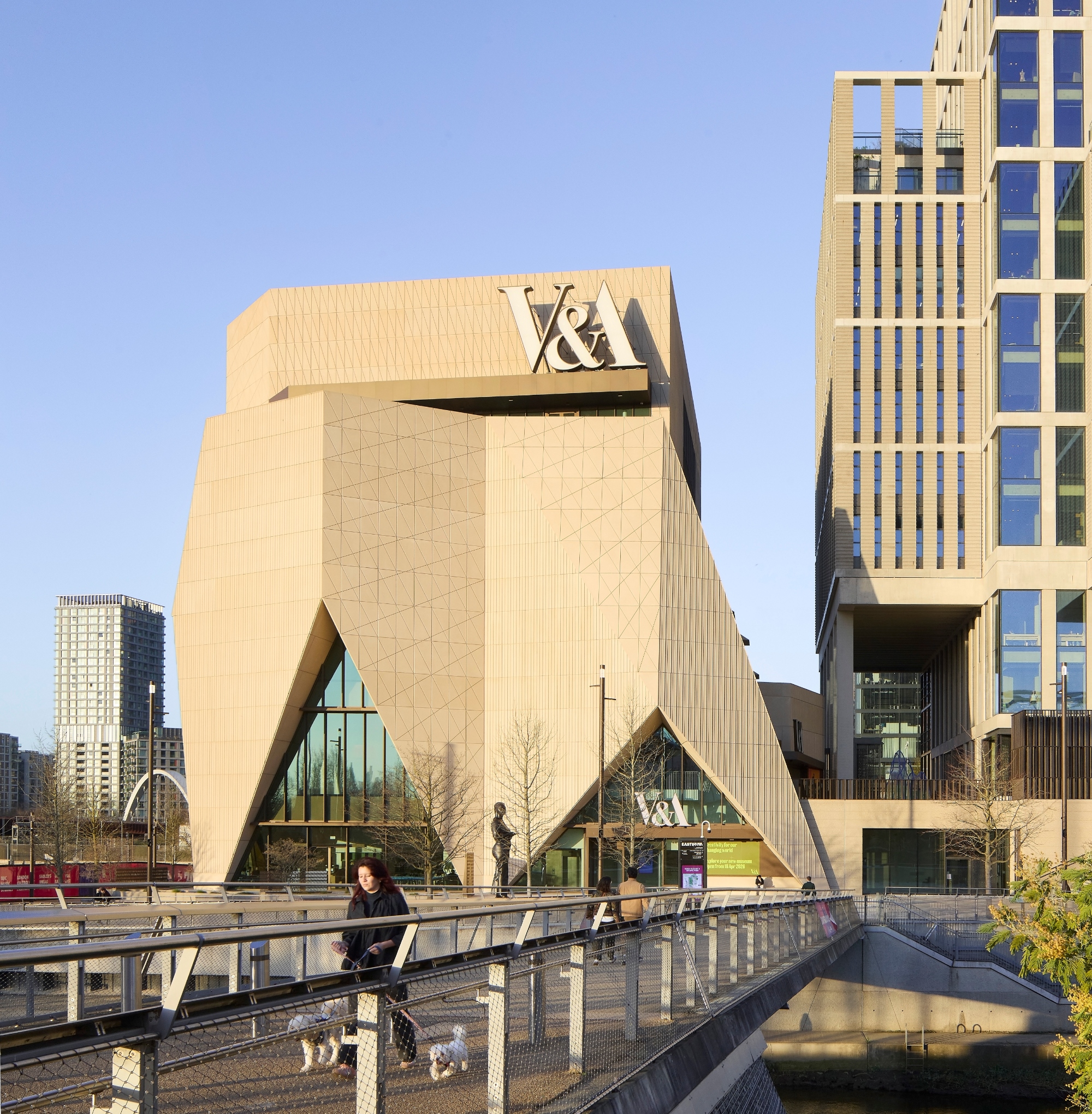
The Victoria & Albert Museum has completed its expansion into east London with the opening of V&A East, a new $180 million outpost that began welcoming the public over the weekend. The institution’s mission is to re-engage young and local audiences with a world-class collection of historic treasures by highlighting its surprising contemporary resonances.
V&A East’s boxy, beige facade, pierced by pointed shards of window, was concocted by Irish architects O’Donnell + Tuomey and has received mixed reviews. Its futuristic appeal does, however, help establish a distinct identity from that of the original V&A in west London—an ornate Victorian shrine to the history of design and the decorative arts. By contrast, V&A East brings this vaunted collection of more than 2.8 million artifacts from across continents into new dialogues “around topical issues in the world today,” according to senior curator Zofia Trafas White.
Inside V&A East Museum’s “Why We Make” galleries. Photo: © David Parry for the V&A.
At the core of the new museum is its two permanent “Why We Make” galleries, featuring over 500 objects that have been chosen with the interest of local Londoners in mind “and offer a new way into the V&A,” said Trafas White. She promised a mix of local and global stories from 1100 up to the present day.
“We explore topics like identity, wellbeing, social justice, and environmental responsibility,” Trafas White explained in an email, adding that displays organized by chronologies, geographies, or materials have been eschewed in favor of a more thematic approach.
In one section titled “Breaking Boundaries,” visitors are introduced to radical queer performance artist Leigh Bowery as well as some of fashion’s most inventive designers, like Vivienne Westwood and Rei Kawakubo. In “Our Place in the World,” the search for identity in a self-portrait by Sofonisba Anguissola, one of only a few women painters to make her name during the Italian Renaissance, has a legacy in the work of photographers like Claude Cahun and Maud Sulter.
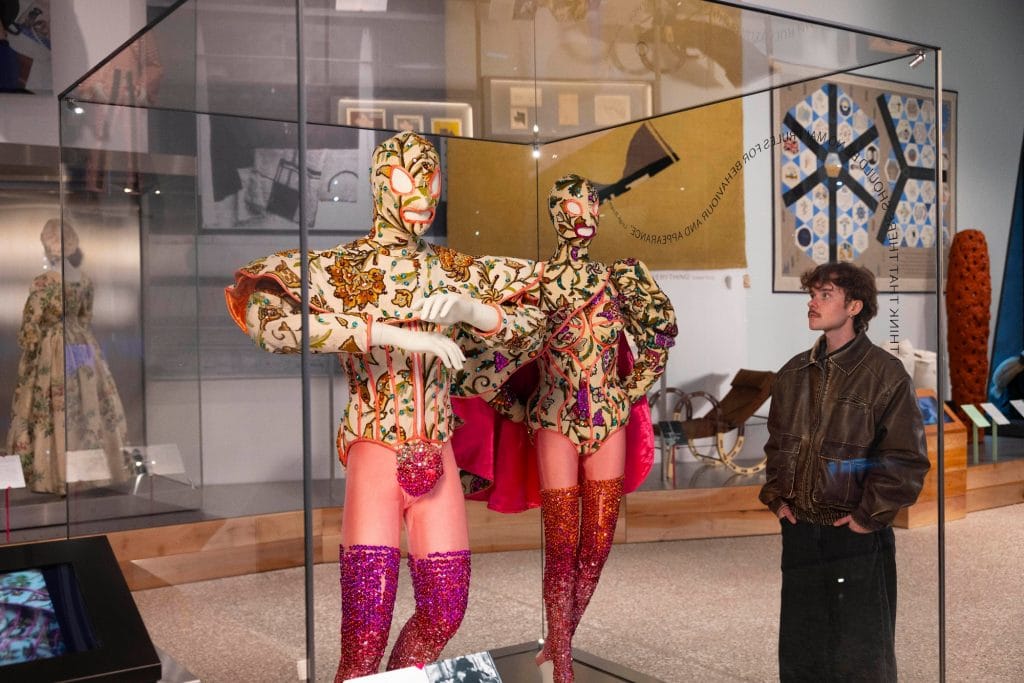
Inside V&A East Museum’s “Why We Make” galleries. Photo: © David Parry for the V&A.
“Bringing together objects into conversation with each other allows presenting new connections between makers across time,” the curator said. These makers “shared attitudes and agendas, championing positive change for people and planet, speaking to pressing issues in our world today.”
The temporary exhibition program, meanwhile, is being launched with “The Music is Black: A British Story,” which tells the institutionally overlooked story of Black British music over 125 years through some 200 objects from the V&A’s collection. Early trailblazers like Winifred Atwell, Shirley Bassey, and beloved stars of reggae, ska, and rock are recognized alongside a host of contemporary names like Jme and Lil Simz who continue to innovate across genres like drum & bass, grime, and U.K. garage, redefining British music in the process.
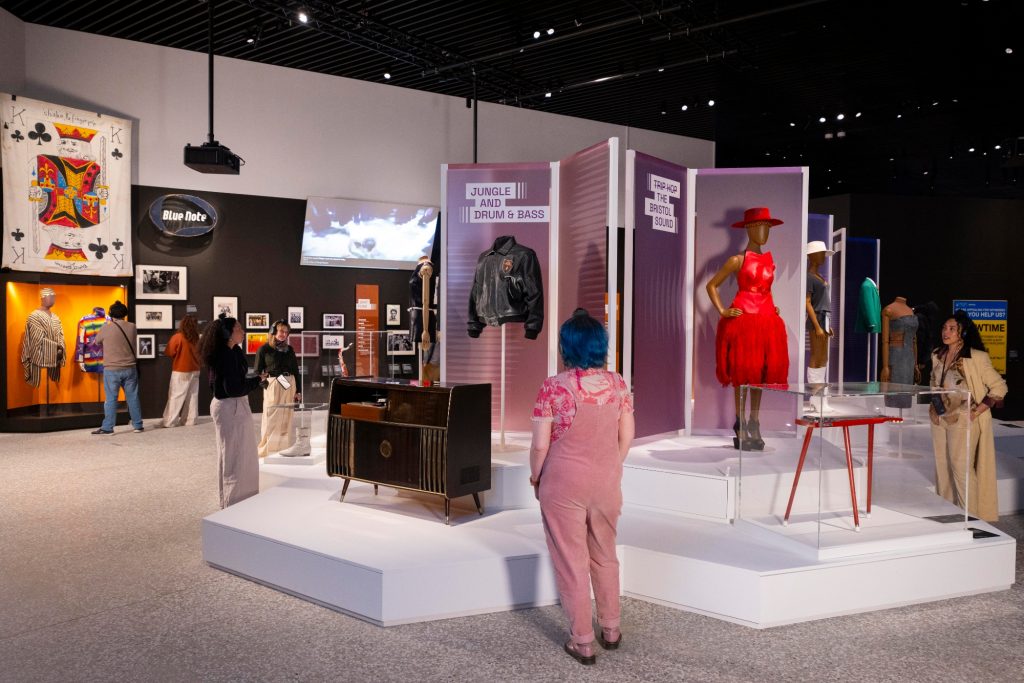
Inside V&A East Museum’s inaugural exhibition, “The Music is Black A British Story.” Photo: © David Parry for the V&A.
One dimension of the multi-sensory experience comes from the records of Black British culture produced by artists like the Nigerian modernist Ben Enwonwu, as well as Denzil Forrester, Frank Bowling, Golden Lion-winner Sonia Boyce, and a new piece by Rene Matić. Elsewhere, artifacts bring memorable cultural moments into the museum, such as a painted vest worn by Stormzy at Glastonbury Festival in 2019.
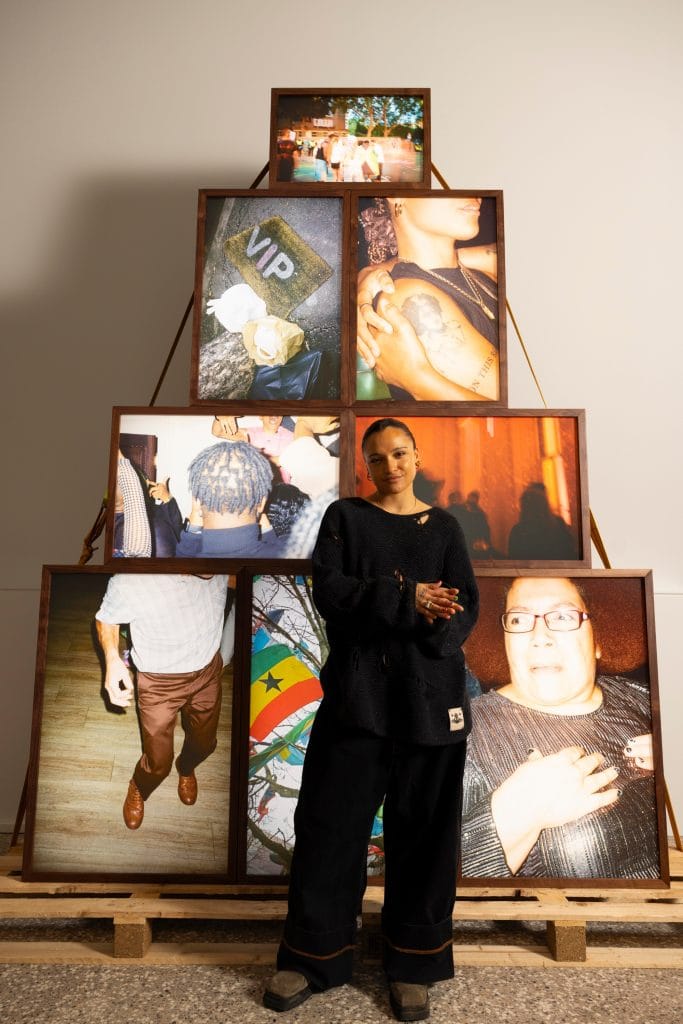
“New Work” commission by Rene Matić for V&A East Museum. Photo: © David Parry for the V&A.
“Everyone is welcome at V&A East,” emphasized the museum’s director Gus Casely-Hayford in a press statement. “We hope you see yourself, your stories, and experiences represented here.”
The latest addition to London’s thriving East Bank cultural district in Queen Elizabeth Olympic Park, Stratford, V&A East sits in close proximity to its sister museum V&A East Storehouse, which opened last May. The vast complex takes the form of a storage unit spanning four stories, clocking in at total of 172,222 square feet, some 250,000 objects, 350,000 books, and 1,000 archives, which are accessible to visitors who freely roam the aisles unguided by typical museum signposting.
The experiment has already proven a hit with underserved audiences. Data on visitors to the Storehouse in its first six months revealed that nearly a third were under the age of 35 and more than 45 percent of U.K. visitors were from minority ethnic groups, according to The Art Newspaper.
