


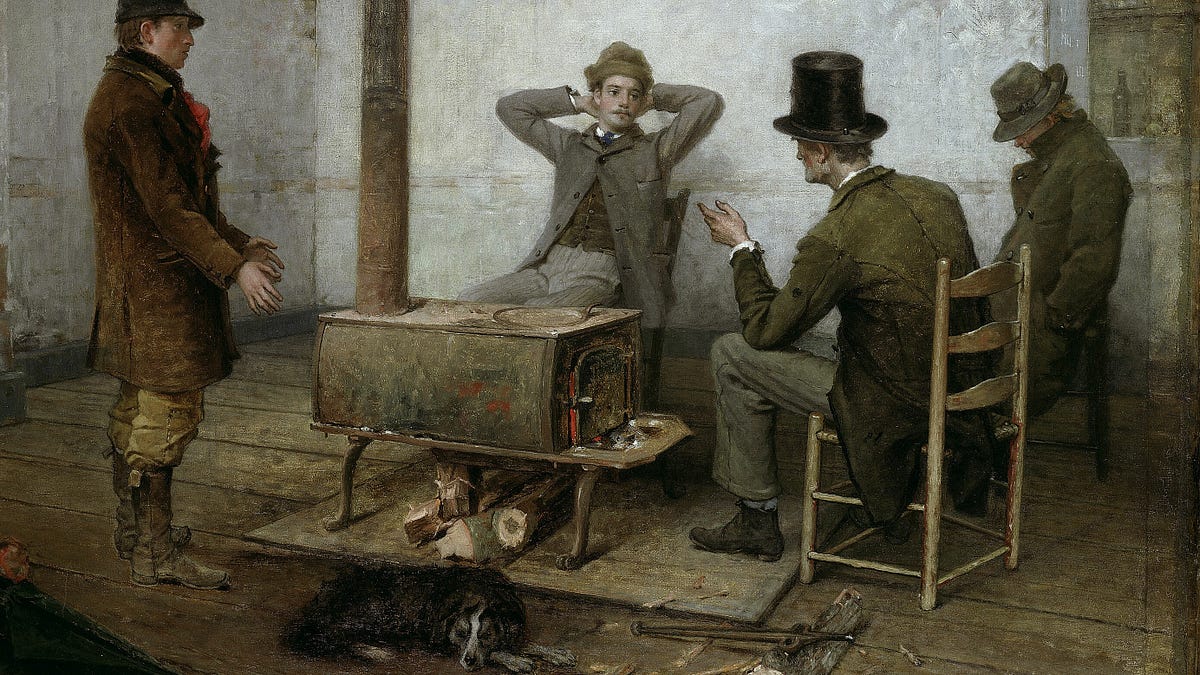
Loneliness is one of the great challenges not just of our time but of our whole form of self-government. A new report from Columbia World Projects sums up America’s civic “supply problem,” in a litany reminiscent of Robert Putnam’s “Bowling Alone”:
[T]he institutions that once connected ordinary people to democratic life have hollowed out. Private-sector unions that once anchored working-class communities and provided year-round civic education, social life, and political connection have nearly disappeared. Local party organizations that once operated in neighborhoods, helped people with everyday problems, and gave citizens a real stake in politics have been replaced by national data operations that go quiet between election cycles. Civic education in schools has been cut. Religious congregations that have operated as sites of meaning making and anchored civic life are disappearing, with 100,000 churches projected to close over the next five years. The basic conditions that make democratic participation possible are in short supply for millions of Americans.
The report then identified a partisan asymmetry in the American system: “evangelical networks, conservative media, and organizations such as Turning Point USA” often “meet people where they are, offer genuine community, and make members feel like they matter. On the left: not much.”
The report’s call was to rebuild civic life “from the bottom up,” with “organizations and parties that are physically present in communities year-round, which treat members as people with vision who develop their own ideas and strategies and articulate future goals, rather than as an audience for professionals.” Ads and emails need to get replaced by “slow, relational, place-based work.”
I agree. My own biases are toward wanting more community, and my day job involves promoting local media subsidies so that people feel better connected to where they live.
But I also have to constantly confront my own assumptions for why community is such a good thing, given how much Americans, as a people, persistently behave as if there is too much community or resist creating more of it, even now. Over and over again, Americans choose to sever bonds that connect us with each other: We move away from our hometowns, we leave our churches, we quit our unions, we quit our parties, we stay in instead of going out, we donate instead of volunteering, we let friendships fade away. Whenever faced with some unsatisfactory civic situation — to borrow Albert O. Hirschman’s formulation — Americans frequently choose “exit” over “voice” or “loyalty.”
Problematically, the most powerful cultural centrifuge that flings Americans apart is American democracy itself.
In pre-Revolutionary America, social life would have been unrecognizable even just for the density of its civic webs, as I wrote about last week in a review of Gordon S. Wood’s “The Radicalism of the American Revolution.” Everybody was tied to somebody else:
Servility smothered everything: the slaves in the fields, the indentured servants in the homes, the wives treated like the children of their husbands, the yeomen who doffed their hats to the gentlemen, the gentlemen who answered to Crown appointees of whatever quality, all of them bowing under a faraway King. Life in the American colonies was simple, poor, stupid and subservient.
The Revolution — freedom — shattered American communal life as it was then known. Universal emancipation and suffrage would take longer to come along. But as early as 1835, Alexis de Tocqueville perceived democracy’s annihilating power:
Aristocracy had made a chain of all the members of the community, from the peasant to the king: democracy breaks that chain, and severs every link of it. As social conditions become more equal, the number of persons increases who, although they are neither rich enough nor powerful enough to exercise any great influence over their fellow-creatures, have nevertheless acquired or retained sufficient education and fortune to satisfy their own wants. They owe nothing to any man, they expect nothing from any man; they acquire the habit of always considering themselves as standing alone, and they are apt to imagine that their whole destiny is in their own hands. Thus not only does democracy make every man forget his ancestors, but it hides his descendants, and separates his contemporaries from him; it throws him back forever upon himself alone, and threatens in the end to confine him entirely within the solitude of his own heart.
The coarseness and atomism of American democracy came as a shock to the Founders themselves, who had dreamed of a new Roman Republic and instead woke to Andrew Jackson. “This democratic society was not the society the revolutionary leaders had wanted or expected,” Wood wrote. Ralph Waldo Emerson, like de Tocqueville, was similarly unsparing about America’s democratic individualism:
It is the age of severance, of dissociation, of freedom, of analysis, of detachment. Every man for himself. The public speaker disclaims speaking for any other; he answers only for himself. The social sentiments are weak; the sentiment of patriotism is weak; veneration is low; the natural affections feebler than they were. … There is an universal resistance to ties and ligaments once supposed essential to civil society. The new race is stiff, heady and rebellious; they are fanatics in freedom; they hate tolls, taxes, turnpikes, banks, hierarchies, governors; almost the laws. … The age tends to solitude.
Of course, in time America would also come to be known as the nation of joiners, home to countless social clubs and the budding art of voluntary association, boosted by spates of unionization and religious revivals. But it’s also hard not to compare today’s anomie with America’s early years and wonder if our communitarian periods and institutions are the aberrations, if democratic culture is simply experiencing a regression to a lonely mean.
The harsh reality of community life is that it can be coercive, if not held together by coercion itself. I’m not just talking about religious communities. When I was the president of a union, I was perfectly aware that I was in charge of something that was practically alien in 21st century American life: legally imbued (under federal laws created in the social-democratic 1930s) with the exclusive power to bargain members’ working conditions and require them to pay for the costs of representation, even if they strongly protested the process, its outcome or even my existence as the president. Of course, this power had been won through years of painstaking organizing and via the popular consent of democratic election; this power could also be undermined at any moment by calling for a work stoppage that no one participates in.
But the parts of unionization that were transformational — the ethic of solidarity, the sharing of information, a greater sense of belonging, the communal gatherings — could be seen by skeptics completely through antonyms: the potentially lifelong stigma around scabbing during strikes you didn’t agree with; the loss of some privacy around sensitive personnel matters; suspicions of groupthink; and the enormous time commitment of communal gathering on top of having a full-time job. To be together was powerful, and it was also a burden. Succeeding as a 21st century union was to be aware, at all times, of this burden and to maintain a constant consent for the burden’s continued existence. To fail to do so would be to become another statistic in the broader trend of the American labor movement’s long decline.
Having gone through the union experience — and having changed many journalists’ lives for the better because of it — made me far more sensitive to the delicate character of the American civic movement, which often explores how to achieve the same benefits of community (which Americans like) without the same intensity of social obligation (which Americans apparently don’t). The movement’s gentle aspirations are coincidentally spelled out in its preference for the adjective “civic,” with its Latin connotations of wreathed republicanism, and not “political,” with its grimier democratic origins in the rough-and-tumble streets of the Greek polis. I often imagine the sensibilities in tension with each other, the reformers versus the public. “There are always two parties, the party of the Past and the party of the Future; the Establishment and the Movement,” Emerson wrote. The uncomfortable question for the civic movement of the future is whether the establishment opposition — the real leviathan — is the culture created by democracy itself.
The Columbia report, to its credit, sees civic and political strength as connected solutions to the problem of democratic isolation:
Three practical frameworks stood out. First, the idea of socially thick and politically thick parties: parties that are embedded in everyday community life and that have real internal debate, not just top-down message discipline. Second, the role of para-parties, which means organizations like Mom’s for Liberty, Voto Latino or Faith in Minnesota that work alongside political parties and could play a larger role if given formal seats in decision-making. Third, the observation that electoral reforms like ranked-choice voting, fusion voting, and proportional representation are valuable but not sufficient on their own. They have to be paired with the harder work of rebuilding civic infrastructure.
And media’s role in the civic infrastructure, as I am fond of quoting de Tocqueville on, is to gather the wandering spirits of democratic isolation who otherwise can’t afford the burdens of communal gathering:
The principal citizens who inhabit an aristocratic country discern each other from afar; and if they wish to unite their forces, they move towards each other, drawing a multitude of men after them. It frequently happens, on the contrary, in democratic countries, that a great number of men who wish or who want to combine cannot accomplish it, because as they are very insignificant and lost amidst the crowd, they cannot see, and know not where to find, one another. A newspaper then takes up the notion or the feeling which had occurred simultaneously, but singly, to each of them. All are then immediately guided towards this beacon; and these wandering minds, which had long sought each other in darkness, at length meet and unite.
The newspaper brought them together, and the newspaper is still necessary to keep them united. In order that an association amongst a democratic people should have any power, it must be a numerous body. The persons of whom it is composed are therefore scattered over a wide extent, and each of them is detained in the place of his domicile by the narrowness of his income, or by the small unremitting exertions by which he earns it. Means then must be found to converse every day without seeing each other, and to take steps in common without having met. Thus hardly any democratic association can do without newspapers.
Of course, even de Tocqueville’s idea of communal life in America recognized that media was a solution to a practical democratic problem: often, in a free society, people like to stay home.
The views in this newsletter are mine alone, though maybe they’re also anybody or everyone else’s.
