


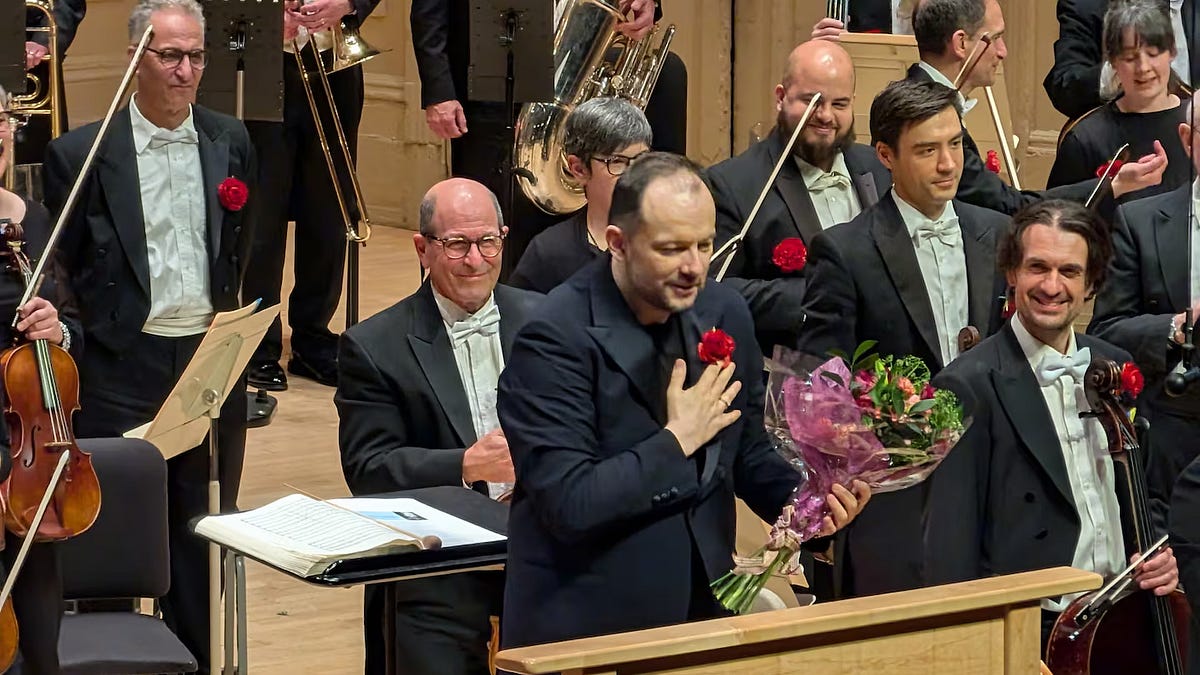
David Allen’s recent New York Times piece on the Boston Symphony Orchestra is thoughtful, elegantly written, and raises important questions about one of America’s greatest musical institutions. Yet after reading it, I found myself returning to a question the article never seriously confronts. When ninety of the world’s finest musicians publicly tell us they have found an extraordinary artistic leader, what burden of proof should be required before we conclude they are all mistaken?
Before going any further, let me make something equally clear. David Allen is not a musician. That fact is neither a criticism nor a disqualification. Some of the greatest music critics in history were not performers, and criticism is a discipline worthy of enormous respect. I have admired serious critics all my life and lament how diminished their influence has become in an age of instant opinions and social media outrage. But criticism also has limits. Those limits become especially apparent when a critic dismisses the considered judgment of the very artists whose work he is evaluating. Throughout his article, Allen minimizes the extraordinary public support that the Boston Symphony musicians have shown for Andris Nelsons. Their loyalty is treated less as evidence worthy of examination than as an emotional reaction from musicians unable to accept change. It is a curious position. If a critic’s professional opinion deserves respect, why should the collective judgment of one of the world’s finest orchestras deserve less?
The answer cannot simply be that the critic is more objective. Objectivity is valuable, but proximity matters as well. Critics attend performances. Audiences hear concerts. Administrators oversee institutions. But only the musicians experience the entire artistic relationship — from the first rehearsal to the final performance, year after year. They know who arrives prepared, who inspires confidence, who earns trust, who elevates an ensemble and who does not. Their testimony is not infallible, but neither is anyone else’s. It deserves to be treated as primary evidence, not an inconvenient obstacle to a predetermined narrative.
Nowhere is this more evident than in Allen’s discussion of the reported Susanna Mälkki incident. The episode is presented as evidence of broader dysfunction within the orchestra. Yet anyone genuinely seeking to understand what happened would have to begin with the musicians themselves. Better still, one would have to read the conductor evaluations submitted by the players that week — the closest thing to a contemporaneous collective record of the orchestra’s artistic judgment. Those evaluations are confidential, as they should be. But their very existence is a reminder that the public record is necessarily incomplete. That matters. It does not mean the published accounts are wrong. It means they cannot be complete. When the most direct evidence from the people who experienced the collaboration firsthand is unavailable, responsible journalism and responsible criticism should acknowledge the limits of what can be known. Otherwise, a single reported incident risks carrying more explanatory weight than the available evidence can bear.
Allen also argues that Nelsons’ artistic time has simply run its course. His Tchaikovsky no longer convinces him. His interpretations have become mannered. Twelve years, apparently, are enough. That is a perfectly legitimate critical opinion.What is less convincing is the implicit assumption that longevity itself is evidence of artistic exhaustion. Great orchestras were not built through constant turnover – if anything, they’ve been destroyed by it. They were shaped over decades by conductors whose relationships with their musicians deepened with time. Karajan in Berlin. Haitink in Amsterdam. Ormandy in Philadelphia. Mravinsky in Leningrad. Szell in Cleveland. One may debate individual artistic results, but history suggests that continuity has often produced greatness rather than stagnation. The modern tendency to treat music directors as interchangeable executives moving from institution to institution deserves far more scrutiny than it receives.
There is another assumption underlying the article that deserves examination. Allen repeatedly praises Boston’s Festival of Contemporary Music while criticizing Nelsons’ artistic priorities. I have no quarrel with contemporary music. New music is essential to the life of an orchestra. But contemporary music exists within a tradition that made it possible. The masterpieces of the past are not obstacles to progress; they are the foundation upon which every living composer stands. Programming should enrich that tradition, not seek to replace it. For years audiences have said, often with complete honesty, that they endured the new work in order to hear the Bruckner or the Brahms. Ask any musician, I’ve personally heard that a million times. That may frustrate critics, and contemporary music lovers like myself, but it remains an important reality. The challenge is not to lecture audiences into different tastes. It is to commission and champion new music compelling enough to stand beside the repertoire without institutional persuasion.
Boston should certainly evolve. Every great orchestra must. But evolution should begin with humility rather than certainty. Before dismantling what has been built over generations, one ought to know with some confidence that the replacement will be better — not merely newer, more fashionable or more aligned with current administrative thinking. I have written in my previous pieces why I do not believe Boston should attempt to become Los Angeles. Every orchestra has its own history, culture and artistic identity. Success cannot simply be imported from another institution by copying its priorities or its organizational philosophy.
What troubles me most about Allen’s essay is not that he disagrees with the musicians. It is that he rarely seems to take them seriously. An orchestra is not its board. It is not its president. It is not its donors. It is not its critics. It is, first and foremost, its musicians. I can’t repeat that enough. When nearly an entire orchestra publicly risks its reputation to defend a music director, the proper response is not condescension but curiosity and respect – musicians have earned at least that. One may ultimately conclude they are wrong. But before reaching that conclusion, one ought to ask a simple question: What do they know that the rest of us do not? Until that question is taken seriously, the conversation about the Boston Symphony Orchestra will remain incomplete. And criticism that claims to speak for the future of one of the world’s great orchestras will have failed to listen to the people who know it best.
