

GAIL (India) Limited CMD Reviews Vijaipur LPG Hub, Inaugurates Floating Solar Plant To Boost Green Energy Push – Indian PSU

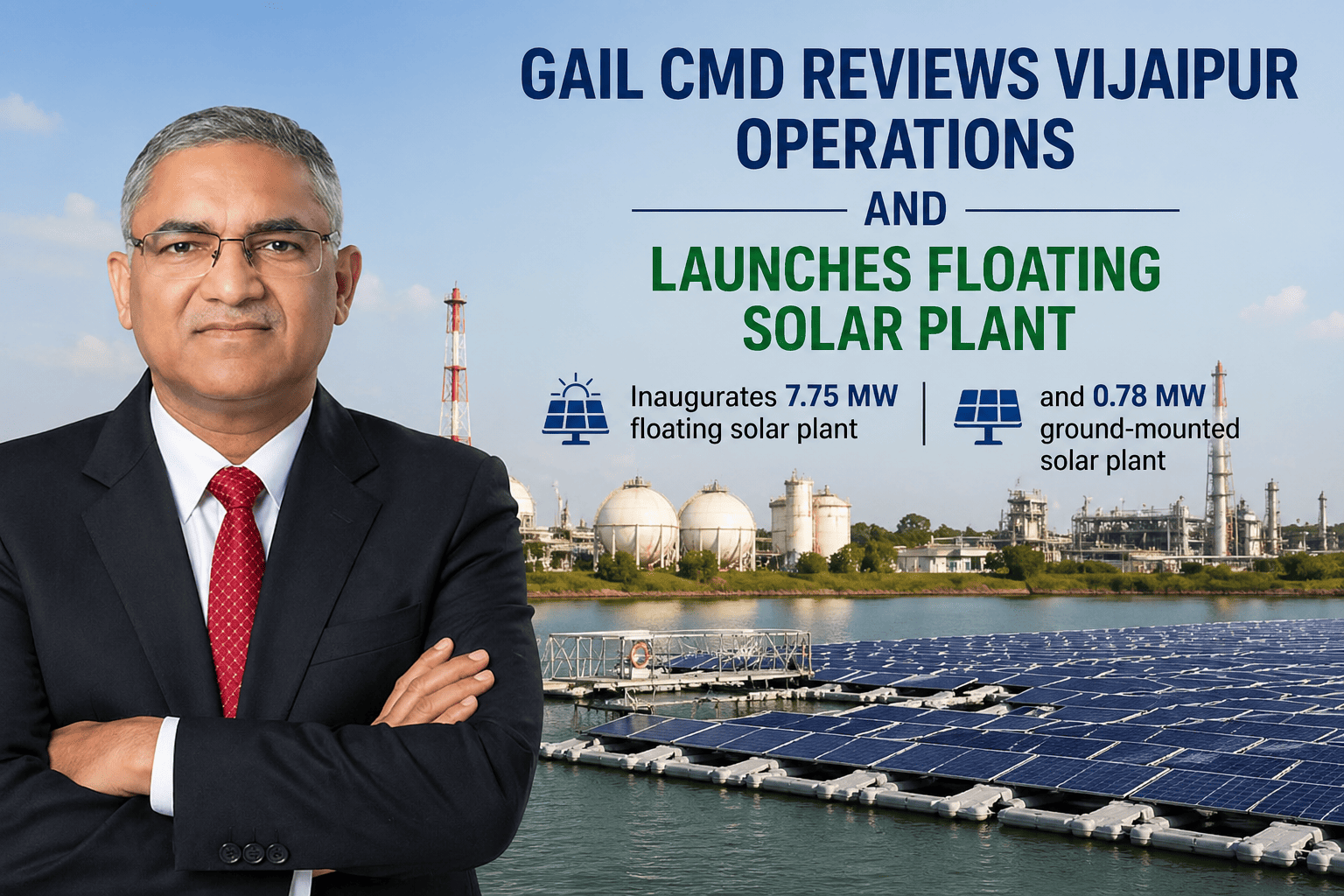
In a significant move underscoring operational resilience and clean energy integration, GAIL (India) Limited Chairman and Managing Director Deepak Gupta carried out a comprehensive review of the company’s strategic Vijaipur complex in Madhya Pradesh, while simultaneously inaugurating new solar power assets aimed at reducing the carbon footprint of one of India’s key LPG production centres.
The high-level visit, undertaken on April 21, assumes particular significance at a time when India’s energy infrastructure is being recalibrated to deliver both uninterrupted fuel supplies and a stronger renewable energy mix. Vijaipur remains one of GAIL’s most critical operational nodes in the liquid hydrocarbon value chain, especially in Liquefied Petroleum Gas (LPG) production that caters to millions of domestic households as well as essential institutional consumers across the country.
Sharp Focus On LPG Reliability And Supply Continuity
During the review, Deepak Gupta assessed the plant’s production performance, reliability parameters, evacuation systems and supply chain preparedness with a clear emphasis on ensuring that LPG availability remains insulated from global market volatility and geopolitical disruptions.
Senior officials briefed the CMD on plant load factors, maintenance discipline, compressor availability, dispatch logistics and emergency contingency arrangements. The review also examined how the Vijaipur complex can continue to sustain high throughput amid shifting international energy equations and pressure on hydrocarbon supply chains.
Sources indicated that GAIL management laid special stress on uninterrupted LPG dispatches, optimisation of internal utilities, and preparedness to tackle any disruption in feedstock movement or downstream evacuation.
The Vijaipur unit is regarded as one of GAIL’s flagship processing locations and plays an indispensable role in strengthening the PSU’s hydrocarbon supply reliability architecture.
Renewable Energy Capacity Gets Major Lift
In a parallel development that signals GAIL’s accelerating shift toward low-carbon operations, the CMD inaugurated a 7.75 MW floating solar power plant along with an additional 0.78 MW ground-mounted solar installation within the Vijaipur premises. These newly commissioned renewable assets substantially enhance the clean power portfolio of the complex and are expected to support internal energy consumption of the LPG production ecosystem.
The floating solar project is particularly notable because it leverages existing water bodies to generate green electricity without requiring additional land footprint — a model increasingly being adopted by large industrial utilities seeking efficient decarbonisation pathways.
Officials said the integration of these renewable units with the plant’s conventional power systems will help reduce dependence on thermal energy, improve flexibility in the energy mix, and lower the overall emissions intensity of operations.
The development aligns with GAIL’s broader clean energy strategy, which has recently gathered pace with the PSU announcing large-scale investments in utility solar projects and battery-backed renewable systems in multiple states.
Critical Compressor Automation Upgrade Completed
Another major milestone marked during the visit was the commissioning of an advanced control system upgrade on GAIL’s Solar Turbines DVPL gas turbine compressors, each crucial for maintaining process continuity and gas handling efficiency at the complex.
The compressor units — rated at 15.3 MW and 10 MMSCMD — have now been migrated to the latest TurboTronics 6 platform, significantly modernising the plant’s automation and operational control framework.
This technological upgradation is expected to deliver multiple gains:
- improved process reliability,
- better predictive monitoring,
- tighter IT-OT integration,
- lower operational emissions,
- and enhanced response time during system fluctuations.
Plant teams also carried out validation tests, architecture checks and revised operating protocol familiarisation to ensure seamless adaptation to the new digital control environment.
Industry experts note that such control-system modernisation is increasingly becoming indispensable for legacy hydrocarbon infrastructure as PSUs seek to simultaneously improve productivity, reduce downtime and align with ESG-linked operational benchmarks.
Blending Conventional Energy Security With Decarbonisation
The Vijaipur review sends a clear message that GAIL is attempting to build a dual-track operational model — one that protects India’s conventional LPG and gas supply backbone while embedding renewable energy into the heart of its industrial infrastructure.
Rather than treating green energy as a standalone expansion, the PSU is now visibly integrating solar generation, smart controls, and process optimisation directly into mission-critical hydrocarbon facilities. This marks a structural shift in how large public sector energy companies are approaching sustainability.
With LPG demand continuing to remain strong across domestic and commercial segments, and with India simultaneously pushing aggressive climate commitments, Vijaipur is emerging as a testbed for this balanced energy-security-plus-energy-transition framework.
Strategic Message From GAIL Leadership
By personally reviewing plant preparedness, commissioning new solar assets, and overseeing technology upgrades, CMD Deepak Gupta has reinforced GAIL’s message that operational excellence and sustainability are no longer parallel agendas — they are now being fused into one execution roadmap.
The PSU has indicated that continuous monitoring of plant efficiency, supply resilience and renewable integration will remain a top management priority in the coming months.
As India’s public sector energy giants face the twin challenge of ensuring uninterrupted fuel supplies and meeting decarbonisation targets, GAIL’s Vijaipur initiative offers a clear glimpse of how the transition may unfold: stronger conventional systems backed by smarter, greener infrastructure.
