


A transatlantic flight between the United States and the UK can take anywhere between six and ten hours, depending upon where it flies from the US. Passengers flying the popular New York JFK to London Heathrow route usually reach their destinations in six hours, while those flying out from Los Angeles can take up to 10 hours.
Flights durations between any two destinations can vary slightly depending upon various factors, such as the total aircraft load, wind and weather conditions, as well as the landing timings at the destination airport.
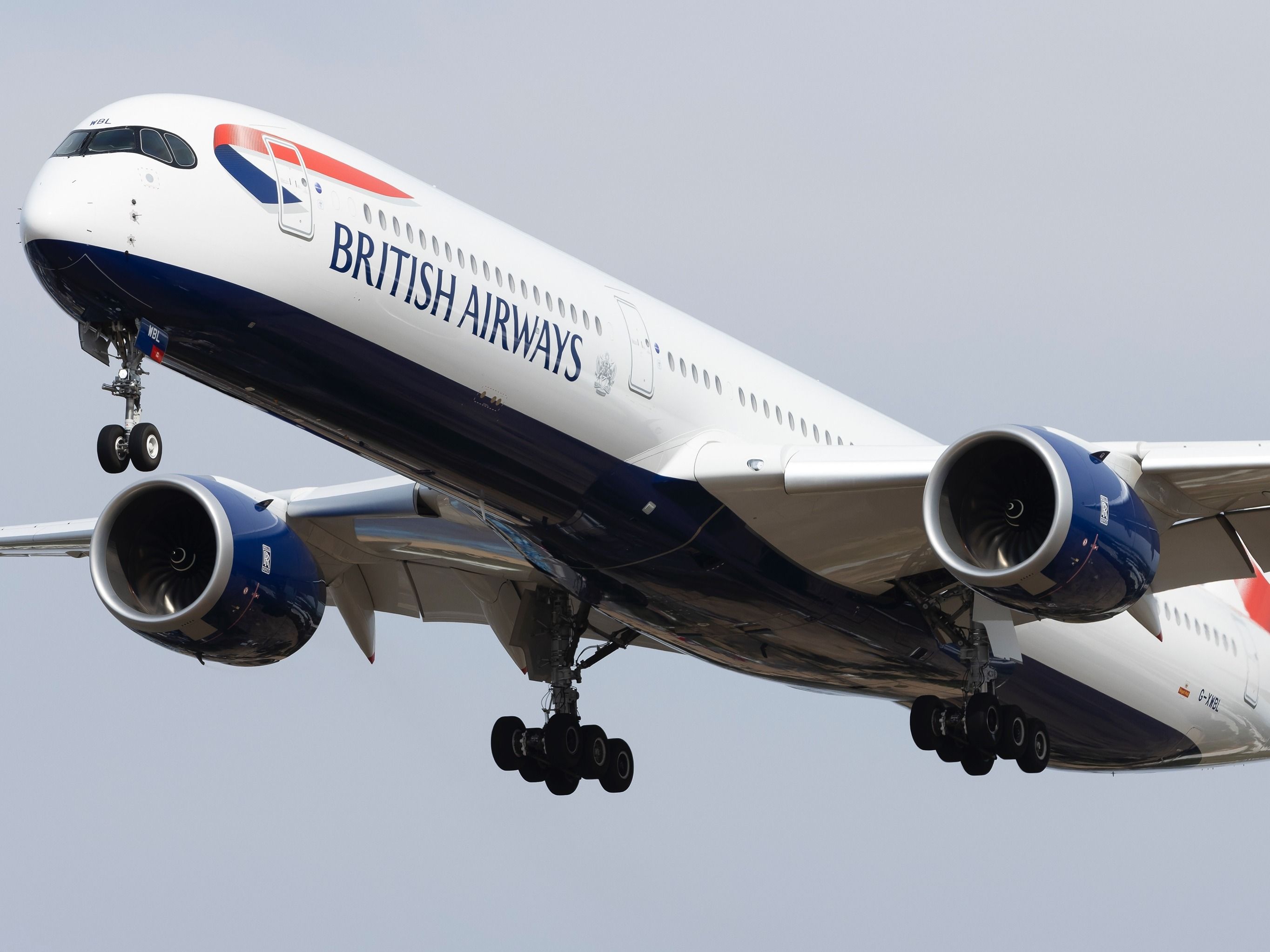
Photo: Danc47667 | Shutterstock
For example, a typical  British Airways
flight on an Airbus A350-1000 between Harry Reid International Airport in Las Vegas and London Heathrow usually takes anywhere between 9 hours and 15 minutes to even 9 hours and 40 minutes.
However, a few days ago, the same flight reached its destination in less than 9 hours – 8 hours and 53 minutes to be precise, according to Flightradar24. So, what happened that allowed the aircraft to reach such incredible speeds and reach London in record time? According to various reports, strong air currents that also led to the recent Storm Éowyn helped the A350 fly a lot faster and shave off more than half an hour from its flight time.
British Airways A350-100 reaches near-record speeds
On January 21, British Airways flight BA274 between Las Vegas and London Heathrow took off at 21:17 against the scheduled departure time of 20:55. The Airbus A350-1000
flew east and gradually settled for 37,000 feet as its cruising altitude, as per Flightradar24, for its flights across the United States and well after it left the East Coast to fly over the Atlantic Ocean.
After completing about two-thirds of the flight, the aircraft climbed to 41,000 feet and stayed there for a bit before it began its descent into London Heathrow. While this may seem like an ordinary flight – and mostly it was – one aspect of it was out of the ordinary: the aircraft reached London in under nine hours.
When the duration of previous LAS-LHR flights was checked, the average time of the journey was well over nine hours, sometimes clocking as much as nine hours and 30 minutes.
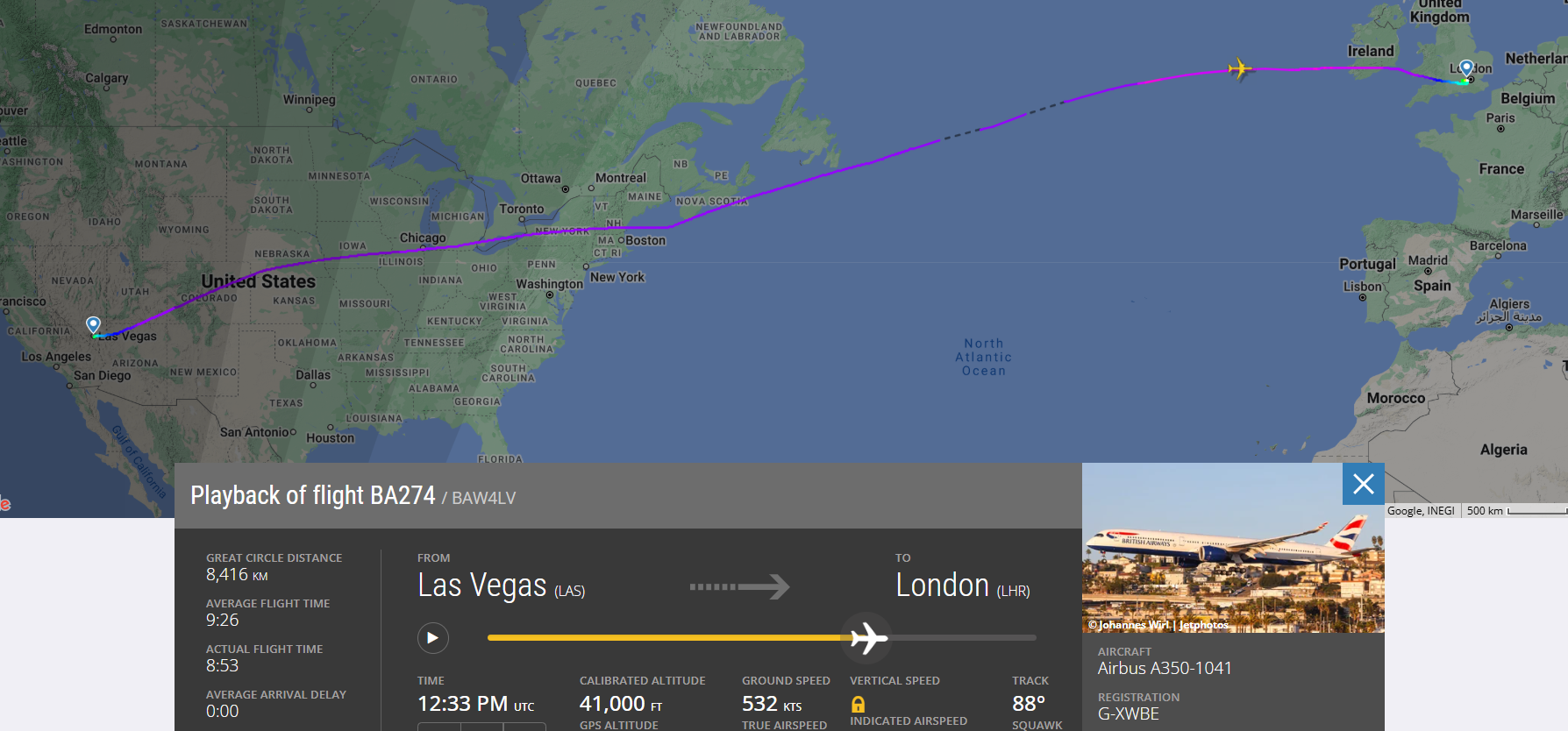
This shorter-than-usual flight was because the A350 reached incredible speeds, reaching more than 814 miles per hour (1,310 km/hour) shortly after it started flying over the ocean. The flight, however, didn’t break the sound barrier, as there’s a distinction between groundspeed and airspeed (a plane’s speed relative to the air around it at its cruising altitude). As such, even though it seemed that the plane achieved supersonic speed, in reality, it remained subsonic.
It’s not unusual for airplanes to encounter strong tailwinds at that altitude, and these help them move quicker toward their destinations, saving both fuel and time. But on January 21/22, the British Airways aircraft reached some of the highest subsonic speeds recorded for a scheduled commercial flight.
What are jet streams?
It’s also interesting to note that it’s usually faster to fly from west to east than the other way around. This is largely due to fast-flowing, narrow air currents in the atmosphere found at high altitudes called jet streams.
Strong jet streams caused the recent BA flight to reach LHR from Las Vegas in record time. These currents are caused by the atmospheric heating from the sun’s radiation and the Earth’s Coriolis force (defined as a rotating object having a force perpendicular to the rotation axis).
These jet streams pick up further speeds during the winter months, and they’re often positioned closer to the United Kingdom. The Travel quotes Professor Liz Bentley, Chief Executive at the Royal Meteorological Society, as saying,
“The jet stream in winter is often stronger, leading to more storms forming, and its position is often closer to the UK so those developing systems are directed towards our shores. The subsonic speed record currently stands at 835 mph, so that record could well be broken in the coming hours.”
The most prominent jet streams are the polar stream and the subtropical stream. These can be found at 60° and 30° north and south of the equator, respectively. Of the two, the polar stream is the stronger and causes much faster winds. Most airlines on transatlantic and transpacific routes make use of the polar stream while planning flight paths.
Airlines often take advantage of these strong currents as these help the aircraft gain extra speed and make the flight more cost-effective by slashing time and the amount of fuel used. By strategically planning flight routes in such a way consistently, airlines can save a significant amount of money over time.
Research has also shown that the winter jet stream over the North Atlantic and Eurasia has had an average speed gain of 8% to 132 miles per hour. There are indications that it could also shift northwards and beyond its historical boundaries within the next few decades. Simple Flying has done a detailed analysis of jet streams and these recent findings in the article below.
Related
Why It’s Quicker To Fly East Than West
Airlines plan their routes to take advantage of geophysical phenomena.
Storm Eowyn
According to The Times, the jet stream that helped the BA flight in question achieve great subsonic speeds also powered the disruptive Storm Eowyn in the United Kingdom. As with any extreme weather development, Storm Eowyn also had far-reaching consequences for flights in the UK.
More than 1,000 flights were canceled during the early morning hours on January 24.
The aviation analytics company Cirium pointed out that this was 20% of the flight schedule. On that day, 2,832 flights were scheduled to depart from Ireland and the UK, split between 348 flights from Ireland and 2,484 from the UK.
A storm of this magnitude has the tremendous potential to be disruptive, and according to the BBC, over 150,000 customers in the Republic of Ireland were without power as a result of the storm. In fact, during the peak of the storm, more than 750,000 people were without any power. The Irish News says that more than 40,000 homes in Northern Ireland are still expected to be without power by Tuesday evening.
The Irish Times quotes Minister for Housing James Browne who defended the response of the government to the devastation caused by the storm. He said that this was “a storm without precedent,” adding,
“The State is leaving nothing on the pitch to get everything done, power back, water back, communications back as quickly as possible.”
Such was the scale of disruption that crews from other nations, such as Austria and Finland, had to be called in to help restore power in the areas affected by Storm Eowyn.
Previous record speeds
Coming back to jet stream-powered flights, the recent BA flight wasn’t the first one to achieve such high subsonic speeds. There have been other instances when airplanes reached high subsonic speeds when they met favorable wind conditions.
In February 2020, a British Airways Boeing 747
set the record for the fastest-ever subsonic scheduled commercial flight between New York and London
. The New York-London corridor is a popular route with several airlines. It also crosses the vast stretches of the Atlantic Ocean, with planes flying at high altitudes where such jet streams are common.
While British Airways no longer operates 747s, it was once the largest operator of the aircraft type. The plane served the carrier for decades, but it was retired during the COVID-19 pandemic when many other large quad jets around the world met with similar fates.
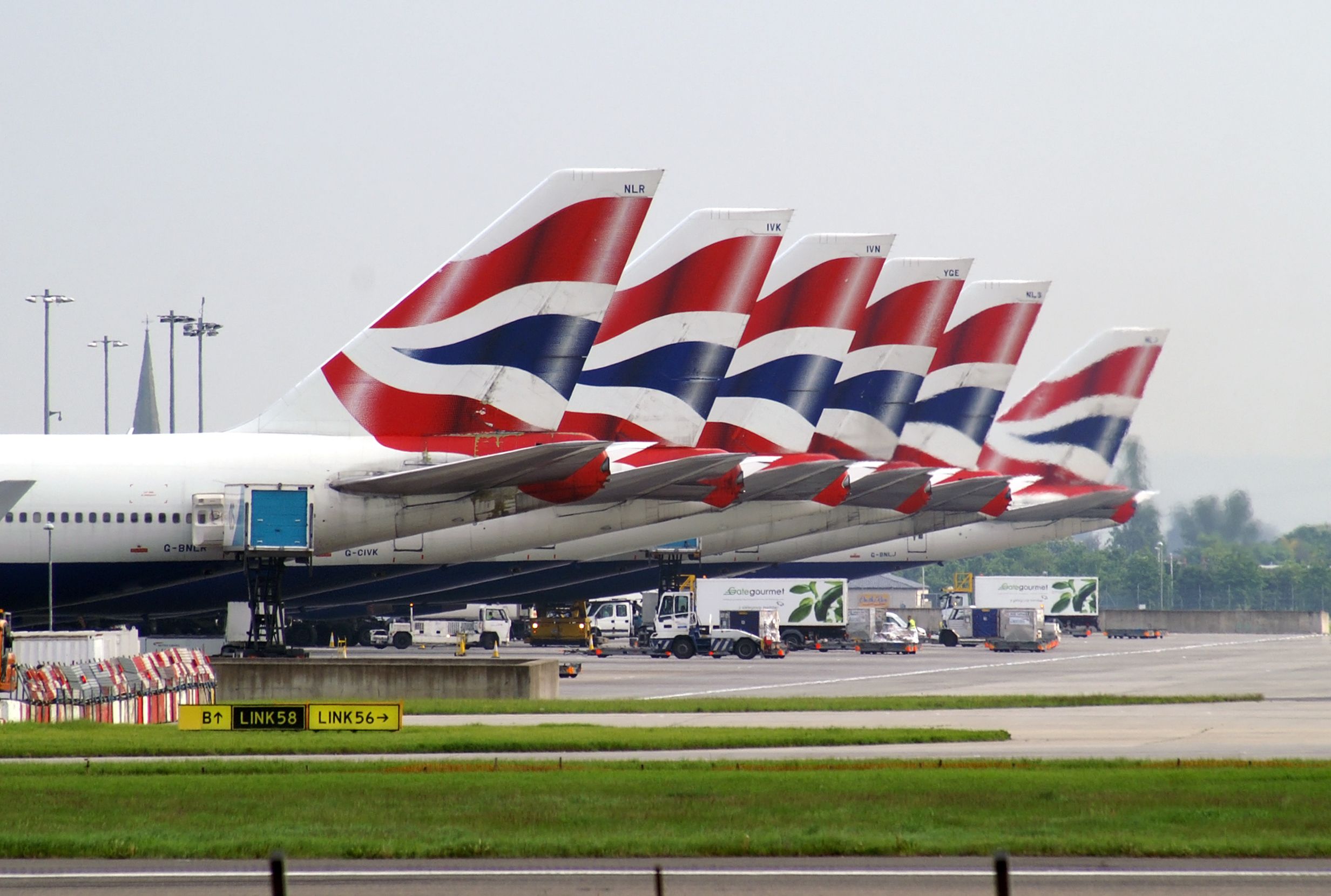
Photo: Ondrej Zabransky | Shutterstock
However, one of the carrier’s jumbo jets reached a maximum speed of 825 mph (1,328 km/h) and completed the transatlantic journey in a record-breaking four hours and 56 minutes.
A Virgin Atlantic aircraft, too, once managed to achieve high subsonic speed in 2019 on a flight from Los Angeles to London. With a strong tailwind, the aircraft, a Boeing 787 Dreamliner, topped at 801 mph (1,289 km/h). The airline’s founder, Richard Branson, put out the following cheeky message on X (formerly known as Twitter).
On another occasion, another Virgin plane, an Airbus A350, flying from Los Angeles to London also hit a high speed of 833mph (1340 km/h).
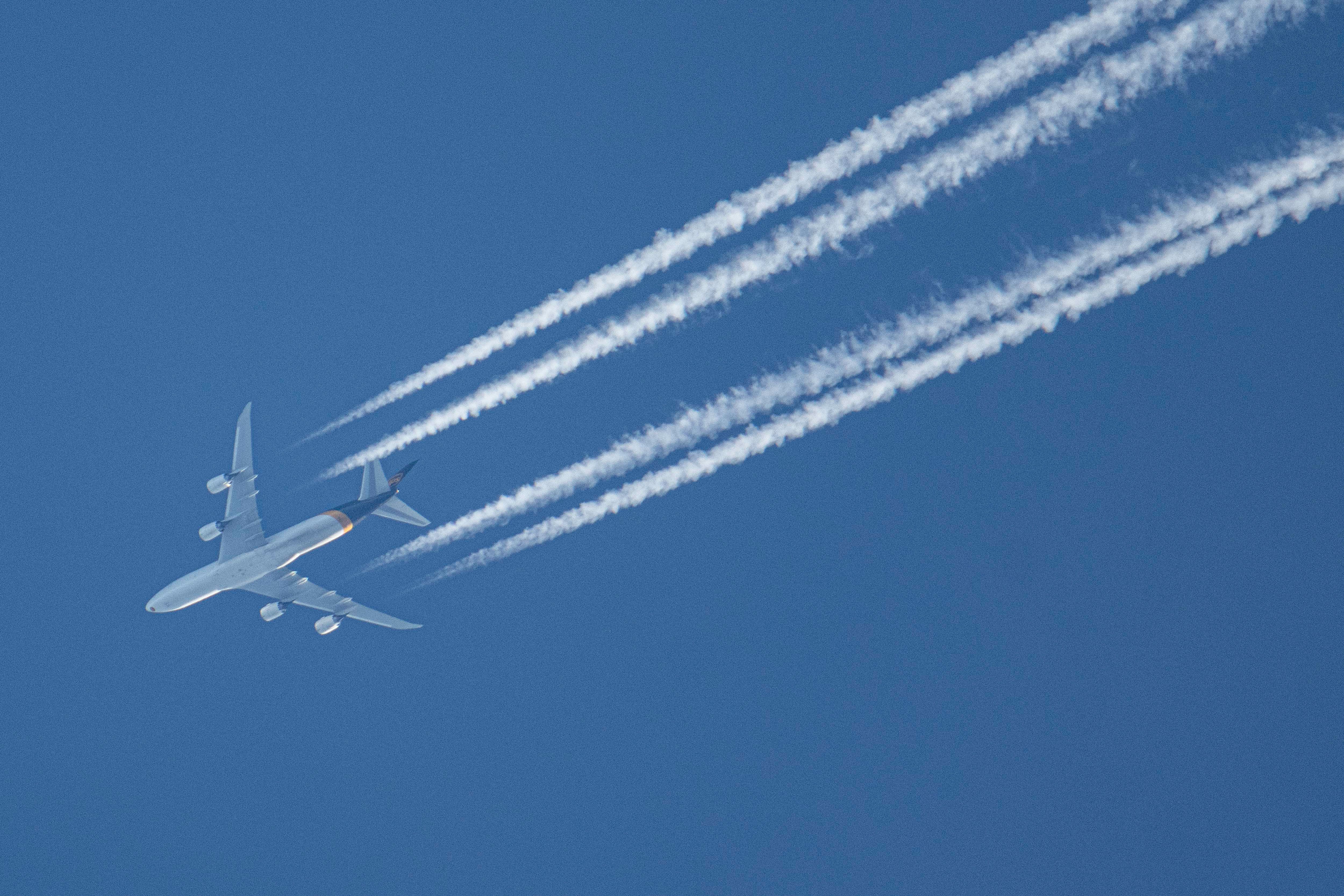
Aircraft encounter jet streams when they normally reach an altitude of around 30,000 feet. However, the highest ceiling of many commercial planes is a lot more than that. In fact, many commercial jets today can fly as high as 41,000 feet.
Many large widebodies have a ceiling of up to around 43,000 feet (12,500 meters), with the Airbus A380 superjumbo being one of them. The A350 and Boeing 787 also have around the same ceiling. However, their heavier variants, the larger 787-10 and A350-1000, have a slightly lower ceiling at 41,100 feet and 41,450 feet, respectively.
Among the narrowbodies, the latest-generation Boeing 737 MAX planes can fly up to 41,000 feet, while the A320neo family of jets can fly up to 39,000 feet. Simple Flying has analyzed this in detail in the article below.
Related
What Is The Highest Altitude Passenger Aircraft Can Fly?
Several factors are taken into account when determining the ‘service ceiling’ of an airplane.
