

Letters by Forgotten Surrealist Jacqueline Lamba Reveal Love Affair With Frida Kahlo

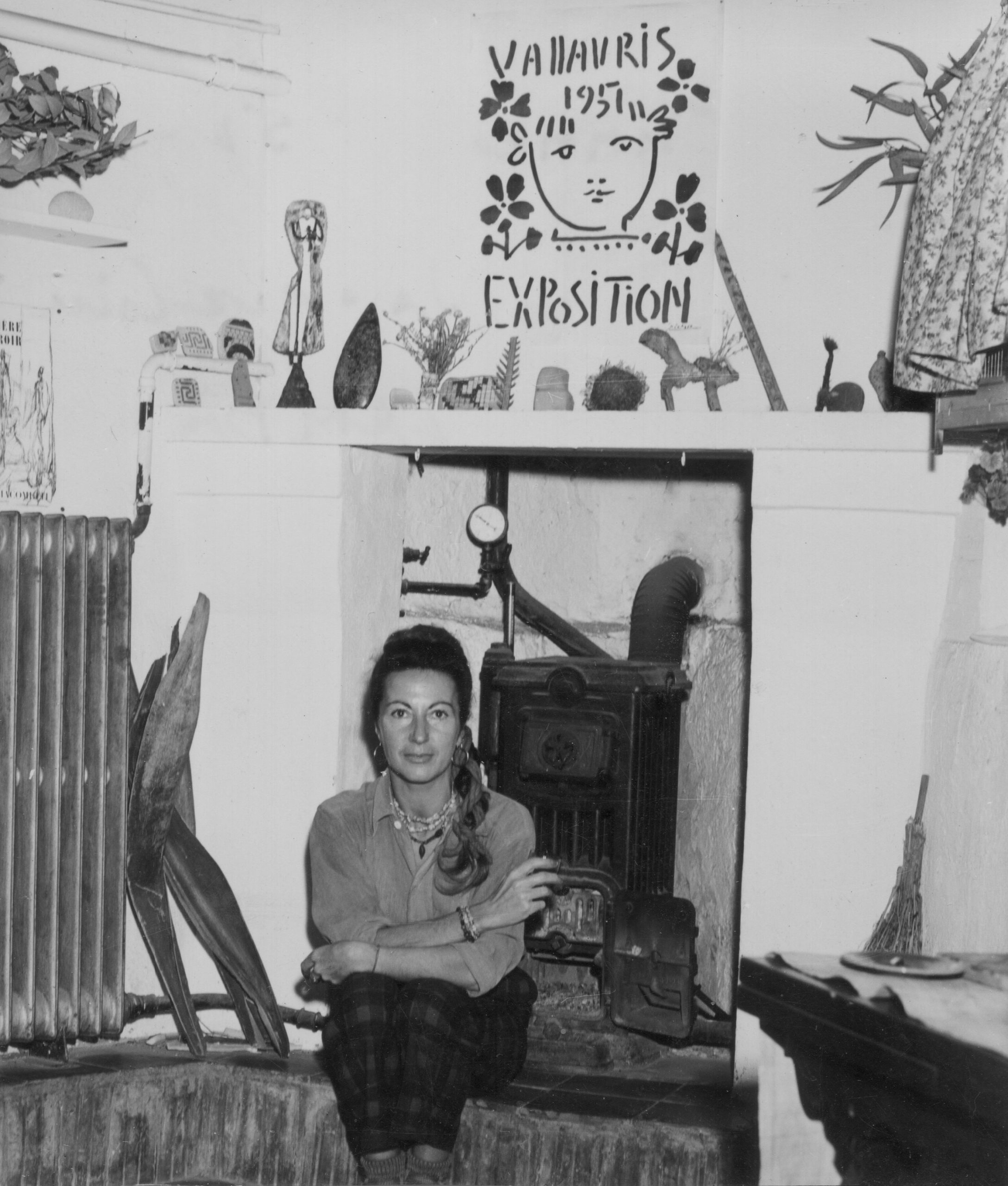
A revelatory new biography of the overlooked French Surrealist painter Jacqueline Lamba brings to light her long-rumored affair with Frida Kahlo—all thanks to a cache of newly discovered love letters.
Kahlo specialist Salomon Grimberg has long hoped to revive Lamba’s reputation, which he believes has been unfairly overshadowed by that of her husband, the Surrealist icon André Breton. His research led him somewhere unexpected when he chanced upon a stash of correspondence attributed only to “a French woman,” and offered for sale by a dealer who “had no idea what he was selling,” Grimberg said in a phone call.
The intimate letters, which include declarations like “I love you intensely” and “it is only I who knows how I love you,” date from the late 1930s, when Lamba and Breton had returned to Paris after staying Kahlo and her husband Diego Rivera in Mexico. They are quoted extensively in the biography, Jacqueline Lamba: The Forgotten Surrealist, published by Merrell Publishers this spring.
Jacqueline Lamba and André Breton at the International Surrealist Exhibition at the New Burlington Galleries in London, 1936.
Lamba’s Early Years
Grimberg traces Lamba’s story from early childhood. Born in 1910, she was left with a nanny in Paris while her parents and older sister moved back to Egypt. After failing to bond with any parental figure other than her father, who died when Lamba was three, she grew to be an “obstinate” child, according to one family friend. Up until adolescence, she was plagued with the knowledge that her parents had desired a son. They dealt with their disappointment by referring to Lamba as “Jacquot” and using male pronouns.
Lamba’s early adulthood was complicated by the fact that “she became extremely beautiful, and was cursed by it,” claimed Grimberg. “Suddenly the attention she had wanted as a girl came to her,” he added. “And she misunderstood it.”
Her striking looks drew the attention of Breton, already a celebrated artist when Lamba set out to seduce him during an “accidental” encounter at Café de la Place Blanche in 1934. At the time, Lamba, aged 24, made a living by swimming nude in the glass pool at Le Coliseum nightclub, where Breton would watch her. They married just two and a half months after meeting, in a ceremony at which she wore a black wedding dress. Their witnesses were Alberto Giacometti and Paul Éluard, and Man Ray took photographs.
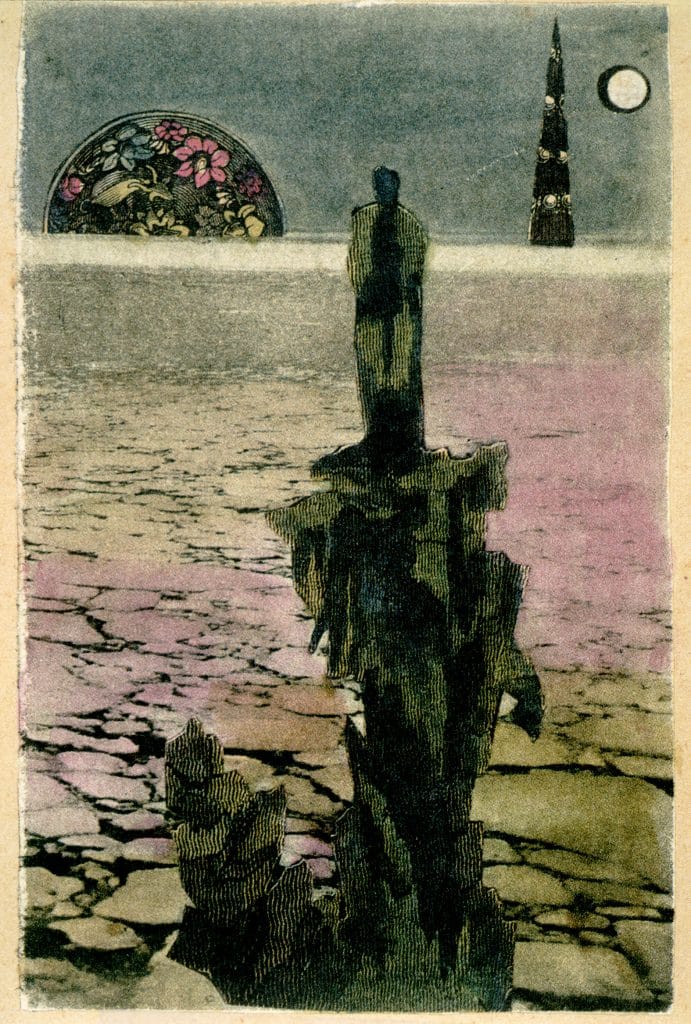
Jacqueline Lamba, Collage, dedicated to Helena Lam, Air-Bel, Marseille (1940). Private collection.
Though Lamba made Surrealist paintings during her marriage, she was not supported by Breton, who Grimberg said “wanted her to keep house and take care of their daughter Aube.” She often ran away, deserting the child, who would later describe her as a distant and vain mother.
Very few of Lamba’s paintings made between 1934 and 1940 survive, and only a handful of abstract works from between 1942 and 1944. One rare early painting is Portrait of André Breton as Saint-Just (1937), in which Breton appears ghostly pale in an antiquated black suit. Grimberg reads the title’s invocation of a guillotined French revolutionary as a display of both admiration and resentment from Lamba. The artist later claimed that Breton destroyed her work to punish her for eventually separating from him.
Through her friend Dora Maar, Lamba became close with Pablo Picasso. The trio went on trips together, and Lamba often posed for paintings. Grimberg makes the case that in paintings like Reading at a Table (1934), at the Metropolitan Museum of Art, and Interior With a Girl Drawing, at New York’s Museum of Modern Art, the subject mistakenly identified as another of Picasso’s lovers, Marie-Thérèse Walter, is, in fact, Lamba. Additionally, archival evidence, including photographs of Lamba nude at Picasso’s house, suggests that Lamba likely had threesomes with the couple, as well as Éluard and his wife Nusch, Grimberg argued.
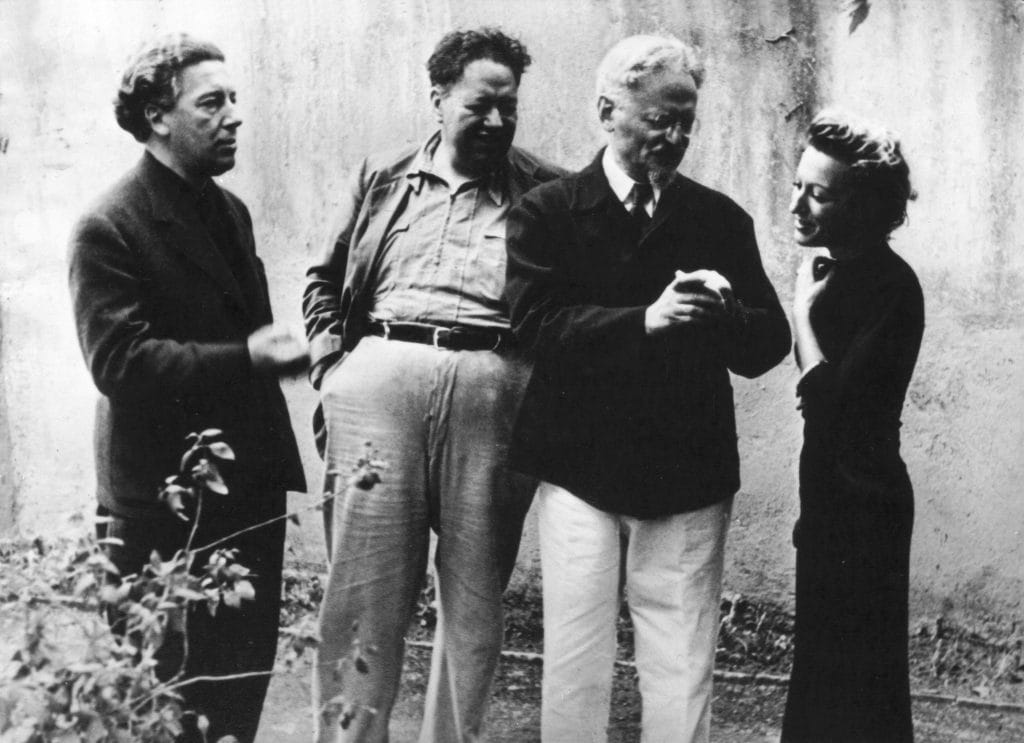
André Breton, Leon Trotsky, Diego Rivera, and Jacqueline Lamba in Mexico City, 1938. Photo: Photo12 / Universal Images Group via Getty Images.
Lamba’s Bond With Kahlo
There is no evidence that these relationships went beyond the purely physical but, as surviving letters show, this was not the case for Lamba’s relationship with Kahlo. The pair met in 1938, when Lamba and Breton were staying with Kahlo and Rivera. There, they also met Russian revolutionary Leon Trotsky, who Rivera had helped seek asylum in Mexico. Initially, Lamba bonded with Kahlo over their troubled marriages, with the latter still reeling from Rivera’s affair with her sister Cristina.
Grimberg had heard rumors of the couple’s affair, but these could not be substantiated until he discovered Lamba’s letters. He found them to be “extremely intimate, in the sense of how you speak to a very close friend, telling her things that you would not tell other people.” They informed several sections of the biography.
Before Lamba’s return to Paris, Kahlo gave her a miniature self-portrait in which strings around her neck pull her in different directions. Grimberg reads the work as foretelling the effect that their separation would have on Lamba, as well as being reflective of Kahlo’s own helplessness. “She was pulled by another force, which was her love of Rivera,” he said.
Nonetheless, Lamba pined for Kahlo. “Don’t forget me,” she wrote on her journey back to Paris in 1938.
“Frida darling, I have still not received a line from you, other than the letter for André,” Lamba wrote on September 9. “I always wait, I sleep as little as possible, life seems like a corridor, a bit narrow but it surely leads to the doors full of surprises and you are waiting behind one of the doors there, the one that remains the most desired.” Another letter was sealed with lipstick kisses.
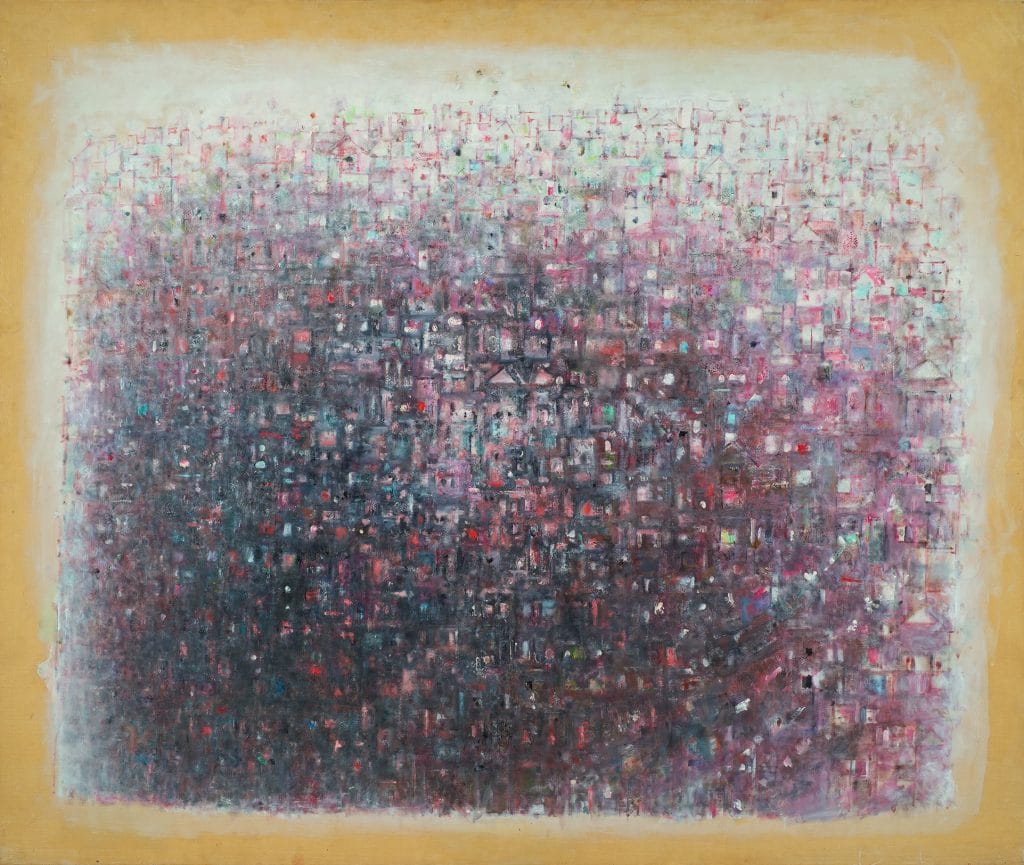
Jacqueline Lamba, Paris, Panorama (1971). Image courtesy Weinstein Gallery, San Francisco.
Lamba and Breton divorced in 1944, after nine years of marriage. When she had her first exhibition in New York in the same year, Breton never visited, despite it receiving critical acclaim. “He said he had too much work in the office,” said Grimberg. Despite the fact that “he never supported her,” the pair remained good friends. Lamba married American sculptor David Hare, and remained in New York until their divorce in 1955. During this period, she began painting abstract compositions.
Grimberg met Lamba at her studio in 1986, and was immediately struck by her work. She was at that time living “a monastic life,” and, freed from her ex-husbands, “had an epiphany and suddenly found what she was looking for within herself. She began creating beautiful paintings showered by light,” he said. “This went on for the rest of her life.”
Lamba’s last exhibition took place in 1967, at the Picasso Museum in Antibes, for which the elderly Spanish artist helped her choose which works to include. She was reluctant to show her work again. Eventually, after Lamba’s death in 1993, Grimberg organized a retrospective that toured four institutions, including the Pollock–Krasner House and Study Center in New York and the Salvador Dalì Museum in St. Petersburg, Florida, between 2001 and 2002.
