


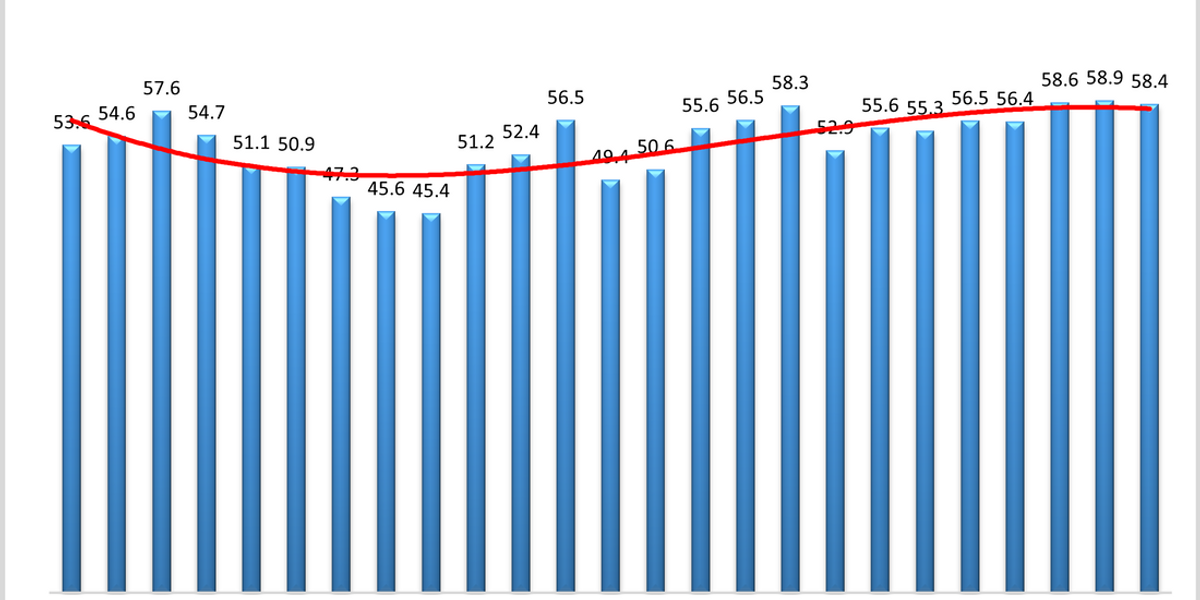
Economic activity in the logistics industry expanded in November, continuing a steady growth pattern that began earlier this year and signaling a return to seasonality after several years of fluctuating conditions, according to the latest Logistics Managers’ Index report (LMI), released today.
The November LMI registered 58.4, down slightly from October’s reading of 58.9, which was the highest level in two years. The LMI is a monthly gauge of business conditions across warehousing and logistics markets; a reading above 50 indicates growth and a reading below 50 indicates contraction.
“The overall index has been very consistent in the past three months, with readings of 58.6, 58.9, and 58.4,” LMI analyst Zac Rogers, associate professor of supply chain management at Colorado State University, wrote in the November LMI report. “This plateau is slightly higher than a similar plateau of consistency earlier in the year when May to August saw four readings between 55.3 and 56.4. Seasonally speaking, it is consistent that this later year run of readings would be the highest all year.”
Separately, Rogers said the end-of-year growth reflects the return to a healthy holiday peak, which started when inventory levels expanded in late summer and early fall as retailers began stocking up to meet consumer demand. Pandemic-driven shifts in consumer buying behavior, inflation, and economic uncertainty contributed to volatile peak season conditions over the past four years, with the LMI swinging from record-high growth in late 2020 and 2021 to slower growth in 2022 and contraction in 2023.
“The LMI contracted at this time a year ago, so basically [there was] no peak season,” Rogers said, citing inflation as a drag on demand. “To have a normal November … [really] for the first time in five years, justifies what we’ve seen all these companies doing—building up inventory in a sustainable, seasonal way.
“Based on what we’re seeing, a lot of supply chains called it right and were ready for healthy holiday season, so far.”
The LMI has remained in the mid to high 50s range since January—with the exception of April, when the index dipped to 52.9—signaling strong and consistent demand for warehousing and transportation services.
The LMI is a monthly survey of logistics managers from across the country. It tracks industry growth overall and across eight areas: inventory levels and costs; warehousing capacity, utilization, and prices; and transportation capacity, utilization, and prices. The report is released monthly by researchers from Arizona State University, Colorado State University, Rochester Institute of Technology, Rutgers University, and the University of Nevada, Reno, in conjunction with the Council of Supply Chain Management Professionals (CSCMP).
