


Support CleanTechnica’s work through a Substack subscription or on Stripe.
Despite efforts by the US government to unwind the web of commercial interconnections that have defined international trade for the past 20 years, the fact remains that no country manufactures all its own raw materials, components, and finished products. The magical thinking wafting through the White House notwithstanding, there are very few consumer goods or industrial products sold in the US that do not depend on suppliers in other countries.
All attention today is focused on the Strait of Hormuz, whose shipping channel is just a scant 2½ miles wide. Paul Krugman points out in a recent essay that there are so-called “choke points” like Hormuz embedded throughout the global economy.
Readers may recall that Volkswagen suffered a slowdown in production of its electric cars at the start of the Russian invasion of Ukraine because the company that manufactured the wiring harnesses for those cars was located in Ukraine.
Krugman writes that while the Strait of Hormuz is an important choke point, it is far from unique. “If the Hormuz crisis seems bad, think about the disruption to global supply chains if China were to attack Taiwan or if North Korea were to attack South Korea. Taiwan accounts for over 60 percent of the world supply of semiconductors and over 90 percent of the supply of the most advanced semiconductors.
“South Korea is a major exporter of memory chips. An ongoing imbroglio between the Dutch government and the Chinese chip company Nexperia, based in the Netherlands, has threatened to upend auto production around the world. India is a major exporter of key pharmaceuticals, including vaccines. Trump backed down on his Liberation Day tariffs imposed on China because it is by far the greatest source of rare earths and retaliated by cutting off the flow.”
In an essay by economists Arvind Subramanian and Martin Kessler in 2013, the pair coined the term “hyperglobalization.” They noted that in the 1980s, world trade wasn’t much bigger as a share of world GDP than it had been before World War I. By 2008, however, it was on a whole other level.
The pair wrote that the “rapid growth in world trade was not simply a matter of countries trading more, but of world production becoming much more complex and interdependent.” Krugman explains that “if you ask where an iPhone is produced, there isn’t a simple answer. The phone is assembled in China or India, but the components inside the phone are produced in many countries, and these components themselves use inputs produced in many other countries.”
It Worked Well Until It Didn’t
Over the past 40 years, national economies have become “so inter-dependent that there are potential choke points everywhere you look,” Krugman says. “Yet this global system of inter-dependence was reasonably workable as long as a key linchpin — the United States — supported it and made sure that goods, services, and money kept flowing freely.
“This is not to say that the system was perfect. It’s not clear that we should depend on imports for some vital goods, like vaccines or rare earths. But now we have the worst of both worlds. The world is now highly dependent upon a complex global supply chain and the erstwhile leader of the free world is erratic.” Here is the nub of Krugman’s argument:
“Does anyone know what our Iran policy will be a week from now, or even tomorrow? Moreover, the Iran debacle has revealed us to be far weaker than most people realized — so weak that we are afraid to stop Iran from exporting oil even as we threaten to destroy its civilian infrastructure. The truth is, even our allies no longer trust or respect us.
“So what we are facing now isn’t simply a matter of consumers losing the ability to purchase imports. Instead we are facing a scenario in which producers lose access to crucial inputs they need to keep producing. The crisis in the Strait of Hormuz is raising prices at the pump, which is bad. But it is also threatening to deprive American farmers of fertilizer during planting season, to cut off essential helium supplies to semiconductor producers in Asia, to deprive pharmaceutical producers of crucial materials, and more.
“In short, terrifying as the Hormuz crisis is, I worry that it may be only the beginning. For a world economy that is riddled with multiple potential choke points can no longer rely on a strong, reliable and trustworthy America to act as a guarantor of the system. While things are bad now, they may very well get a lot worse.”
A Choke Point In North America
Here’s an interesting tidbit. Detroit is an anglicized version of the French word détroit, which means strait, channel, or narrows. Founded in 1701, the city was named le détroit du Lac Érié because it was situated on the river connecting Lake Huron and Lake Erie.
Today, the passage of goods back and forth across the Detroit River is responsible for up to $700 billion in annual commercial activity between the state of Michigan and the province of Ontario. The daily economic impact is estimated to be more than $300 million. The major automakers based in and around Detroit get many of their components from suppliers in Canada, and many vehicles are partially assembled in Detroit before being shipped across the border to be finished in Ontario.
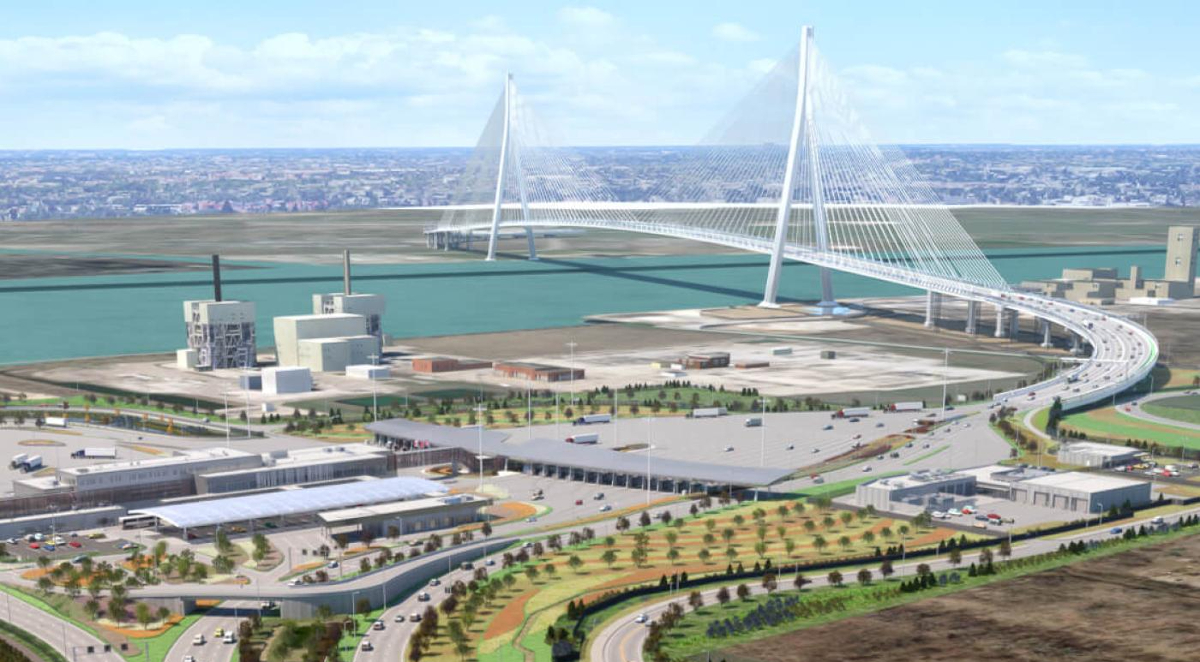
What that means is that the Ambassador Bridge (and the new Gordie Howe bridge, if it ever opens) is as much of a choke point as the Strait of Hormuz. The US and Canada theoretically are equal partners in the United States–Mexico–Canada Agreement (USMCA) trade agreement that allows most goods to travel back and forth across the border duty free.
But how comfortable is Canada that the lunatic in the White House won’t have a brain fart one morning and sign an executive order declaring the USMCA null and void unless and until Canadian companies contribute to his re-election campaign? Yes, we know he is not eligible for another term, but he believes he is not constrained by any laws, so anything can happen between now and 2028 and probably will. If he decides to tell the USMCA “You’re Fired!” who will stop him? Pam Bondi? Kash Patel? In your dreams.
EU & Australia Free Trade Agreement
In the news today, there is a hint of how global trade relations are shifting away from control by the US. The EU and Australia have just concluded a free trade agreement, something that has been talked about for almost 8 years. But the erratic policies of the current US administration have convinced both sides to get the deal done before the roof falls in.
The agreement removes tariffs on most goods and could potentially increase access by the EU to critical Australian minerals. The move is intended to bypass the choke point on rare earth and other critical materials currently enjoyed by China.
According to France 24, farmers in Australia and the EU are unhappy with the deal. The Australians think it does not go far enough to improve their access to European customers and EU farmers believe the quotas on Australian meat products are too generous. Some say the best deal is the one in which no one is completely happy.
Of particular interest to CleanTechnica readers, the agreement will make it easier for automobiles manufactured in the EU to have access to the Australian market. Australia currently imposes a 33 percent luxury tax on some cars, but the threshold that triggers that tax will be raised to A$120,000, which should also benefit European automakers. It could also make more EVs affordable for Australians.
Is Cooperation Just A Sweet Old Fashioned Notion?
In the final analysis, the Strait of Hormuz has made everyone more conscious of the dangers of choke points and how easily they can disrupt global commerce. The current occupant of the White House seems to believe the US doesn’t need any international partners. That “go it alone” strategy may work in the short term, but is unlikely to be successful in the long run.
The key to making choke points less scary is cooperation, something Repugnicans reject as they pursue their Wild West cowboy dreams. Perhaps they didn’t grow up watching Sesame Street with their children the way many of us did.
Sign up for CleanTechnica’s Weekly Substack for Zach and Scott’s in-depth analyses and high level summaries, sign up for our daily newsletter, and follow us on Google News!
Have a tip for CleanTechnica? Want to advertise? Want to suggest a guest for our CleanTech Talk podcast? Contact us here.
Sign up for our daily newsletter for 15 new cleantech stories a day. Or sign up for our weekly one on top stories of the week if daily is too frequent.
CleanTechnica uses affiliate links. See our policy here.
CleanTechnica’s Comment Policy
