

Uttarakhand Releases Science, Technology and Innovation Policy 2026 to Drive Research, Innovation and Self-Reliance – Indian PSU

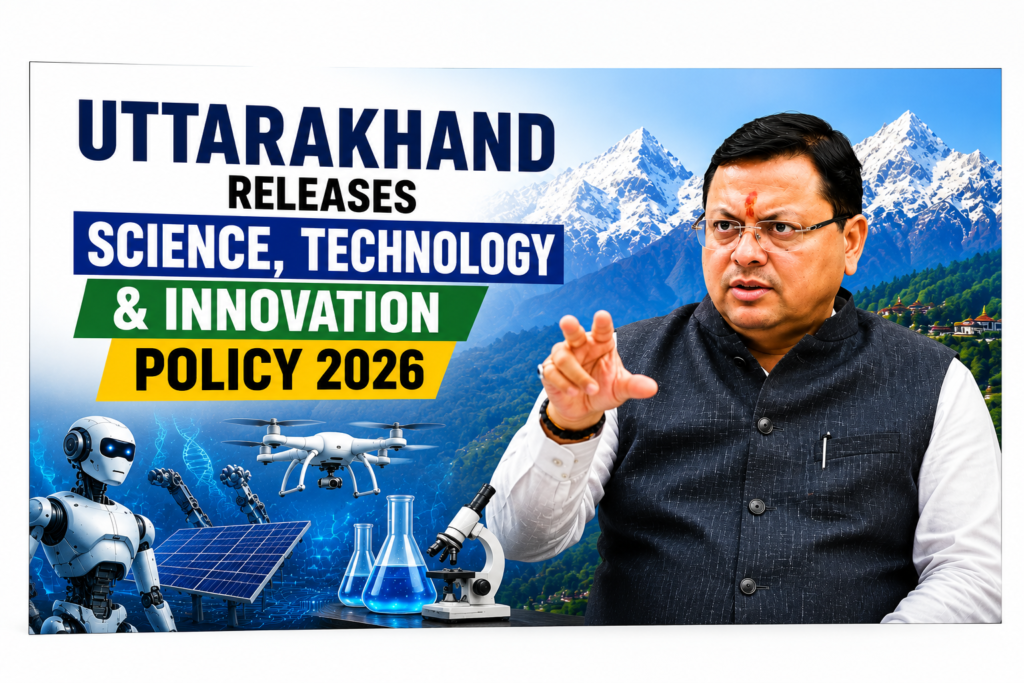
In a major step towards building a knowledge-driven economy and promoting technology-led development, the Uttarakhand government has released the Uttarakhand Science, Technology and Innovation (STI) Policy 2026. Announced under the leadership of Chief Minister Pushkar Singh Dhami, the policy aims to transform the state into a leading hub of science, technology, innovation and information technology while addressing local challenges through scientific solutions.
Issued by the Department of Information Technology, Science and Technology, the policy seeks to encourage research, innovation and scientific temper across sectors, while ensuring sustainable development, economic growth, social inclusion and environmental balance.
To ensure effective implementation, the state government will establish an advisory body responsible for policy execution, monitoring and evaluation. A decentralized institutional framework will also be developed to promote research and innovation activities throughout the state.
The policy envisages a robust collaborative ecosystem involving government departments, academic institutions, research organizations, industries, public sector undertakings, start-ups and innovators. A state-level coordination committee will be formed to facilitate the establishment of Science, Technology and Innovation units across government departments, PSUs, private enterprises and startups.
A key feature of the policy is its emphasis on democratizing access to scientific knowledge and research. Scientific information, research findings and resources generated through publicly funded projects will be digitally archived and made accessible to stakeholders. Researchers and institutions will also benefit from access to scientific journals and archives through the Government of India’s “One Nation, One Membership” initiative.
In line with the vision of Atmanirbhar Uttarakhand, the policy places special focus on indigenous technology development and localization. It also seeks to integrate traditional knowledge systems with modern scientific research to develop solutions tailored to local needs and challenges.
The government plans to strengthen science and innovation education by developing modern infrastructure in educational institutions and conducting capacity-building programmes for students, researchers and teachers. State-of-the-art teaching and learning centres will also be established in line with the National Education Policy.
To promote scientific awareness and public participation, the state will work towards establishing science cities, science centres, planetariums, Atal Tinkering Labs, artificial intelligence laboratories, astronomy consortia and centres of excellence.
Recognizing the transformative potential of emerging technologies, the policy gives priority to areas such as artificial intelligence (AI), blockchain, robotics, drones, augmented reality (AR), virtual reality (VR) and mixed reality (MR). Research and development in space technology, biotechnology, nanotechnology, digital technologies, food and water security, energy security and disaster management will also receive focused support.
The policy seeks to strengthen engagement between grassroots innovators, scientists and technical experts through workshops, joint research projects, fellowships and scholarships. A dedicated engagement portal for Uttarakhand’s scientific community will also be developed.
Another significant initiative under the policy is the establishment of a Science, Technology and Innovation Observatory, which will serve as a centralized digital repository of information on schemes, programmes, grants and incentives related to science and innovation. Innovators will also receive support for patents, copyrights, intellectual property rights and related legal processes.
Highlighting the importance of the policy, Chief Minister Pushkar Singh Dhami said the document would serve as a roadmap for transforming Uttarakhand into a knowledge, research and innovation-based economy. He emphasized that the policy seeks to integrate science and technology with governance, disaster management, education, agriculture, healthcare and employment generation while providing a common platform for youth, researchers, startups, scientists and grassroots innovators.
The Uttarakhand State Council for Science and Technology (UCOST), the nodal agency for science dissemination in the state, will play a key role in implementing the policy. According to UCOST Director General Prof. Durgesh Pant, Uttarakhand faces significant challenges, including natural disasters, climate change and increasing pressure on the fragile Himalayan ecosystem.
He noted that the policy would strengthen coordination among science and technology institutions, research organizations, academia, industry and innovators to develop effective solutions to these challenges. The policy also seeks to ensure inclusive participation in science and innovation by providing equal opportunities to women, rural communities, marginalized groups and persons with disabilities.
With its comprehensive focus on research, innovation, emerging technologies, education and inclusive development, the Uttarakhand Science, Technology and Innovation Policy 2026 is expected to provide fresh momentum to the state’s journey towards technological self-reliance and sustainable growth.
